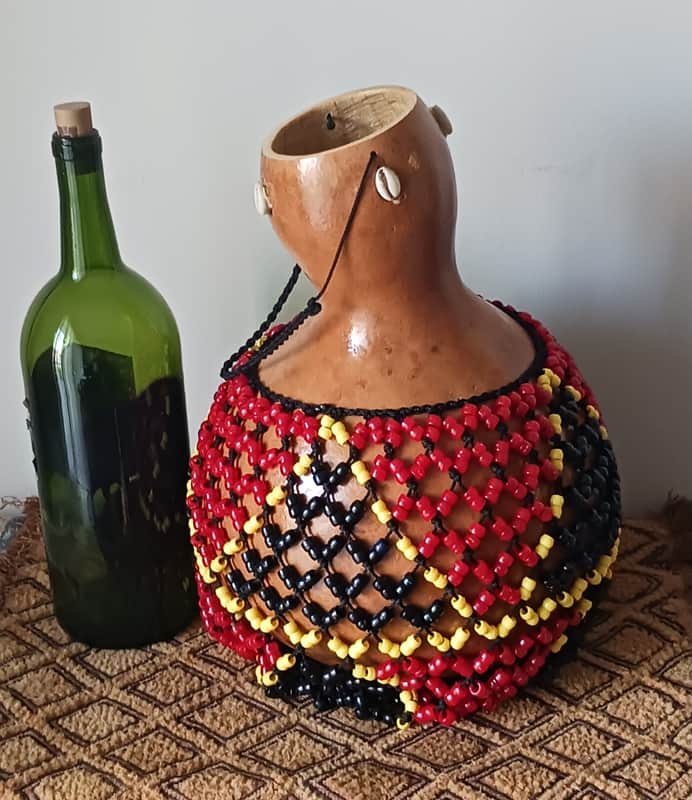
Jumbo Nigerian netted gourd rattle (sekere)
This listing has ended
See similar gear from other Reverb sellers

Our users rate Reverb
Gourd rattles with an external network strung with bead, seed, shell, or bamboo strikers occur widely in West Africa, from the Congo/Angola region in the south to Mali and Senegal in the north. In the United States, by far the best-known rattle of this type is the Ṣẹ̀kẹ̀rẹ̀ (pron. SHEH-keh-reh) of the Yoruba people of Nigeria and Benin.
The instrument also occurs in Cuba (under the name chekeré) and in Brazil (there called xequerê), having been introduced by Yoruba captives transported to those countries during the years of the trans-Atlantic slave trade. As in Africa, the instrument, played singly or in groups of three of varying tonality, typically occurs in ceremonies in honor of certain orişa (oricha in Cuba, orixa in Brazil).
Essentially, the Ṣẹ̀kẹ̀rẹ̀ might be thought of as a combination rattle-drum. This is because, in addition to being shaken as a rattle, the player also can simultaneously tap the base and neck of the instrument to produce a drum-like sound. Another interesting technique involves using the palm to tap the mouth of the gourd; this results in a sound similar to that of the udu, a pot-like ceramic instrument of Nigeria's Igbo people.
This Pan-African Arts-crafted model features red, black, and yellow pony beads strung onto black netting (with braided upper and lower collars to prevent slippage). Cowries adorn the gourd's upper neck.
Dimensions: 14" h., 10 1/2" diam.
| Condition | Brand New (New) Brand New items are sold by an authorized dealer or original builder and include all original packaging.Learn more |
|---|---|
| Brand | |
| Model |
|
| Categories | |
| Year |
|
| Made In |
|
Product safety information may be available here.