Mutable instruments CV Pal 2022
This gear has sold
See similar gear from other Reverb sellers

Our users rate Reverb
Fresh build, calibrated and ready to go!
Cheap and simple midi to cv device for eurorack systems.
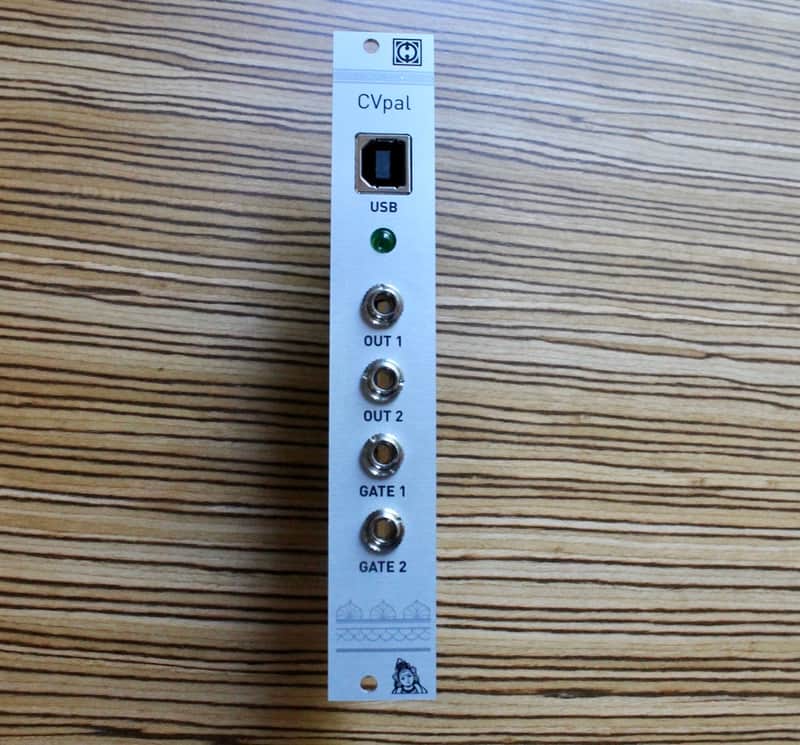
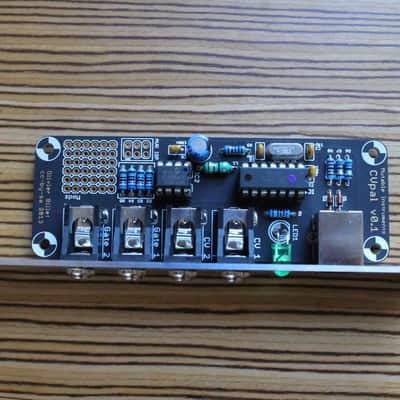
Mutable Instruments’ CVpal is a DIY USB MIDI to CV interface - enabling you to control an analog synthesizer or modular system from a computer or smartphone/tablet equipped with a USB port. The CVpal is class-compliant and as such, does not require any driver. It features various conversion/voice allocation modes, covering monophonic, duophonic and drums/triggers applications.
Quirks ahoy!Before moving forward, it is important to state some limitations of the CVpal - most of them due to its ridiculously simple design:
- The CVpal is a USB device not a USB host! It can be connected to ‘active’ devices such as smartphones, tablets, laptop or desktop computers, but not to USB MIDI controllers.
- The CV output is in the 0 .. 4V range - so a tessitura of 4 octaves is covered. The CVpal does not support V/Hz conversion; only V/Oct.
- The Gate output uses V-trig, has a 5V high level, and a direct polarity (note on = 5V, note off = 0V). Most Eurorack modules use a trigger level below 2.5V and can thus be triggered by the CVpal. If a module or synth requires a higher level, a level conversion circuit such as the CD4504 can be used. Polarity inversion can be implement with a CD4049 or with a software hack. S-trig conversion can be implement with a few parts.
- The CVpal works optimally with iOS, OS X >= 10.6.3 or Linux kernel >= 2.6. On other operating systems, the messages might be delayed by up to 8ms, causing a very jittery timing!
The CVpal can either be mounted in a Eurorack system, or used as a standalone box. In both cases, it does not need any external power source as it is powered by the USB bus.
ABOUT CONVERSION MODESThe CVpal interprets MIDI messages differently depending on the MIDI channel on which they are received. For example, when receiving messages on MIDI channel 1, it behaves like a monophonic synthesizer and outputs a CV/Gate pair. When receiving messages on MIDI channel 10, it behaves instead like a drum trigger converter and outputs a trigger for 4 drum instruments.
Channel 1: Monophonic modeThis mode is enabled when any MIDI message is received on channel 1. The CVpal behaves like a classic monophonic CV-Gate converter implementing most recent note priority.
- OUT 1: Note CV
- OUT 2: Velocity CV
- GATE 1: Gate
- GATE 2: Gate
This mode is enabled when any MIDI message is received on channel 2. The CVpal behaves like a monophonic CV-Gate converter implementing most recent note priority, but the primary Gate output is now a digital square oscillator!
- OUT 1: Note CV
- OUT 2: Velocity CV
- GATE 1: Square oscillator playing the received MIDI note
- GATE 2: Gate
Bonus digital square oscillator! Hell Yeah!
Channel 3 / Channel 4: Dual monophonic modeThis mode is enabled when a MIDI message is received on channel 3 or on channel 4. The CVpal behaves like two independent monophonic CV-Gate converters with most recent note priority. One of them listens to notes received on channel 3, the other on channel 4.
- OUT 1: Note CV for channel 3
- OUT 2: Note CV for channel 4
- GATE 1: Gate for channel 3
- GATE 2: Gate for channel 4
This mode is enabled when a MIDI message is received on channel 5. The CVpal behaves like a duophonic CV-Gate converter with voice stealing.
- OUT 1: Note CV output 1
- OUT 2: Note CV output 2
- GATE 1: Gate
- GATE 2: Gate
This mode is enabled when a MIDI message is received on channel 6. The CVpal converts continuous controllers (CC) 01 (modulation wheel) and 02 (breath controller) to control voltages.
- OUT 1: Modulation wheel CC (01)
- OUT 2: Breath controller CC (02)
- GATE 1: Binarized value of CC 3
- GATE 2: Binarized value of CC 4
These modes are enabled when a MIDI message is received on channel 7 or 8. The CVpal behaves like a monophonic CV-Gate converter, with an additional CC value produced on the secondary output.
- OUT 1: Note CV
- OUT 2: Modulation wheel or breath controller CC (01 or 02)
- GATE 1: Gate
- GATE 2: Gate
This mode is enabled when a MIDI message is received on channel 10. CV Outputs 1 and 2 are respectively triggered by the MIDI notes 36 (kick drum on the GM drum map) and 38 (snare drum on the GM drum map). Gate outputs 1 and 2 are triggered by the MIDI note 40 (snare drum 2) and 46 (closed high-hat).
- OUT 1: BD (note 36) trigger
- OUT 2: SD (note 38) trigger
- GATE 1: SD2 (note 40) trigger
- GATE 2: CHH (note 46) trigger
Same as Channel 10, but with gates instead of triggers.
Channel 12, 13, 14: Monophonic mode with clock/reset outputIn these modes, the CVpal behaves like a classic monophonic CV-Gate converter implementing most recent note priority, but also outputs triggers for synchronizing modular sequencers. A clock (with variable resolution) is sent to GATE 1; and a reset (corresponding to the MIDI ‘start’ message) is sent to GATE 2.
- OUT 1: Note CV
- OUT 2: Note Gate
- GATE 1: Clock trigger
- GATE 2: Reset trigger
The resolution of the clock trigger depends on the MIDI channel used: 24 ppqn for channel 12; 8 ppqn for channel 13; 4 ppqn for channel 14.
| Condition | Brand New (New) Brand New items are sold by an authorized dealer or original builder and include all original packaging.Learn more |
|---|---|
| Brand | |
| Model |
|
| Categories | |
| Year |
|
| Made In |
|
Product safety information may be available here.