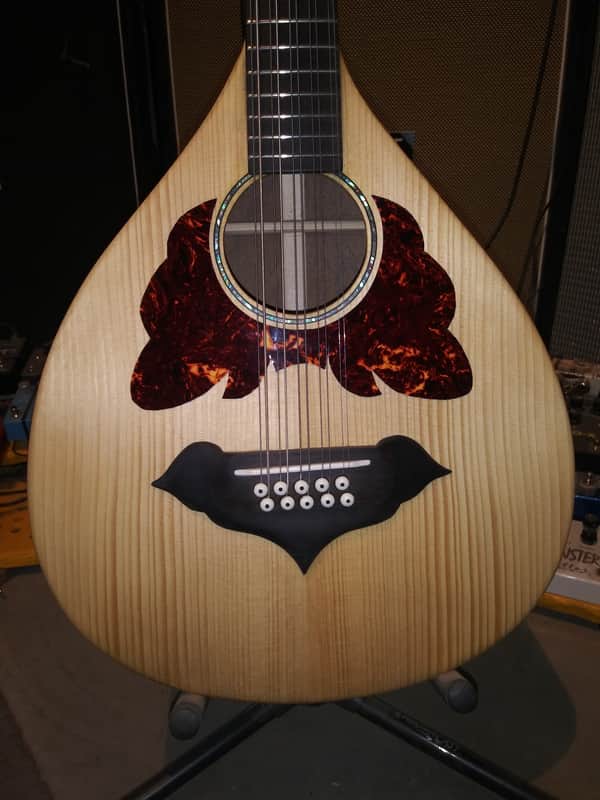
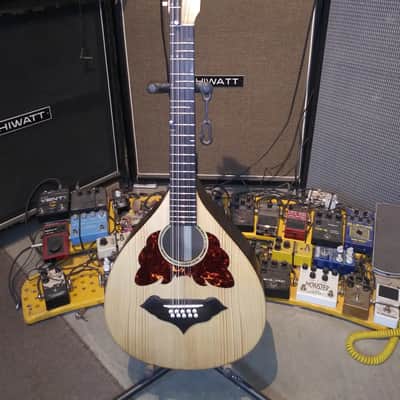
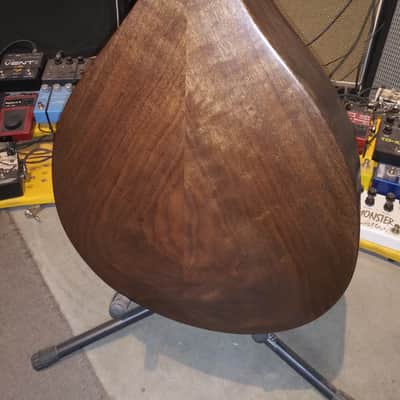
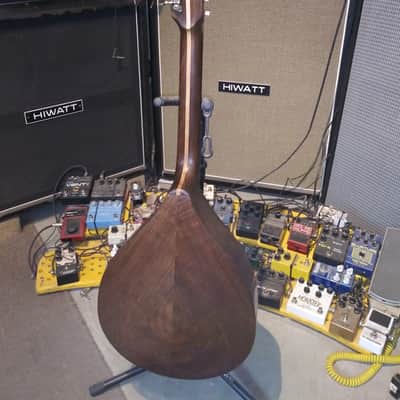
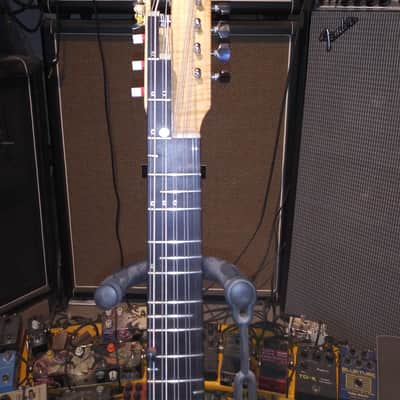
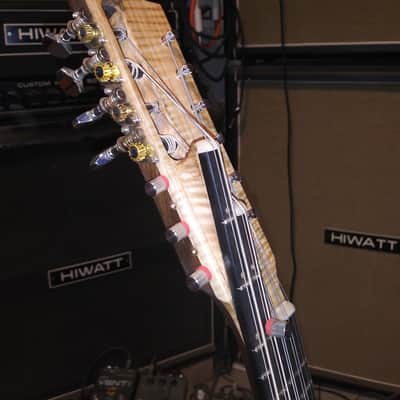
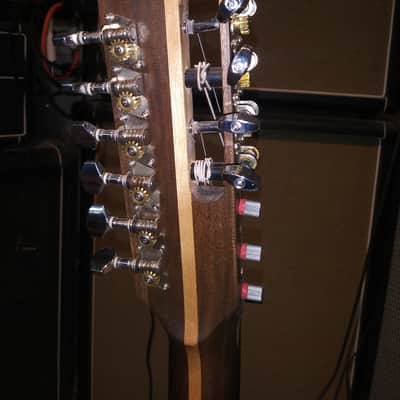
Custom NORDIC MANDOLA 2019 Natural
This gear has sold
See similar gear from other Reverb sellers
Our users rate Reverb
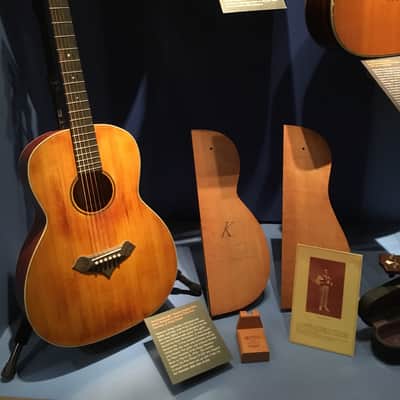
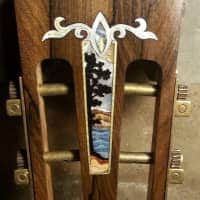
It was constructed using solid walnut for the back, sides, and neck. The top and bracing are Adirondack red spruce. The fingerboard and bridge are ebony. I have installed several pin point capo inserts into the fingerboard. There are five threaded single capos that can be mounted into the fingerboard to change the tuning. When not in use, these capos thread Into the side of the headstock for safe keeping. I currently have two inserted so it plays like an octave mandolin with an extra course of "g" on the bottom end. (There is a really great description about these in the online info below) The headstock veneer and fingerboard ramps are tiger maple. The bridge is from a previous project. It was one of the prototype bridges i created for a guitar that i recreated for the Martin Guitar museum. (Last photo is of my guitar displayed in the Martin Museum) please contact me for any additional photos or information. Thanks and please read the below description for lots of interesting details about this type of instrument.
According to english wikipedia, the mandola is the ancestor of the mandolin (which name simply means “little mandola”). The mandola/mandolin distinction has a potential to mess with peoples heads because of the similarity with the viola/violin terminology. A viola is tuned a fifth below the violin. An octave violin is tuned an octave below a violin. So if a mandola is tuned a fifth below a mandolin, why do we at all use the term “mandola” for these instruments when it’s tuned an octave below a mandolin? I’m not sure, but it probably has something to do with the fact that what in the US is called “octave mandolin” usually has been called “octave mandola” in europe. The viola-tuned mandola is called tenor mandola.
So the term mandola can describe any fretted string instrument with pear-shaped body and flat back which is bigger than a mandolin. But, as states: “The confusion will continue to reign for some time to come as the terms continue to be used interchangeably.”
History
I won’t go in to the history of fretted instruments, or even the mandolin family. There’s of about if you head over to .
The history of the nordic mandola is rather short – it was developed by swedish multi-musician Ale Möller and luthiers Christer Ådin and Helge Ekvall in the 80s. Möller had been living in Greece playing bouzoki when he decided to return home and find the music of his own culture. He went to Dalarna to learn the traditional folk music which primarily is played by fiddlers. But he didn’t want to play the fiddle.
“I knew from all the other kinds of music I played that the instrument is just a voice. The music, the style, is the language. I tried to translate it into my instrument, the bouzouki. I found that it could be done. “But to do so required changing the instrument. The notes and tunings were obviously not the same, and he had a long series of instruments built, trying to find not only an instrument that could play the same scales as the music of Sweden, but also, as he put it, “an instrument that would have the right sound, the right feel.” He finally settled upon a mandola, an octave mandolin, that with frets added could play the quarter notes he needed to truly play the fiddle tunes properly. (quote from)
So that’s the story. Since Ale is a famous and influential musician the instrument found it’s way to more builders and musicians – among them myself. I still remember finding the cd with Ale’s band Enteli at the local record shop when I was in 9th grade. The album cover was a stage with tons of weird instruments, and in the middle was one which my eyes was drawn towards – the nordic mandola.
Tuning, pin point capos and theorbed base
The common tuning of the nordic mandola is, from the base string at zero-fret:
C G D A E
Most nordic mandolas has 5 choruses, with octaves on the C and G string.
But here’s the little peculiarity with this instrument. As Ale and Ådin/Ekvall developed the instrument, they found a need to be able to have different drones in the base. This led to the invention of something called “pin point capos”. The pin point capo is a little screw with a rubber packing on it which goes into holes drilled in the fretboard. This allows for shortening of single strings, and thus being able to change the base notes – without changing the tuning. The base strings are usually elongated/theorbed so the lowest string goes down to A, and the second goes to F.
The point (hehe) with the pin point capos is that they can be put on any of the strings which allows for very cool open tunings – without changing the fingering. In example, if a tune goes in A I usually put a pinpoint capo on A on the second lowest string, and on e on the third. My open tuning then is A A E A E. If I play in D I’d put the capos on D and a giving me a tuning of D A D A E . Pretty convenient and it can be a good source for inspiration to just make up weird tunings and play around.
This is an instrument that evolves and changes over time – people try different approaches to the capos and theorbed bases. In example, in Ådins latest creations he has theorbed the top string as well, going down to D.
Quarter note frets
As RootsWorld writes in the above quote, the nordic mandola usually has frets added to be able to “play the quarter notes […] needed to truly play the fiddle tunes properly.” . Yepp, swedish fiddle players has this annoying habit of not conforming to the tempered western scale. So to be able to play tunes together with these stubborn fiddlers, we use quarter tone frets. This is of course totally optional – if you’d order one you would get to decide if, how many and where these should go
This item is sold As-Described
This item is sold As-Described and cannot be returned unless it arrives in a condition different from how it was described or photographed. Items must be returned in original, as-shipped condition with all original packaging.Learn More.
| Listed | 7 years ago |
|---|---|
| Condition | Very Good (Used) Very Good items may show a few slight marks or scratches but are fully functional and in overall great shape.Learn more |
| Brand | |
| Model |
|
| Finish |
|
| Categories | |
| Year |
|
| Made In |
|
Product safety information may be available here.