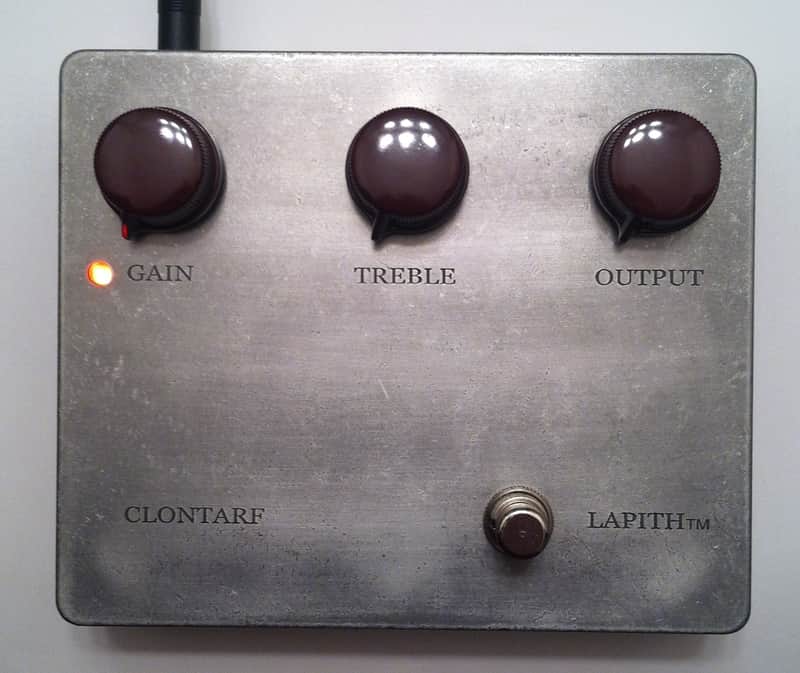
Clontarf Lapith - '94 Klon Centaur Klone - Overdrive Pedal - #031
This gear has sold
See similar gear from other Reverb sellers

Our users rate Reverb
This is Lapith unit #031. Now with the magic diodes!
The Clontarf Lapith is a replica of the Klon Centaur, particularly the first 300 or or so of those made in 1994.
The Lapith comes equipped with the exact same diodes that were used in the
Centaur and KTR. After months of armchair detective work, I had narrowed
the manufactured of the diodes down to two companies. The part number
was unknown until the creator recently spilled the beans. He had always
maintained that he has the only available stock, which is only partly
true. No one has had them openly for sale for years. I was able to make
some inquiries with surplus electronics dealers and find some old stock,
and they sound spot on.
----
The Lapith circuit is a reproduction of a ‘94 Klon Centaur. In ‘95, the circuit was changed slightly to give it “a very small amount of additional low-mid response.” Only about 300 were built before this change. Since everyone else is offering a post-’94 spec’d klone, I thought it would be cool to have one that was like one of the rarer earlier ones. Personally, I hear no difference between the '94 specs and my later Gold Centaur, but that might just be with my rig.
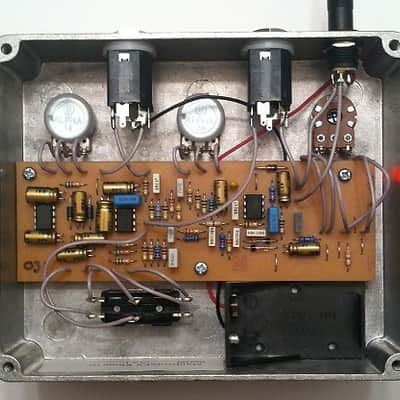
PCB - The PCB layout is identical to the original Centaur’s. The original’s PCB was factory fabbed, but the Lapith’s is etched from copper clad. The PCB artwork had been altered to avoid trademark infringement and to optimize it for etching, but I’ve take care to keep as much as possible in the same place to preserve any parasitic capacitance mojo that may or may not be happening due to PCB design.
Enclosure - Because the Centaur’s enclosure was sandcasted into a unique shape, I’ve chosen the closest standard sized production enclosure, the 1590XX (sometimes referred to as 1790NS). They’re about the same size. Rather than silkscreening the text on top, I’ve chemically etched the labeling into the aluminum so it won’t scrape off or wear over time.
Resistors - I
have no idea what brand of resistors were used in the original Centaur
(they’re not labeled for brand), so I use Xicons in the Lapith. Xicons
are high quality and common in boutique pedals. The Lapith has carbon
film and metal film in all the same places as the Centaur. Additionally,
I’ve identified a few resistors that were incorrect in every version of
the Klon schematic. Those values are off by only a very small amount (under 1%),
and you’d never hear the difference, but I wanted to make sure that this
thing was as technically correct as I possibly could.
Capacitors
– The first ten Lapiths used the same Panasonic ECQ caps as the
Centaur. Because I haven't been able to find certain values since
Panasonic stopped making them, I've switched to box caps for unit #011 on up. I don't hear
any difference between PCBs populated with either brand. The two pF
values are film caps in the Centaur, not ceramic as most klones use.
I've made it a point to use film for these values.
Knobs
and Potentiometers - The Centaur
knobs and pots were both special orders, not available as standard
parts. The original used a
special run of 24mm CTS pots that mounted to the PCB. The closest
regular production pots I can find are 24mm Alphas, which is what went
into the first ten Lapiths. I was unhappy with these because the actual
values were often way off from their stated values, and the the size of
the dual-ganged pot didn't leave enough room for the DC jack. The Lapith
now has 16mm Alphas, which measure in much more accurately.
The
dual-ganged pot connected to a small break-away board that was then
connected to the main PCB with ribbon wire. This makes sense for mass
production, but it seems like an unnecessary amount of solder joints
when the wires could just run straight to the pot, so the Lapith doesn't
make use of the break-away board. This also gives the PCB some space
for an extra standoff so it can be more securely mounted to the
enclosure.
Power – The Lapith has a standard Boss/Ibanez style center negative 2.1mm jack for a power supply. The Centaur took a pin-style plug that was more common 20 years ago or so, and it came with an optional adapter. The Boss/Ibanez style has become industry standard since then, so I decided to just go with that rather than use a jack that no one has plugs for these days. It ruins a small part of the Klon experience, I know, but you actually want to be able to use the thing, right? There is a plastic 9v battery compartment where the Centaur has a recess molded into the enclosure.
Diodes – For the last few years, the
diodes were the only unknown part of the Klon circuit. After months of
looking through datasheets and buying anything that looked even remotely
like them, I was able to narrow it down to one or two manufacturers,
but no one knew the actual part number. Now that the part number has
been made public by the creator, I've managed to get my hands on a
small batch them. Not just the same part, but also the same
manufacturer. After a year of testing various aspects of the circuit,
matching potentiometers, and measuring cap tolerances, I've found that
none of that matters as much as the diodes.
Table - The Centaur was built on a card table in the builder's apartment. The Lapith is built on a livingroom table in my apartment. This makes it extra boutique and mojo.
Price
- The first Lapiths were priced the same as the Centaur was before it went up in
'05. Since there are less NOS mojo thingamabobs in the revised version, I've lowered it quite a bit.
If you have any questions, please shoot me a message.
--------------------
Here's a FAQ I put together from common questions:
Does the Lapith have magic germanium diodes/unicorn tears?
Yes.
Except that instead of coming from the other side of a Unicorn's tear
ducts, they came out of a box that had been sitting in a warehouse for
twenty years.
Is this the actual circuit? Or is it a striped down version?
Yep,
it's the actual circuit. Charge pump, buffer, and everything.
There are some stripped down versions out there, but this is the
whole thing.
Is it True Bypass?
No, the
real Klon is not true bypass either. The buffer is very good
though. I don't hear any difference when I compare my buffered signal
with a true bypass looper. For long cable runs or big pedal
boards, the Klon buffer should also help keep your signal strong.
It might not like being on front of vintage fuzz effects though,
those like to be connected directly to your pickups without a
buffer. The easiest thing to do is just place it after the fuzz.
Unicorn magic! Sparkles and rainbows! Mojo! Hype!
Well,
first of all, unicorn magic went out of the world when the red
bull drove them all into the sea. Everyone knows that. I don't
believe in mojo, I do think the Klon is a well tuned circuit, even
without the unicorn tear diodes.
What PCB do you use?
It's
a reproduction of the original Klon PCB that I traced with vector
graphics (so there's no cad file to share, sorry), with some minor
alterations to avoid solder bridges and avoid trademark issues. I etch
and drill the PCB by hand, for great mojo.
It it
transparent or does it have a mid-hump? I keep hearing both. Which
is it? Does it really only work its magic through a Fender?
Yes
and no, and no and yes. Set clean, the Klon is transparent. The
overdrive has a mid-hump that is noticeable as you turn up the
gain. Used hamfistedly (run into a clean amp with the gain turned
all the way up), there's a very noticeable mid-hump. Those
Youtube videos comparing it to the Bad Monkey don't seem to get
what the Klon is about. Generally, I've found that a truly
transparent signal will often muddy up when used to push an
already driven amp, so the mid-hump should actually help the Klon
sound like your guitar and amp, but more, by keeping things
tighter.I f you keep the gain between 10am and 1pm, and your amp
is
already on the verge of getting crunchy, that's when the Klon
will sound its best.
The Klon was originally designed with a
Fender amp in mind, but tweaked to sound good through most rigs. I'm a
Marshall guy and I think it works great with British amps,
provided you're using it sensibly.
The thing to keep in
mind is that most overdrive pedals are designed as to sound good
run into clean amps, meant to be used as their own little distortion
channels. A lot of players use them to push already driven amps
harder, but that's not what they were designed for. The Klon was
one of the first pedals designed to do this specifically. It helps
to think of it almost like a additional gain stage for your amp.
Can you make me one in another colour?
Sorry,
I'm really bad at spray painting and I'm not set up for powder
coating. I can only do bare enclosures with etched labeling, clear
coated. This means that sometimes the serifs on the text can get
a little blotchy, but the plus side is that the labeling will
not scratch off like silk screened text. The clear coat may chip,
but it won't get that old beat up look over time like most
pedals. Since the pedal in the photo is the one you'll receive,
you should be able to see any imperfections in the etch. Rarely, I
use transparent automotive paint with varying results, but clear coats
usually come out the best.
What is your return/warranty policy?
If
you simply want to return the pedal for a refund, you can do so 7
days from receiving it with no questions asked (though I'd like
to know what you didn't like about it so I can improve on it).
You are responsible for all shipping charges. If there's
something wrong with the pedal (intermittent switching, loose
wire, something shorting, etc...), I will fix it and send it back
to you, and maybe even compensate you for shipping depending on
the circumstances. Basically, if I screwed something up, I'll
make it right. If you break the pedal, I'm willing to repair it,
but you are responsible for the shipping charges and possibly a
small charge for parts and labour, depending on what broke. Just
shoot me a message and we can figure out how to go about fixing
it.
How do I know what power supply to use?
The
jack should be 2.1mm, that's the standard size for stompboxes.
When you look on the back of the power supply, you should see its
specs. Always use 9V DC. Be careful that it doesn't put out AC.
There should also be a little logo that tells you which parts of
the jack are positive and negative. You want one with a negative
center. A positive center will take out things out inside the
pedal. Never run this pedal at more than 9V. There's a charge pump
inside that doubles the voltage, so if you give it more than 9V,
the charge pump will double that and it will start burning out
components. Any adapter made for run-of-the-mill Boss or Ibanez
pedals will work well. Visual Sound also makes the 1spot, which is
one of the best power supplies on the market.
Shipping details?
I
usually ship via USPS. I usually ship on Tuesdays and
Thursdays, so please keep in mind that if you send payment on a
Thursday, I probably won't be able to get it out that day and it
won't be until the following Tuesday that I'll get an opportunity
to get to the post office.
Is this the actual pedal or do I have to wait for one to be built after I order?
The
pedal in the photo is the one that you are buying. It's already
built and I've spend time playing through every one to make sure
it sounds good and works without any issues. If it doesn't, I set
it aside and come back to it a few weeks later to figure out
why.
Any clips?
I'm working on it. I've finally got the recording gear, but I've got to make space for it and get it set up.
Three parts. Supposedly, the changes were made for more lower mid response. I don't hear it myself, and my own later gold Centaur that I use as a benchmark seems to have just as much lower mids as the Lapiths. I wouldn't have even bothered, but I thought the idea of having the older specifications was cool. Due to component tolerance/drift, the knobs might need to be set a little differently, but I can dial them in to sound identical. I think the diodes matter more than the pre/post '94 specs.
| Listed | 10 years ago |
|---|---|
| Condition | Very Good (Used) Very Good items may show a few slight marks or scratches but are fully functional and in overall great shape.Learn more |
| Brand | |
| Model |
|
| Finish |
|
| Categories | |
| Year |
|
| Made In |
|
Product safety information may be available here.