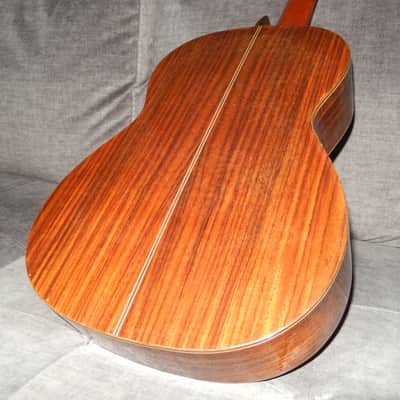
ULTRA RARE - RYOJI MATSUOKA J30 - LOVELY 580MM SCALE CLASSICAL REQUINTO GUITAR
This listing has ended
See similar gear from other Reverb sellers
Our users rate Reverb
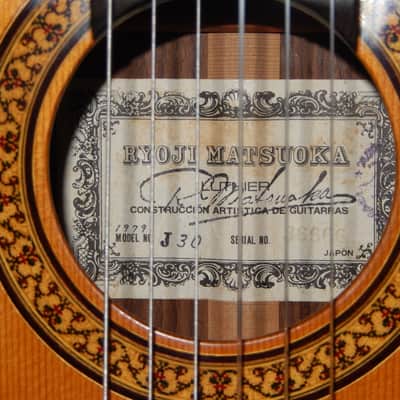
Ryoji Matsuoka N0 J30
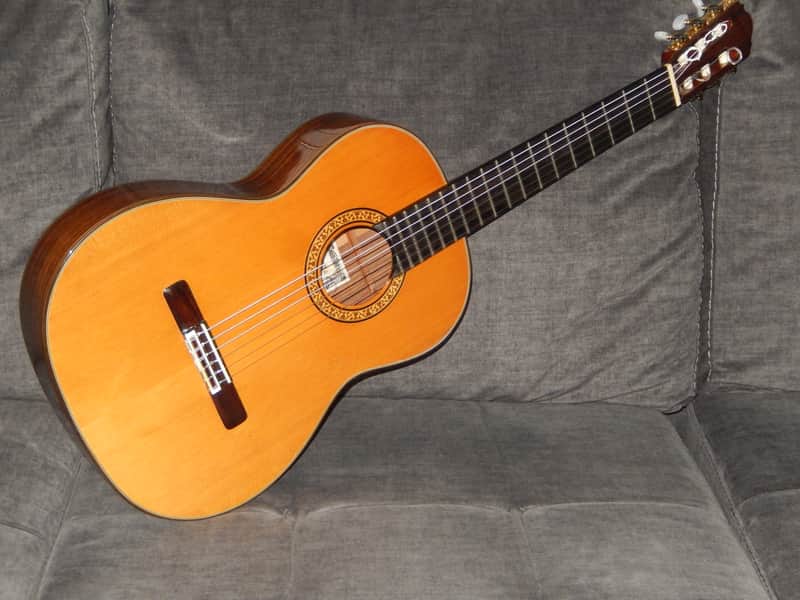
This wonderful guitar was made and signed by Ryoji Matsuoka in 1979.
Despite its smaller size body, it offers great volume and sweet tonality that will charm most demanding listener. This instrument delivers much more than one can expect just by looking at it. With its current action it is simply a joy to play
Although since its origin, Matsuoka’s workshop was mostly dedicated to making full size classical guitars, it was always making limited number of requinto and alto models. Model J30 with 580mm scale is simply an ultra-rare find. Just like other Matsuoka smaller body models, this guitar was priced much higher than regular model M30.
Matsuoka guitars have always offered exceptional value for the money. They were quite underpriced if compared with instruments sold by leading Japanese luthiers of that era. They were certainly a bargain if compared with similar grade but far more expensive “hand made in Spain” counterparts.
Just like many other Japanese Gakkis, Matsuoka workshop has mastered the process of making very high grade “laminates”. These plates were nothing, but 2 very thin layers of solid wood glued together. Such plates perform no different than solid wood plates, while being resistant to cracking and being less expensive in guitar production. Thanks to such business philosophy and team of highly skilled associates Matsuoka guitars are played and treasured all around the world.
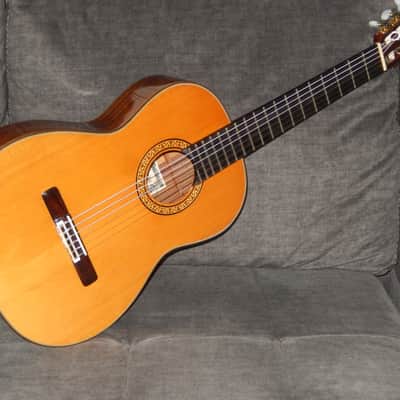
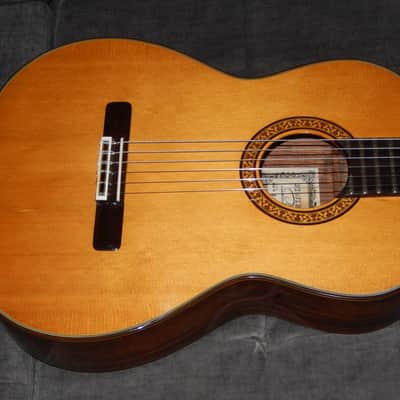
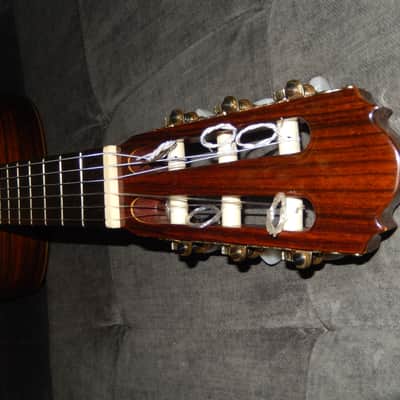
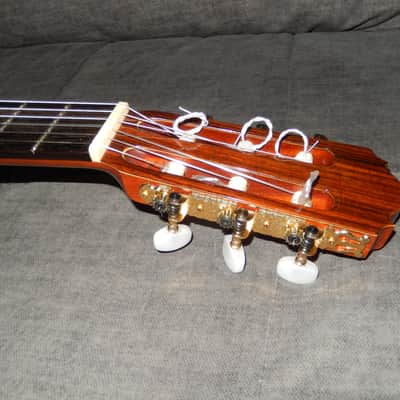
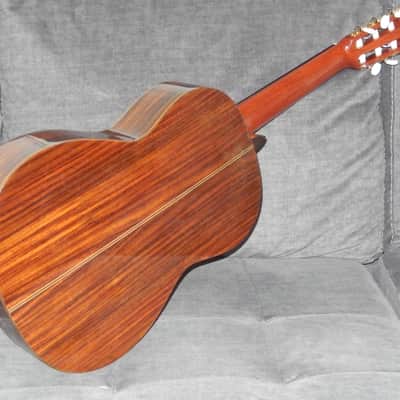
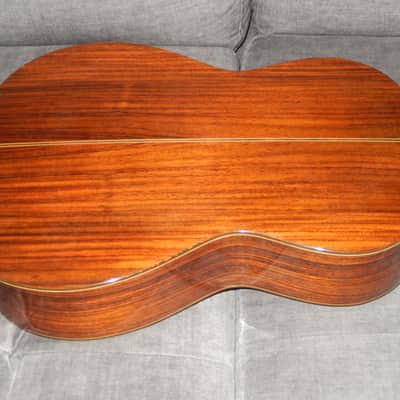
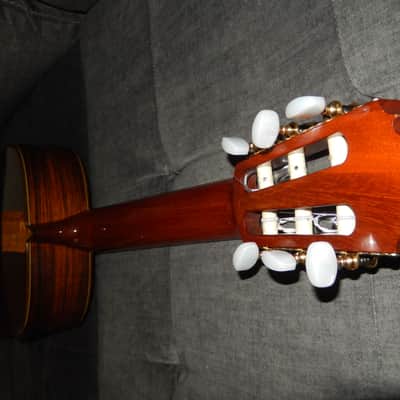
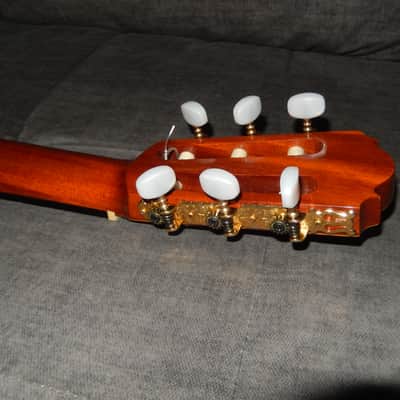
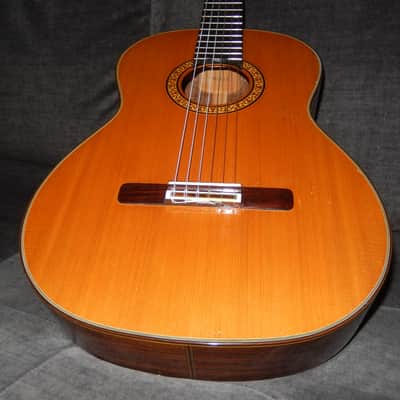
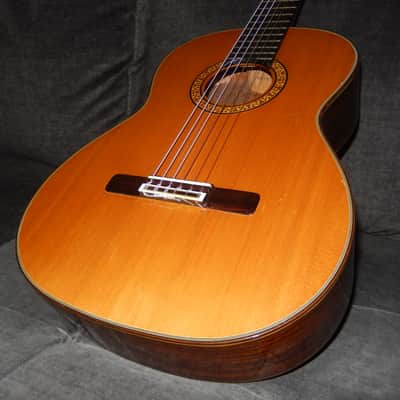
Despite its age this guitar remains in overall very good condition. The soundboard bears several very minor marks, visible mostly from close distance if looked from certain angles. Other areas remain relatively clean. Visible on the pictures mild cloudiness of it finishes is practically not visible in regular light.
Specifications:
Body dimensions:
Total length: 90cm
Body length: 43.5cm
Body width at lower bout: 32.5cm
Body width at upper bout: 25.5cm
Body width at waist: 21.5cm
Body thickness: 8.0-8.4cm
Top: Solid Spruce/lacquer
Back and Sides: Indian Rosewood double-plate/lacquer
“Laminated” is quite unfortunate term regarding Japanese made guitars. These "laminates" were made from 2 layers of solid wood glued together with natural resins. They were made so well that they performed as good as solid woods while being far less expensive in guitar production and far more resistant to cracking in regular use.
Neck: Mahogany
Fingerboard: Ebony
Scale: 580mm
Nut width: 48mm
String spacing at the nut:40mm
String spacing at the saddle:54mm
String action is 3.50mm under E6 and 3.00 mm under E1. This action can be lowered (by removing shims from under existing saddle) to 3.00 mm under E6 and 2.5mm. However this lower action leads to slight buzzes when bass strings are played open.
This guitar will be shipped in non-original (somewhat oversized) used hard shell case.
Real Value of Japanese Vintage Guitars
The key to understand value of vintage Japanese guitars is to acknowledge galloping devaluation of Japanese yen in 1960s & 1970s. This devaluation was somewhat slower in 1980s. The best measure of this devaluation is Starting Yearly Salary of Japanese College Graduate (SYSJCG).
SYSJCG in in 1965 was 19 600 yen, in 1969 – 34 600 yen, in 1970 39 200 yen, in 1972 – 62 300 yen, in 1975 79 200 yen, in 1977 85 200 and in 1980 - 100 000 yen.
During 1960s and most of 1970s model numbers of Japanese guitars were strictly interconnected with their prices in Japanese yen. In late 1970s and during following decades model numbers were no longer strictly associated with their prices. Many Japanese guitar makers introduced model names instead of model numbers. Others were still using model numbers with addition of letter abbreviations or other symbols.
The best and only logical approach while evaluating real value (real grade) of vintage Japanese guitar is to compare its price in Japanese yen with SYSJCG during the year guitar was made.
Any guitar priced 100 000 in 1970 (labelled usually as No10) would be priced 200 000 yen in 1975 (relabeled to No20 or 2000), 300 000 yen in 1977 (labelled as No3, No30 or 3000). Starting in 1977 Masaru Kohno introduced his model No50 priced at 500 000 (skipping theoretical model 40). Soon other famous Japanese luthiers did the same. By 1983 Kohno started using model names instead numbers and was raising their prices as he was pleased. Naturally soon other Master luthiers did the same.
Knowing all of that, you can bet on that Masaru Kohno No50 made in 1982 is practically the same quality as Kohno No15 made in 1972, or Kohno no20 made in 1975 or Kohno No30 made in 1977. I know it for a fact.
The lowest grade models currently made by Matsuoka workshop are M75 and MH75. They are commonly considered as “beginner guitars”. Matsuoka model M30 made in 1973 is simply far, far better instrument. It is naturally better than model M50 made in 1977, model 80 made in 1982 or model M100 made in 1990. At present, the highest grade Matsuoka models are M300 and MH300. They absolutely stand no chance in competition with model M150 made in 1975… or model M200 made in 1977.
It is very important to mention that if modern era luthiers are using 40 years old woods to make a classical guitar, its price is at least $8000.
Some relevant info:
Ryoji Matsuoka was well known Japanese guitar maker who has been producing guitars in Nagoya, Japan since the 1960s. Nagoya is Japan’s 4th largest city and a major industrial port city located on the main island of Honshu in Aichi prefecture.
The Nagoya/Aichi/Kani area (Kani is the prefecture next to Aichee) is one of Japan’s major musical instrument making centers. The city and the outlying areas have a long classical guitar making history with many small shops producing guitars. Major guitar and violin makers include Matsumoku Industrial, Suzuki, Takaharu, Sada Yairi, Kazuo Yairi (Kani), Daion, Yamaki, Ibanez/Hoshino, and Ryoji Matsuoka. Additionally, there are numerous small guitar shops and factories that contract to larger firms, such as Yamaha in Hamamatsu.
The Ryoji Matsuoka guitar works was a small scale guitar manufacturer with less than 15 employees. For a few years during the 1960s and early 1970s, Matsuoka produced the higher end Aria guitar models for Shiro Arai, founder of Aria . These Aria models either have Ryoji Matsuoka's name on the label or are marked RM with a red stamp on the neck block. Matsuoka also made some models for Ibanez, including a few steel string flatop and archtop models.
During the early 1970s, Matsuoka produced Fleta, Hauser, Kohno and Rubio. The copies of Kohno guitars with 2 ebony strips in the necks and higher grade spruce tops were made in much greater numbers than copies of other luthiers. They were also sold at higher price.
From 1975 to 1980 the company produced their own line of guitars: the concert, artist and artisan series.
The Concert series includes the M20 (solid spruce top, nato neck), M30 (solid spruce top, mahogany neck), M40 (solid spruce top, mahogany neck). All 3 models have laminated rosewood back and sides and rosewood fingerboards.
The Artist Series includes the M50 and M60. These guitars have better quality spruce tops and were made in several versions. Some of them, less expensive versions, were made with laminated Indian Rosewood or laminated Jacaranda back and sides, ebony fingerboards and plain neck. On the other end of the spectrum there were also all solid versions with Solid Indian rosewood or solid Jacaranda back and sides, with one or double Ebony reinforcement in the neck.
The Old World Artisan Series includes the M70 and M80, made with all solid woods and one-piece mahogany necks.
During the 1980s and early 1990s, Matsuoka models included the M50, M60, M70, M80, M100, M150, M200, and M300 with Ramirez style headstock and models MH100, MH150, MH200, MH300 with Hauzer style headstock. All of them were made with solid Spruce tops. M50, M60, M70 were made either with laminated back and sides or as all solid guitars. All other models were all solid wood guitars.
In the late 1990-ties models M65 and M75 with Cedar tops were added to the production line mostly with laminated back and sides.
To make matters little more complicated, by the end of 1990-ties some Spruce top models were also made with Cedar top without any change on the label. So we can for example encounter model M60 with either Spruce or Cedar top. Most likely each guitar was sold with attached precise specification.
Since early 1990-ties Matsuoka has also been making guitars for Aranjuez label (launched by Juan Orozco) and lower priced cosmetic copies of a Mathias Dammann classical guitars (they were not exact copies). The top Aranjuez model M720 has been made in cooperation with Kohno/Sakurai workshop. Masaru Kohno and later Masaki Sakurai were making tops with their superb bracing, while Ryoji Matsuoka was responsible for all other parts and final assembly. This cooperation continues until today between Toshiaki Matsuoka and Masaki Sakurai. These M720 guitars with Matsuka and Sakurai labels offer exceptional quality of sound at moderate price. They are sold at Guitar Salon International in Santa Monica, CA for $2700.
| Listed | 7 years ago |
|---|---|
| Condition | Very Good (Used) Very Good items may show a few slight marks or scratches but are fully functional and in overall great shape.Learn more |
| Brand | |
| Model |
|
| Finish |
|
| Categories | |
| Year |
|
| Made In |
|
| Body Shape |
|
Product safety information may be available here.