
2013 Long Neck Tarhu by Peter Biffin, Mint Condition, w/Case, Super Rare!
This listing has ended
See similar gear from other Reverb sellers

Our users rate Reverb
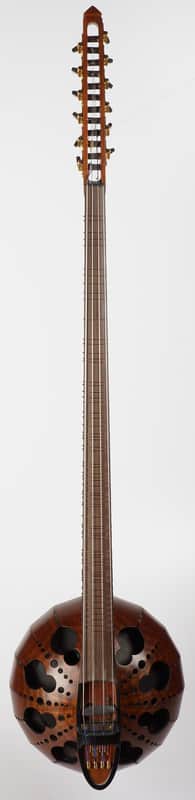
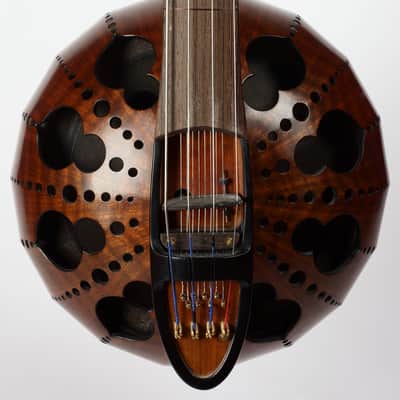
Up for sale is my Long Neck Tarhu built for me by Peter Biffin in Australia in 2013. This is an original design of his, based rather loosely on the Turkish Yayli Tanbur. It can be either bowed or plucked and can take almost any tuning you might want to use, from EADG of an upright bass to the top 4 strings of a guitar (though the high E might not last long, as it’s the absolute outside limit of what you can ask of a 31.5” scale length instrument).
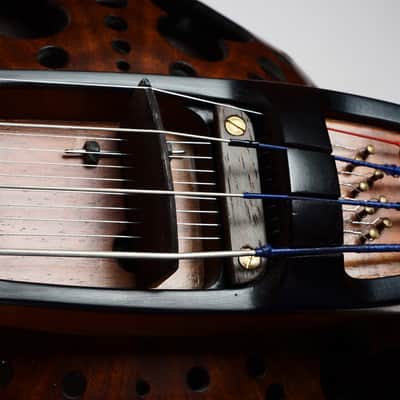
Presently, the 4 main bowed strings are cello strings and
tuned (deepest to highest pitch) A’ (2nd string on upright bass), A,
e, a (or A1, A2, E3, A3). This is an interpretation of the Yayli Tanbur tuning
and is very useful for modal playing. I have also strung and played it in standard
cello tuning (C G D A), but, due to the longer scale length of the Tarhu, you
have to use the G D A and E strings from a 5-string cello set to use this tuning.
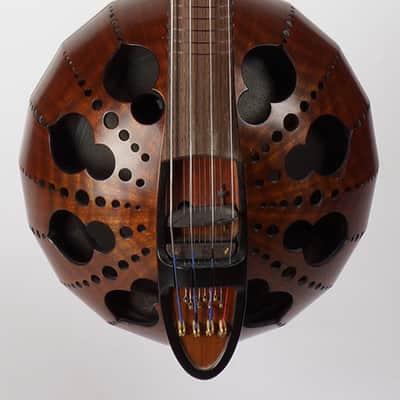
For the most part, the 8 sympathetic strings are tuned to the scale you are playing
in. They tend to last, more or less, forever, as they are never touched, so
they tend not to corrode or wear. Also, being plain steel (or, if you wish, bronze)
strings, they don’t have the little surface nooks and crannies for stuff to get
into and start eating away at the string. Unless you live very near salt water,
you should get at least 10 years out of them.
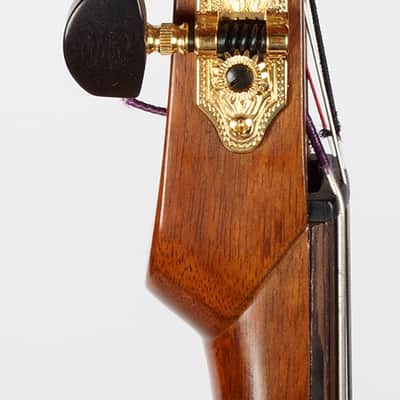
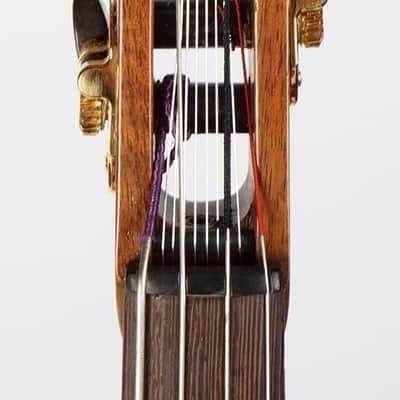
The neck is hollow with the bowed main strings above the fingerboard (naturally), and the sympathetic strings running under the fingerboard. The tuning machines are Schaller classical guitar machines, which work flawlessly. The neck also has an adjustable truss rod, which is accessible in the peghead and adjusted with an Allen wrench. That said, in the nearly 6 years I’ve owned it, the neck has never needed any adjustment at all.
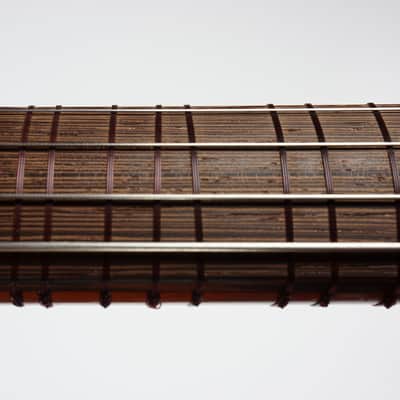
The frets are movable and can be set to whatever scales you want to play. They are currently spaced to the original Turkish tanbur fretting of 27 frets per octave, which includes all of the notes on the standard “Western” scale. If you wish, frets can be removed by clipping them off, to give you the standard 12-note-per-octave Western scale, or they can all be clipped off, to make it truly fretless. It’s up to you. Even if you do remove them, you can always tie new frets on.
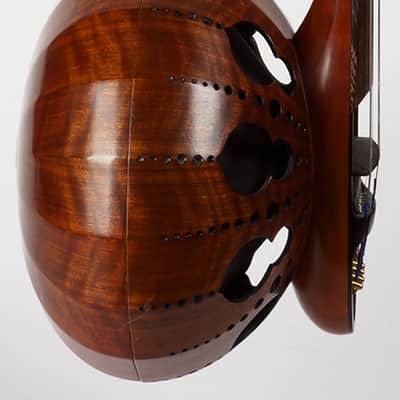
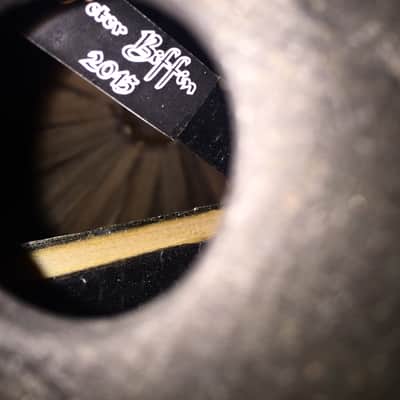
In case you are not familiar with Peter Biffin’s instruments, they are entirely hand-crafted by Peter in Australia. He uses a very-light-weight wooden resonator cone to create the sound that is usually generated by a thin piece of animal matter.
Peter’s workmanship is spectacular, as is his eye for design. His instruments sound fantastic, play wonderfully and look amazing. What more could you ask for?
The following description is taken from Peter’s website:
“The long neck tarhu was the first instrument in the tarhu family to be created. Its design brought together two different streams of stringed instrument playing: the long slender neck allows 2½ octaves to be played on a single string with the melodic fluidity encountered on traditional instruments that employ along-the-string techniques (as in tanbur and erhu); the use of 4 playing strings facilitates across-the-strings playing (as in the violin family), and extends the range of easily available notes to over 4½ octaves.
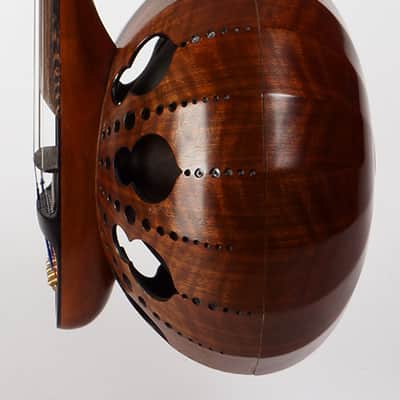
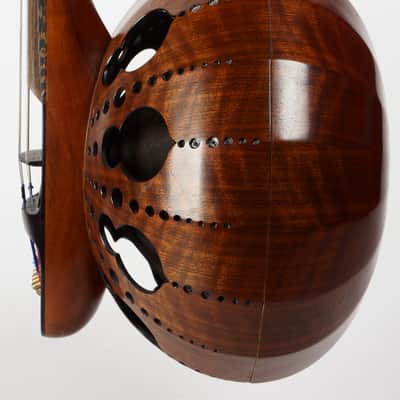
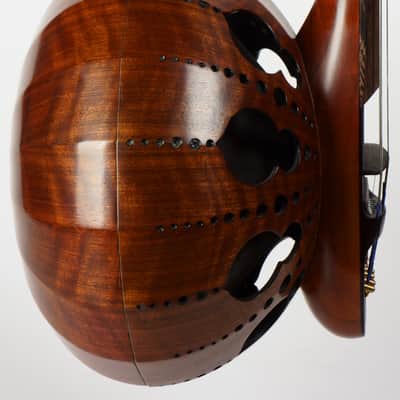
“The tarhu design uses a unique acoustic system, where the string’s vibrations are transferred to a featherweight wooden cone suspended within the spherical body. This design creates extremely sensitive instruments with an unprecedented range of tone colour variations.
“When the tarhu’s acoustic properties are combined with the wide range of available playing techniques, the result is an instrument that is capable of playing many styles of music inspired by both East and West. The long neck tarhu can be played using bow, several different forms of plectra, and fingerstyle.
“Traditionally, long-necked bowed instruments are fretted with threads tied around the neck, and this method has been found quite suitable for the tarhu. Many different tuning systems are available using tied frets, as the threads are moveable, and frets are easily added or removed. Systems range from 12 tones to the octave, thru to traditional Turkish tanbur fretting of 27 notes to the octave.
“When playing with a bow, the traditional Turkish fretting produces a result that is close to fretless, in that the tones are so close together that an almost smooth glissandi can be achieved. However, once a fretless longneck tarhu has been tried, it becomes clear that there is a big difference between a fretted "almost smooth glissandi" and a fretless glissandi that is actually smooth. There is also a deeper level of tone colour exploration possible without frets. When used as a plucked instrument, the difference between fretted and unfretted tarhus is more pronounced, glissandi of any sort not being possible when frets are present.”
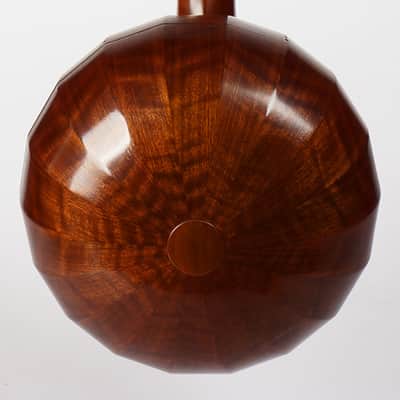
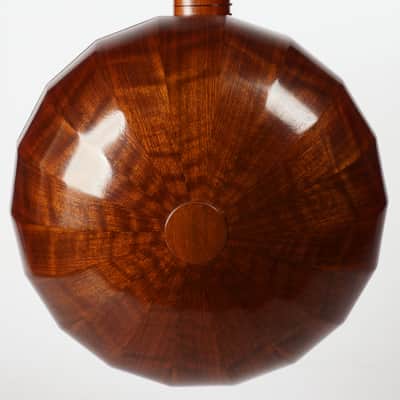
I believe that the neck and bowl are made of some form of figured Mahogany, but it might be Australian Blackwood with a stain on it. The fingerboard is Wenge. It comes with a short “spike” that goes into a hole in the bottom end of the instrument, if you prefer to play it that way. Longer and/or specialized spikes and rods can be made to fit into that same hole, in case you want it to rest on the floor like a cello or fit to your thigh. I, personally, never used the spike, preferring to grip it with my knees and angle the neck 45 degrees to the left of my body. If I am wearing slippery pants, a piece of suede helps with the grip.
The overall length of the instrument is 48” (122 cm). The scale length is 31.5” (80 cm). The body is approximately 11” (28 cm) in diameter, and the overall depth of the instrument is approximately 10” (25 cm) at the bridge, which is the deepest point on the body.
It is in absolutely perfect, as-new condition, with no visible wear, scratches, dents, dings, cracks, issues or repairs anywhere. In spite of having been played a good bit for almost 6 years, even the frets are still perfect.
To me, one of the many strengths of this instrument is its ability to grab harmonics, which allows you (with practice and good bow control) to create and manipulate complex formants (vowel sounds) and weave them into the notes you are playing. For this reason, I often find myself making very textural recordings on the Tarhu. It’s amazingly expressive and enjoyable to explore all that it is capable of.
As for the demo file that I have uploaded to YouTube, it will give you a good idea of some of what I have just described.
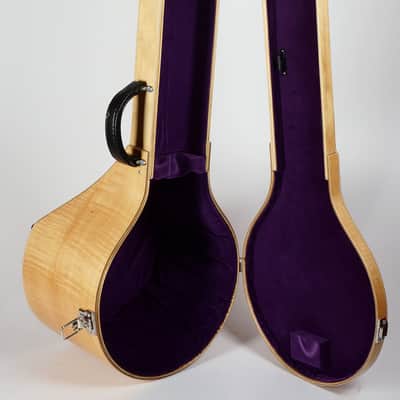
It comes with its original wooden hard-shell case that Peter made for it. It is beautifully lined with padded velour, and provides very good protection, but is not quite flight-case sturdy, so for regular air travel, you would likely want to have an ATA-style flight case made for it.
It will be packed in an oversized, strong box, with bubble wrap between the instrument and the case, and other soft material between the case and the carton. I have a lot of experience packing stringed instruments, having shipped roughly 1000 instruments over the past 40 years, to dozens of countries around the world.
Due to the large size of the instrument and case, and the extra padding needed between the case and the shipping box, shipping costs are not going to be inexpensive, no matter how you look at it. When I bought it new, it cost nearly $500 to get it here from Australia.
The instrument comes with a 48-hour approval period. If, within the 48-hour period, you decide that the instrument is not for you, simply return it to me in the same condition as I sent it out, with full insurance, and I will refund your purchase price, minus shipping to you and a 10% restocking fee. Buyer pays return shipping.
TERMS, PLEASE READ CAREFULLY: Buyer pays selling price plus shipping and insurance. I typically ship with USPS, UPS or FedEx, though other arrangements can be made at the buyer's request. No fee is charged for packing or handling. I will gladly ship anywhere in the world, but beware, international shipping charges can be steep, and the buyer is responsible for all duties, taxes, VAT, brokerage and storage fees on their end. Please contact me with any questions.
PLEASE NOTE IF YOU ARE OUTSIDE OF NORTH AMERICA: Please send me your address for a proper shipping quote. I get special deals from DHL which is MUCH less expensive than UPS or FedEx.
| Listed | 7 years ago |
|---|---|
| Condition | Mint (Used) Mint items are in essentially new original condition but have been opened or played.Learn more |
| Brand |
|
| Model |
|
| Finish |
|
| Year |
|
| Made In |
|
Product safety information may be available here.