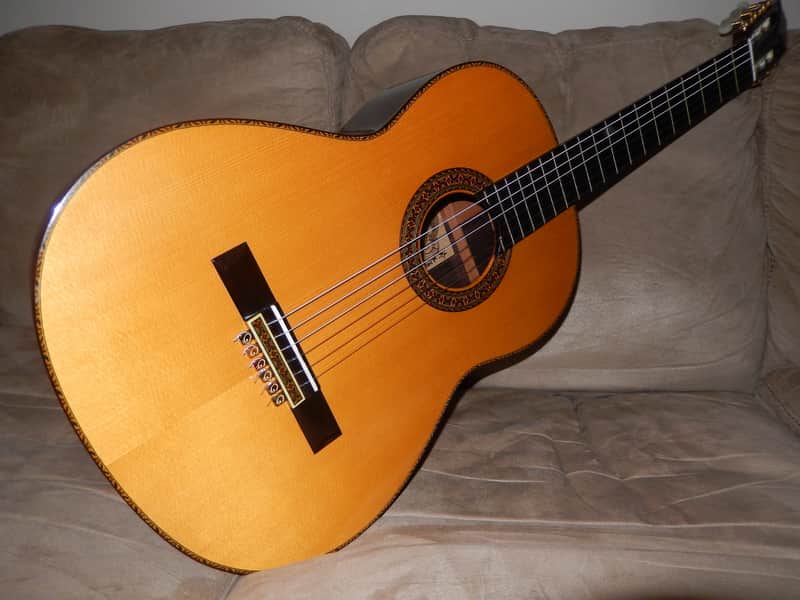
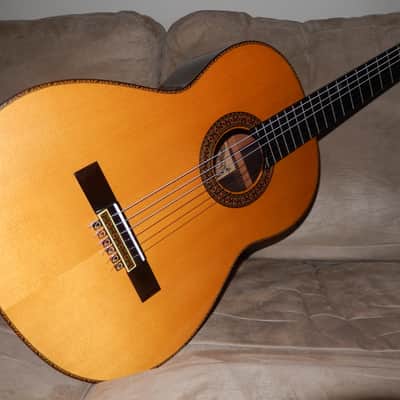
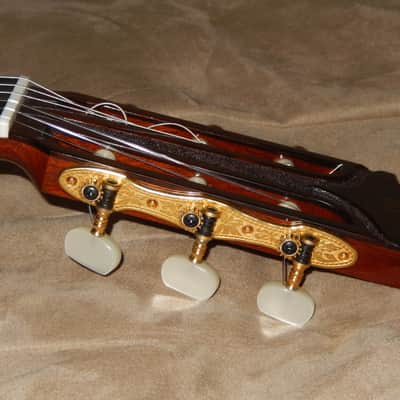
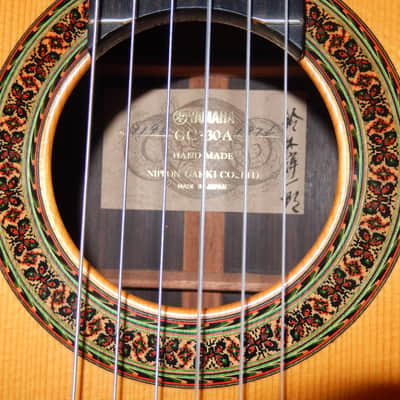
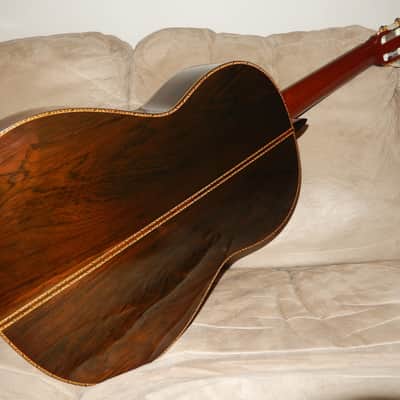
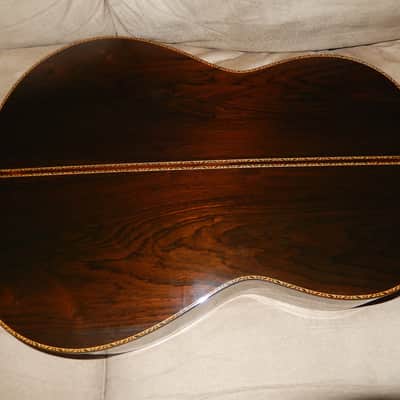
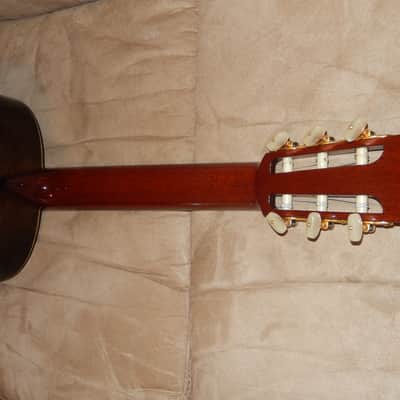
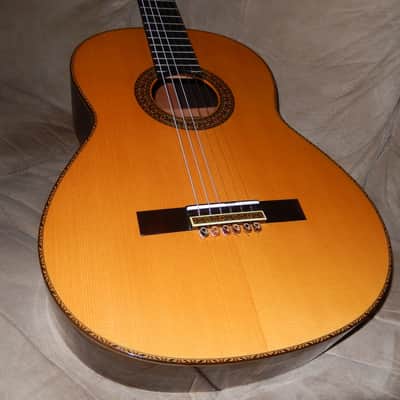
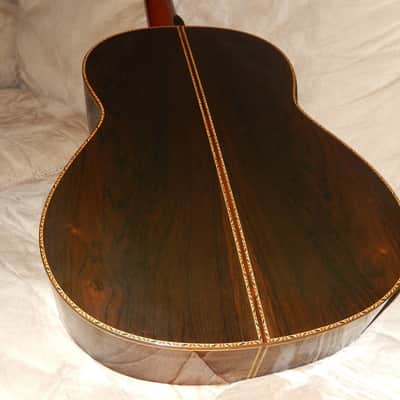
Her Majesty Yamaha GC30A - 1974 - Highest Grade Japanese Made Classical Concert Guitar
This listing has ended
See similar gear from other Reverb sellers
Our users rate Reverb
Please read my 7 days return policy at the bottom of the page
**************************************************************************************
Yamaha GRAND CONCERT GC-30A 1974
This Yamaha guitar was made in 1974 under the guidance of Spanish luthier Manuel Hernandez, by Yoichiro Suzuki, being helped by Suzuki Magosaku and Iguchi Tokio.
This is however very special guitar model. Being priced 300 000 yen in 1974 it was one of the most expensive guitar ever made in Japan. This was the first year this highest grade model was introduced.At this time Japanese guitar makers started to introduce international customers to their, pretty soon highly regarded, products. Their guitar offered the highest possible level of craftsmanship with great deal of attention to even the tiniest details. The "sister model" Yamaha GC30B had Cedar top and identical identical looks and price.
Exactly the same year other 2 luxurious models GC20M (solid Spruce/Solid Brazilian Rosewood) and GC20S (solid Cedar/Solid Brazilian Rosewood) were introduced. They looked similar to GC30A& Gc30B models, except for their headstocks. GC20M & GC20S had lacquer finish, while GC30A & GC30B had shellac finish.
Third place from the top in Yamaha's classical guitar line was taken by models GC10M and GC10S, both "all solid" with highest grade Indian Rosewood b/s and lacquer finish.
All thesemodels made in late 1970s/early 1980s were of somewhat lower grade than the those made in 1974. Despite their lower grade, due to galloping devaluation of Japanese yen, their prices were gradually going up. Production of models GC10M/S and models GC20M/S ended in 1979 and they were replaced by other models, while price of models GC30A & GC30B reached 650 000 yen by year 1984.
In 1985 Yamaha corporation ended production of models GC30A/B and introduced 3 new high end models made from highest grade woods and Brazilian Rosewood b/s. It was GC50 and GC60 (both with lacquer finish) and GC70 (with shellac finish). Yamaha GC30A became Yamaha GC70. Specifications of Yamahas GC30A and GC70 are presented down below.
One of these Yamahas GC30A was given to Andres Segovia, who liked it very much and used it for his daily practicing at his cottage in Spanish countryside.
However, just like in case of any other Yamaha GC model units made in earlier years were of much higher quality than those made in later years. The same model Yamaha GC30A made in 1985 was no match for guitar made in 1974, even though it was priced the same 300 000 yen. This amount of yen had completely different purchase power in 1974 versus 1985. 300 000 yen in 1974 translates to at least 750 000 yen in 1985. Masaru Kohno’s top model at that time was #50 with the price of 500 000 yen. During these years only few other famous Japanese luthiers were able to sell their Master 50 models for the same price.
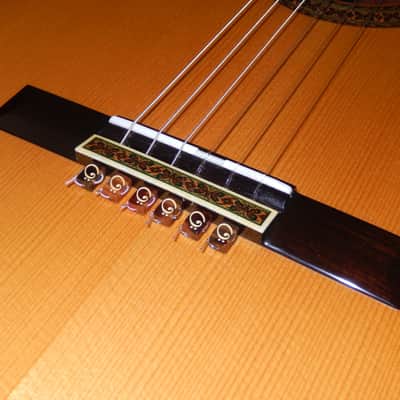
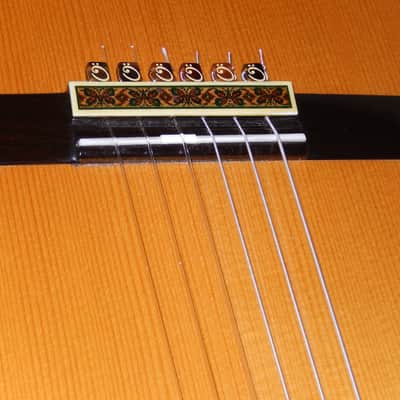
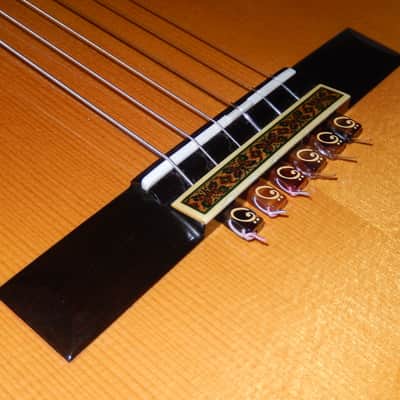
This particular unit very likely hasn’t been played a lot and doesn’t bear any significant signs of usage. One of the reasons could be it is original quite high action along the fingerboard, with 5 mm under E6 and 4.5 mm under E1 measured above 12th fret. This high action (just like in case of many vintage Jose Ramirez 1A guitars) was caused by “not the best” neck/body angle and pretty high & arched nut. In order to make it playable I have made a new lower nut, sanded down slotted part of the bridge (later painted back with lacquer) and lowered the saddle. After this procedure guitar’s action is lowered to 3.3 mm under E6 and 2.8 mm under E1, which made it very easy to play along the whole fretboard. As always after lowering the saddle I used beads at the end of the strings, which leads to much better response if compared to regular tie-end technique. First set of beads I used were wooden balls, but when I realized that they were making shallow imprints within quite soft finish (shellac) I have changed them to block shaped amber ones.
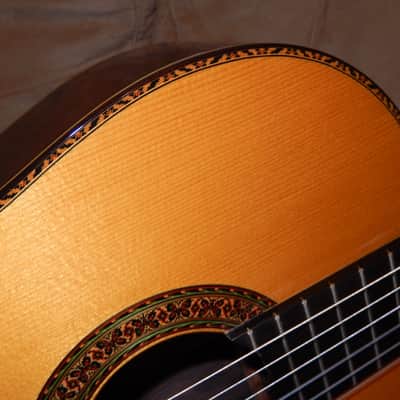
Besides these imprints behind the bridge (obscured by currently installed amber beads) one may find only few microscopic imperfections on the top of this guitar. They are truly very small and very hard to notice at first glance (see pictures 11 & 12).
This model is very rare collectible item. It is also a great instrument to play, especially since so well matured spruce top produces pretty loud and sweet sound, comparable to much more expensive guitars made by famous Spanish luthiers. It is the loudest guitar that I have ever experienced.
In terms of the sound quality this guitar simply leaves behind all other Japanese made classical guitars that I have experienced. Masaru Kohno model #30 made in 1976 (top of the line at that time) is no match for this Yamaha GC30A.
It is definitely one of those guitars with “replacement value” much higher than its retail price at any moment in time. Today 40 years later, this guitar naturally represents also quite a bit of historical value.
Guitar is equipped with Original Luxurious Yamaha Hard Shell Case in excellent condition.
Current action is set to 3.50 mm under E6 and 2.80 mm under E1 and this is practically the lowest the action can go.
SPECIFICATIONS:
SPECIFICATIONS:
GC30A
No Model Entered...
Year(s) Sold:
1974-85
Original MSRP(US$):
$3440.00
Top:
Solid Ezo Spruce
Back / Sides:
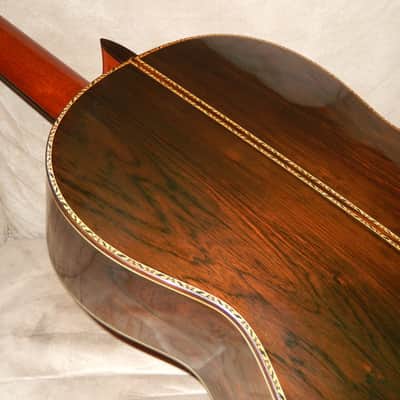
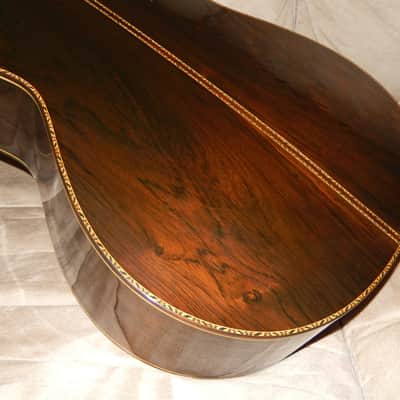
Solid Jacaranda
Neck:
Mahogany
Fingerboard:
Ebony
Bridge:
Jacaranda
Body Depth:
94-99mm
Finish:
Shellac/Lacquer
String Length:
660mm
Changed in 1979 to 650 mm
Nut Width:
52mm (62@12th fret)
Included Accessories:
HSC
Notes:
Hand Crafted
It is very important to mention (for those who pretend to be born yesterday) that purchase power of $1000 in 1975 equals to purchase power of $4000 today.
SPECIFICATIONS: GC70 No Model Entered...Year(s) Sold:1985-2005Original MSRP(US$):$11995.00
Top:Solid German Spruce
Back / Sides:Solid Jacaranda
Neck:Mahogany
Fingerboard:Ebony
Bridge:Jacaranda
Body Depth:94-99mm
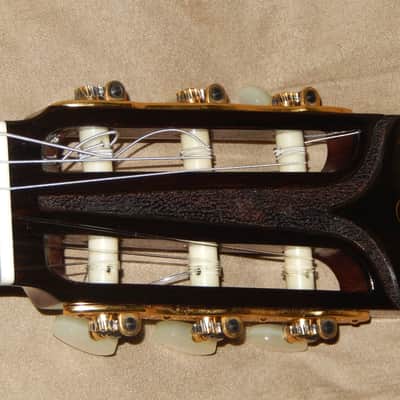
Color(s):Natural Finish:Shellac Tuners:YTM-81 (Gold) String Length:650mm Nut Width:52.5mm (62@12th fret) Included Accessories:HSC
Notes:Custom
Some other important info:
Real Value of Japanese Vintage Guitars
The key to understand value of vintage Japanese guitars is to acknowledge galloping devaluation of Japanese yen in 1960s & 1970s. This devaluation was somewhat slower in 1980s. The best measure of this devaluation is Starting Yearly Salary of Japanese College Graduate (SYSJCG).
SYSJCG in 1965 was 19 600 yen, in 1969 – 34 600 yen, in 1970 39 200 yen, in 1972 – 62 300 yen, in 1975 79 200 yen, in 1977 121 200 and in 1980 - 163 000 yen.
During 1960s and most of 1970s model numbers of Japanese guitars were strictly interconnected with their prices in Japanese yen. In late 1970s and during following decades model numbers were no longer strictly associated with their prices. Many Japanese guitar makers introduced model names instead of model numbers. Others were still using model numbers with addition of letter abbreviations or other symbols.
The best and only logical approach while evaluating real value (real grade) of vintage Japanese guitar is to compare its price in Japanese yen with SYSJCG during the year guitar was made.
Any guitar priced 100 000 in 1970 (labelled usually as No10) would be priced 200 000 yen in 1975 (relabeled to No20 or 2000), 300 000 yen in 1977 (labelled as No3, No30 or 3000). Starting in 1977 Masaru Kohno introduced his model No50 priced at 500 000 (skipping theoretical model 40). Soon other famous Japanese luthiers did the same. By 1983 Kohno started using model names instead numbers and was raising their prices as he was pleased. Naturally soon other Master luthiers did the same.
Knowing all of that, you can bet on that Masaru Kohno No50 made in 1982 is practically the same quality as Kohno No15 made in 1972, or Kohno no20 made in 1975 or Kohno No30 made in 1977. I know it for a fact.
The lowest grade models currently made by Matsuoka workshop are M75 and MH75. They are commonly considered as “beginner guitars”. Matsuoka model M30 made in 1973 is simply far, far better instrument. It is naturally better than model M50 made in 1977, model 80 made in 1982 or model M100 made in 1990. At present, the highest grade Matsuoka models are M300 and MH300. They absolutely stand no chance in competition with model M150 made in 1975… or model M200 made in 1977.
It is very important to mention that if modern era luthiers are using 40 years old woods to make a classical guitar, its price is at least $8000.
Dalbergia nigra From Wikipedia, the free encyclopedia (Redirected from )
Not to be confused with , which is also known as "Brazilian rosewood". Dalbergia nigraA cut made of Dalbergia nigra.
() Kingdom:(unranked):(unranked):(unranked):Order:Family:Genus:Species:D. nigraDalbergia nigra
Allem. ex Benth.
Dalbergia nigra, commonly known as the Bahia Rosewood, Jacarandá da Bahia, Brazilian Rosewood, Rio Rosewood,Jacarandá De Brasil, Pianowood, Caviuna, or Obuina, is a species of in the family.
Brazilian Rosewood, also called Jacaranda de Brasil includes several subspecies and varieties of trees that produce very high density wood, known for its superb tonal properties. Plates of wood cut from Jacaranda trees can have different looks, from colorful wavy or blotchy patterns to straight grain patterns, from very dark ones to lighter in color. Due to the 1968 ban on harvesting Jacaranda in the Jungles of Amazon, many other “not-banned” tree species (like Honduran Rosewood) producing wood of similar tonal properties were identified and used in guitar making. These trees (woods) are commonly called New Jacaranda or Latin America Rosewood. Currently these Amazonian woods are also quite hard to acquire and became very expensive. Therefore luthiers around the world are making their top models using Madagascar Rosewood, known to have very similar to Jacaranda tonal properties. Guitars made with Brazilian Rosewood are super-expensive, easily reaching $10 000 - 20 000 level.
Guitar Salon International (Santa Monica, CA) sells Masaki Sakurai Model PC & Sakurai Maestro RF for $9,500. GSI sells Sakurai-Kohno Professional J model for $6500.00, which in Japan is priced 460 000 yen. KOHNO MAESTRO model in Japan is priced 1 200 000 yen. You can estimate yourself what would be the price of this model at GSI. Not long ago top Yamaha model GC82 with Brazilian Rosewood b/s was priced 1 800 000 yen. Today Yamaha GC82 with Madagascar Rosewood b/s is retailed at $9.999 in US and about $12,500 in Europe.
Prices for similar quality guitars made by Spanish or other well known European luthiers reach much higher level. AT GSI this is very often $18,000+.
Returns
If you are not happy with your purchase you may return the guitar for a full refund. The cost of return shipping will not be refunded.
All you need to do is to:
1. Notify me within 5 days after delivery
2. Pack guitar the same way I do it, using the same box and materials
3. Ship it back to me within next 2 days
Another words I expect this “trail” period to occur within +/- 7 days. Naturally guitar has to be returned in the same condition as I ship it to you. This is simply honest offer for honest buyers. My goal is to make your purchase as risk free as possible. I know very well that spending $1000 of hard earned money is not emotionally easy undertaking for majority of guitar lovers. I am sure that reading my feedback can ease a bit your “purchase anxiety” but it still will be there no matter how hard I try.
Victor
| Listed | 11 years ago |
|---|---|
| Condition | Excellent (Used) Excellent items are almost entirely free from blemishes and other visual defects and have been played or used with the utmost care.Learn more |
| Brand | |
| Model |
|
| Finish |
|
| Categories | |
| Year |
|
| Made In |
|
| Body Shape |
|
Product safety information may be available here.