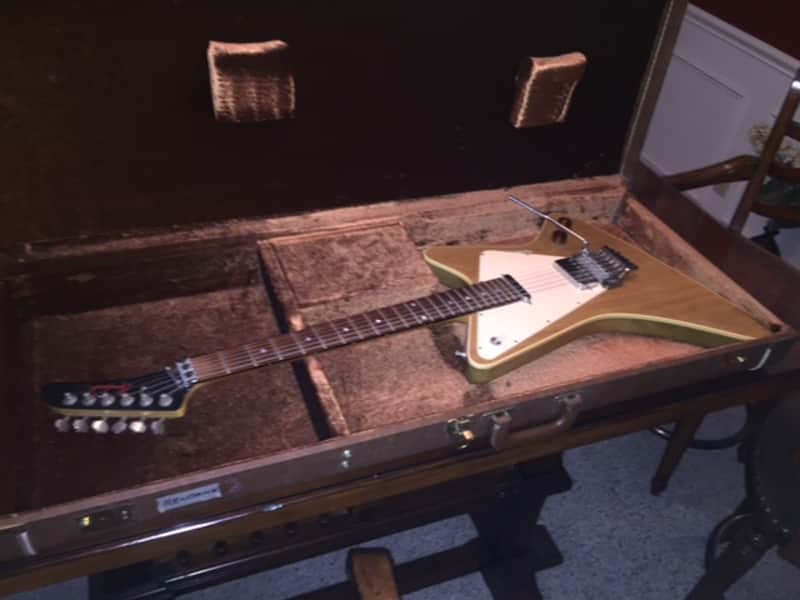
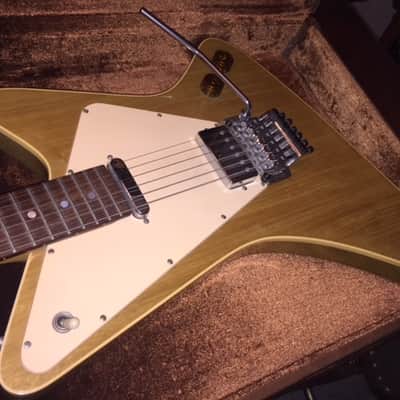
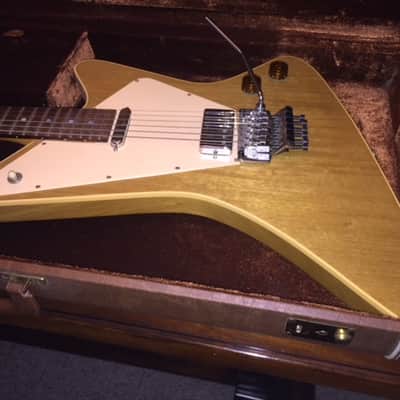
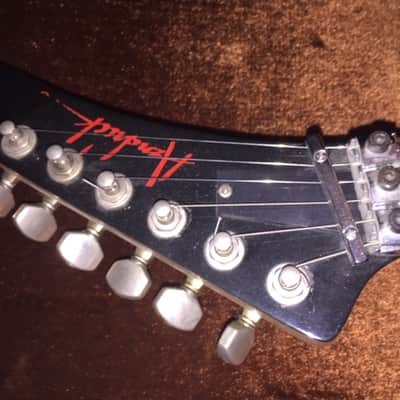
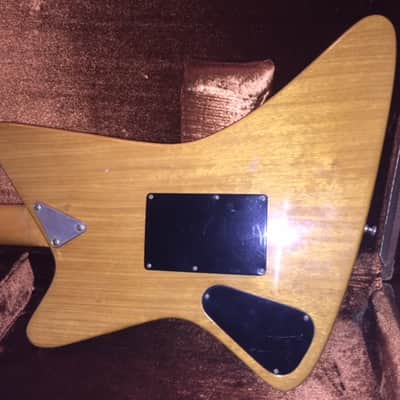
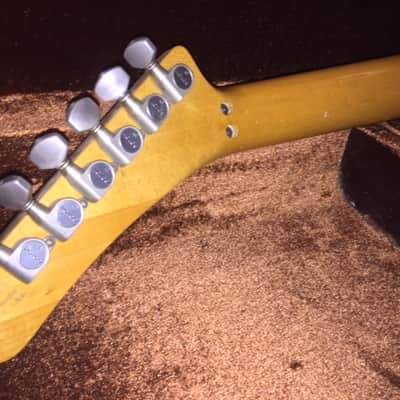
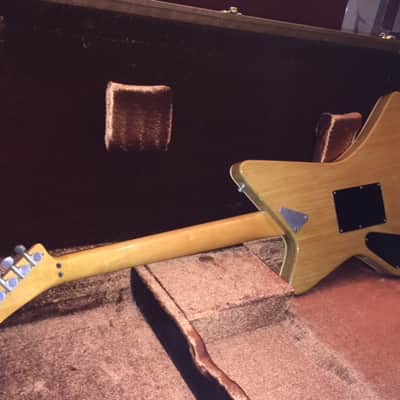
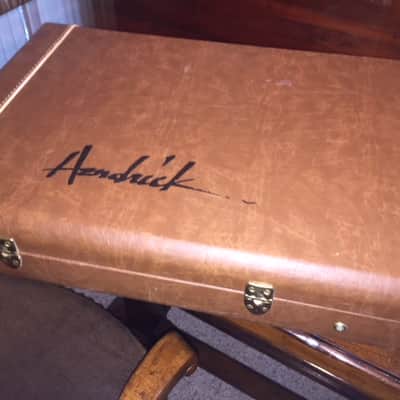
Hendrick Generator 1993? Aged Natural Gloss
Price€3,301.60
+ Shipping
This listing has ended
See similar gear from other Reverb sellers
Listed:8 years ago
Views:465
Saves:12
Offers:0
Hudson, OH, United States
Serial #A001, Korina Body, Rare Hendrick.
Includes the hard shell case.
Learn a little more about the Hendrick guitar below:
Kurt Hendrick built his first guitar in 1982 for Billy Gibbons of ZZ Top. His three main designs, the Generator, Transformer, and Catalyst, are hardly based on any standard design. Hendrick used odd shaped in the body design of his guitars and because of this he built a large following. Many of the early guitars were actually produced in Kalamazoo, MI by the same people that started the Heritage Guitar Company. Less than one hundred instruments were produced during this tenure with the Generator as the only model going into full production status.
One of the most enigmatic brands in the recent history of American guitars was Hendrick, the funky solidbody electrics created by designer Kurt Hendrick. • The son of an aerospace engineer, Hendrick grew up in the 1960s near the National Aeronautics and Space Administration’s Space Center Houston (when it was called the Manned Spacecraft Center) and studied at the Roberto-Venn School of Luthiery. He quit halfway through the course, choosing instead to work at the Apprentice Shop in Tennessee before becoming an instrument repairman with Houston retailer Rockin’ Robin in the early 1980s, about the time the store began importing guitars bearing the Robin brand name. Since that time, he has literally traveled the world while working for various manufacturers.
Things recently came full circle for him, though, when he returned to Houston and began working with Alamo Music Products, which now makes Robin guitars (see this month’s “Bass Space” for a profile on the Robin Ranger).
The veteran designer/builder recently imparted the details on the brand that bears his name and was inspired by (and created with the input of) ZZ Top co-founder Billy F Gibbons, and its best-known model, the Generator.
“I drew from a lot of influences, including NASA and ‘I Dream of Jeannie’ stuff, Vegas ‘shapes’… but Billy took me over the edge!” said Hendrick. “And it wasn’t really his sense of design – he could take any shape, put double binding on it, have it hand-made, and it would look cool. But he opened my eyes to the fact that anything was possible and that I had the ability to design guitars.”
The first guitar Hendrick made went to Gibbons in the summer of 1982, while the second went to Willie Nelson.
“All of a sudden, I was selling guitars to famous people,” he said. “I was in my early 20s, making guitars in my garage, and while it was nice to spend the day working at my own pace, I started missing the interaction with people. Today, at 48, working alone is cool, but at 22 it was pretty lonely! I just wasn’t ready to settle down and be a little old guitar maker. Plus, I liked the idea and dynamics of production – big or small. And it seemed like all the guys I was selling to were very wealthy, while I was driving around on just two wheels. So (going into production) seemed like the logical progression.” Hendrick in the ’80s withf guitars made for Billy F Gibbons.
Hendrick designed three body silhouettes – the Generator, the more traditional-looking Transformer, and the tailfin-equipped Catalyst – in, as it turns out, three different states.
Hendrick then sent his tools to Kalamazoo, where he had a number of instruments made by the folks who later started what would become the Heritage company.
“They needed something to cut their teeth on,” he recalled. “They were good guys, and they could probably see my inexperience – I was 24 years old. Then they got their wheels going, while I was hanging on by a shoestring and didn’t have enough to continue it by myself. The Hendrick guitars from Kalamazoo were made entirely there, and anything with Schaller hardware was made in Kalamazoo.”
Some Hendrick necks were supplied by ESP and were unusual in that they were bolt-on mahogany.
“You can always tell those because they were laminated a hundred different ways,” he observed. “It looked like they were making an acoustic neck, then turned it into an Explorer neck and slapped a Fender-scale fingerboard on it. But the guys at Heritage had an original Explorer tooling kit somewhere.”
The visual aspects of Hendrick guitars were certainly attention-getting. “It wasn’t really cowboy, it wasn’t rock and roll. It was definitely its own flavor, but I think you could see maturity in those later guitars, as well. The Generator was the one I was really proud of. Gibson had gotten away from thick binding, but companies like Hamer and Dean were into it.
“A lot of it came back to my experience at Rockin’ Robin – seeing an old-school guitar and trying to revitalize it.”
Two-pickup Hendricks usually had a single-coil pickup in the neck position and a humbucker in the bridge; Hendrick’s explanation was succinct: “It just looked cool.” Individual examples of bizarre “Curved” versions of the three Hendrick models were also made. It was an arduous process bending the bodies, especially in the days before CNC machines. And Hendrick never made a production bass, but said, “I made a Generator-shaped bass for (ZZ Top bassist) Dusty Hill that (LEFT) The lineup of Hendrick models included, front to back, left to right: Transformer Standard In addition to the publicity afforded to Hendrick by Gibbons, instruments also showed up in the hands of a number of famous players in the ’80s, including Stevie Ray Vaughan, Ted Nugent, Aerosmith guitarists Brad Whitford and Joe Perry, the Scorpions’ Rudolph Schenker, and Dez Dickerson with Prince’s band. “We could have stayed busy selling just to those people,” he recalls.
Today, Hendrick readily acknowledges that his inexperience led to his guitars’ ultimate flash-in-the-pan status – less than 100 were built and the only three curved guitars made were those shown in his one and only catalog.
“The only ones the Heritage folks made was the Generator,” he detailed. “We never got that far with the other models.”
Includes the hard shell case.
Learn a little more about the Hendrick guitar below:
Kurt Hendrick built his first guitar in 1982 for Billy Gibbons of ZZ Top. His three main designs, the Generator, Transformer, and Catalyst, are hardly based on any standard design. Hendrick used odd shaped in the body design of his guitars and because of this he built a large following. Many of the early guitars were actually produced in Kalamazoo, MI by the same people that started the Heritage Guitar Company. Less than one hundred instruments were produced during this tenure with the Generator as the only model going into full production status.
One of the most enigmatic brands in the recent history of American guitars was Hendrick, the funky solidbody electrics created by designer Kurt Hendrick. • The son of an aerospace engineer, Hendrick grew up in the 1960s near the National Aeronautics and Space Administration’s Space Center Houston (when it was called the Manned Spacecraft Center) and studied at the Roberto-Venn School of Luthiery. He quit halfway through the course, choosing instead to work at the Apprentice Shop in Tennessee before becoming an instrument repairman with Houston retailer Rockin’ Robin in the early 1980s, about the time the store began importing guitars bearing the Robin brand name. Since that time, he has literally traveled the world while working for various manufacturers.
Things recently came full circle for him, though, when he returned to Houston and began working with Alamo Music Products, which now makes Robin guitars (see this month’s “Bass Space” for a profile on the Robin Ranger).
The veteran designer/builder recently imparted the details on the brand that bears his name and was inspired by (and created with the input of) ZZ Top co-founder Billy F Gibbons, and its best-known model, the Generator.
“I drew from a lot of influences, including NASA and ‘I Dream of Jeannie’ stuff, Vegas ‘shapes’… but Billy took me over the edge!” said Hendrick. “And it wasn’t really his sense of design – he could take any shape, put double binding on it, have it hand-made, and it would look cool. But he opened my eyes to the fact that anything was possible and that I had the ability to design guitars.”
The first guitar Hendrick made went to Gibbons in the summer of 1982, while the second went to Willie Nelson.
“All of a sudden, I was selling guitars to famous people,” he said. “I was in my early 20s, making guitars in my garage, and while it was nice to spend the day working at my own pace, I started missing the interaction with people. Today, at 48, working alone is cool, but at 22 it was pretty lonely! I just wasn’t ready to settle down and be a little old guitar maker. Plus, I liked the idea and dynamics of production – big or small. And it seemed like all the guys I was selling to were very wealthy, while I was driving around on just two wheels. So (going into production) seemed like the logical progression.” Hendrick in the ’80s withf guitars made for Billy F Gibbons.
Hendrick designed three body silhouettes – the Generator, the more traditional-looking Transformer, and the tailfin-equipped Catalyst – in, as it turns out, three different states.
Hendrick then sent his tools to Kalamazoo, where he had a number of instruments made by the folks who later started what would become the Heritage company.
“They needed something to cut their teeth on,” he recalled. “They were good guys, and they could probably see my inexperience – I was 24 years old. Then they got their wheels going, while I was hanging on by a shoestring and didn’t have enough to continue it by myself. The Hendrick guitars from Kalamazoo were made entirely there, and anything with Schaller hardware was made in Kalamazoo.”
Some Hendrick necks were supplied by ESP and were unusual in that they were bolt-on mahogany.
“You can always tell those because they were laminated a hundred different ways,” he observed. “It looked like they were making an acoustic neck, then turned it into an Explorer neck and slapped a Fender-scale fingerboard on it. But the guys at Heritage had an original Explorer tooling kit somewhere.”
The visual aspects of Hendrick guitars were certainly attention-getting. “It wasn’t really cowboy, it wasn’t rock and roll. It was definitely its own flavor, but I think you could see maturity in those later guitars, as well. The Generator was the one I was really proud of. Gibson had gotten away from thick binding, but companies like Hamer and Dean were into it.
“A lot of it came back to my experience at Rockin’ Robin – seeing an old-school guitar and trying to revitalize it.”
Two-pickup Hendricks usually had a single-coil pickup in the neck position and a humbucker in the bridge; Hendrick’s explanation was succinct: “It just looked cool.” Individual examples of bizarre “Curved” versions of the three Hendrick models were also made. It was an arduous process bending the bodies, especially in the days before CNC machines. And Hendrick never made a production bass, but said, “I made a Generator-shaped bass for (ZZ Top bassist) Dusty Hill that (LEFT) The lineup of Hendrick models included, front to back, left to right: Transformer Standard In addition to the publicity afforded to Hendrick by Gibbons, instruments also showed up in the hands of a number of famous players in the ’80s, including Stevie Ray Vaughan, Ted Nugent, Aerosmith guitarists Brad Whitford and Joe Perry, the Scorpions’ Rudolph Schenker, and Dez Dickerson with Prince’s band. “We could have stayed busy selling just to those people,” he recalls.
Today, Hendrick readily acknowledges that his inexperience led to his guitars’ ultimate flash-in-the-pan status – less than 100 were built and the only three curved guitars made were those shown in his one and only catalog.
“The only ones the Heritage folks made was the Generator,” he detailed. “We never got that far with the other models.”
This item is sold As-Described
This item is sold As-Described and cannot be returned unless it arrives in a condition different from how it was described or photographed. Items must be returned in original, as-shipped condition with all original packaging.Learn More.
| Listed | 8 years ago |
|---|---|
| Condition | Very Good (Used) Very Good items may show a few slight marks or scratches but are fully functional and in overall great shape.Learn more |
| Brand | |
| Model |
|
| Finish |
|
| Categories | |
| Year |
|
| Made In |
|
| Body Type |
|
Product safety information may be available here.