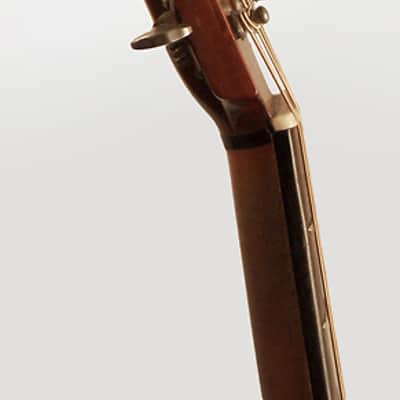
Wilkanowski Arch Top Acoustic Guitar c.1938
PriceR$121,872.42
+ Shipping
This listing has ended
See similar gear from other Reverb sellers
Listed:11 years ago
Views:324
Saves:7
Offers:0

Brooklyn, NY, United States
Our users rate Reverb
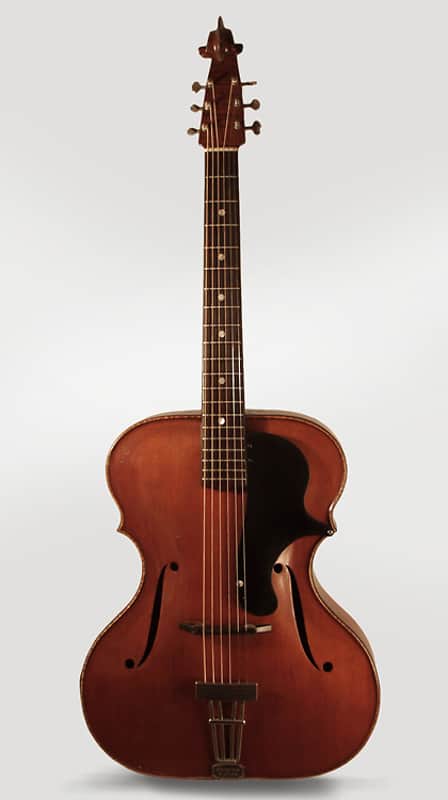
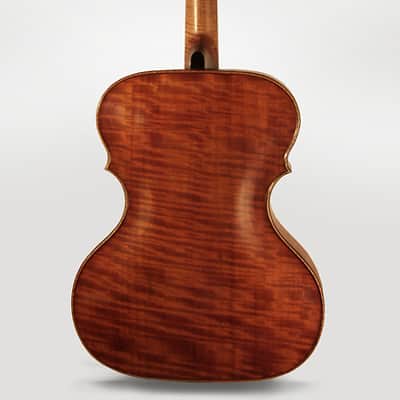
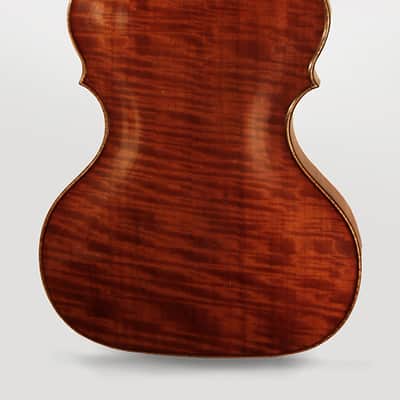
Wilkanowski Arch Top Acoustic Guitar, c. 1938, made in Brooklyn, NY, shaded varnish finish, Lombardy poplar back and sides, spruce top, maple neck with ebony fingerboard, black hard shell case.
This striking guitar is one of the most interesting and unusual American guitars arch-tops created, and a true (if eccentric) classic of the 1930's Deco era. Willi Wilkanowski was a well-known and quite successful Brooklyn violin builder who beginning around 1937 began crafting a very limited number of these unique and striking guitars. No paper or catalog references to Wilkanowski guitars have ever surfaced and they were almost certainly offered only for sale locally in the New York area. While the guitar superficially resembles a small 'cello with a six-string neck, all the forms and design elements are unique to the specific instrument. Only a handful of these guitars are known to exist, and few appear exactly alike. This particular guitar is nearly identical to other examples we have had that were hand dated to 1937-8 is typical of the earliest known style of Wilkanowski.
Willi Wilkanowski was born in Poland in 1886, and was a full-fledged violin maker by the age of 17. After coming to the United States in the early 20th century he built violins sold not only by himself but large concerns like the Ditson Company of Boston and New York, and then the Fred Gretsch Company in Brooklyn. A 1940 Gretsch Jobber Catalog offers Wilkanowski Artist Model violins priced from $50-$150 described as "his own personal work…no other hand touches them." While some sources claim Wilkanowski worked in Boston during the 1920's and early 1930's, he was listed as a violin maker and seller in Brooklyn well before 1933, and anecdotal evidence suggests that the shop was at that location since the 1920's. The 1942 book "KNOWN VIOLIN MAKERS" by John H. Fairfield estimates his production to that point as being 5000 violins and 100 violas, which would be prodigious for an individual or even a small workshop. At some point in the late 1930's, Wilkanowski became interested in the guitar either on his own or thru a customer request and from his violinmaker's perspective approached guitar design in a most unorthodox way.
Wilkanowski's guitars all seem to date from between 1937 and 1941. Some bear labels and some do not, and only some carry hand-applied dates. A few are labeled "Wilkanowski and Son" but what role Willi's son may have played in the making or marketing of the guitars is unknown; no known violins are so labeled. Like this example, most of the guitars carry no apparent serial number. Wilkanowski's family did not continue his instrument building after the father's death in 1954. It is possible that the guitar business was intended to be a separate entity perhaps run by his son or sons, but either it did not prosper or may have been discontinued due to the upheavals of the Second World War.
All Wilkanowski guitars are built to the same general shape and size, but variations include headstock shape, presence or absence of a logo, fingerboard inlay, top ornamentation, soundhole shape, types of tuners and hardware, and exact style and body width. Some of the later guitars carry the name "AIRWAY" and/or a stylized letter "W" on the headstock, which changes from the cast scroll sometime before 1940. Wilkanowski's guitars seem to go thru a rapid evolution of features in a short time, as is typical with completely handmade instruments. Whether these variations resulted from customer input or the builder's ongoung experiments remains unknown. The same published 1942 estimates mention 30 guitars as having been made to that point, selling for $400 each, and no evidence suggests any were built after that. Whether Wilkanowski examined contemporary guitars from Gibson or his fellow New York builders Epiphone and D'Angelico is unknown, but he must have been aware of these archtop instruments and gotten some general ideas from them. Certainly the quoted price reflects that he felt his guitars carried a value equal to a Gibson Super 400 or D'Angelico New Yorker! It is also unknown as to whether he had any input into or was influenced by Gretch's Synchromatic line, which was being designed and launched around 1939. He obviously had extensive business dealings with Gretsch at the time, and some design elements (notably the cat-s eye soundholes found on later Wilkanowskis) show some soer of cross-pollination.
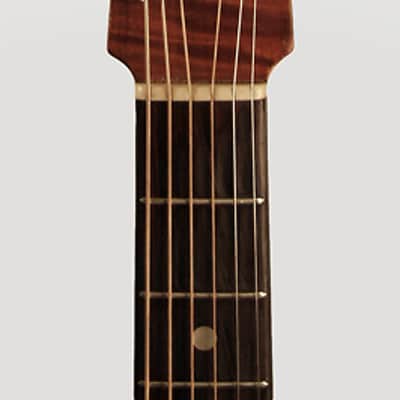
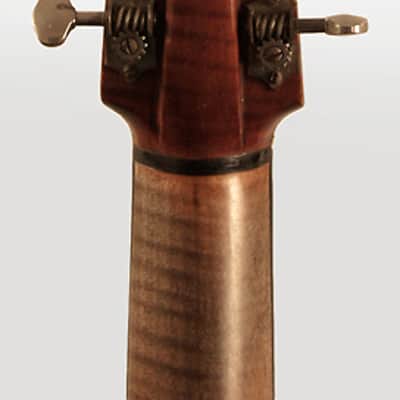
This particular Wilkanowski guitar is both visually fabulous and extremely well preserved. It features an aluminum scroll at the top of the headstock painted in faux wood grain which was used only on the early model guitars. The paint on this piece is carefully matched and blended into the curly maple headstock both front and back. Later Wilkanowskis carry a flattened oval headstock crown not unlike the familiar 1960-70's Ovation design. The headstock itself has a pronounced rounded spine on the back, with the tuners recessed into either side. The neck has a rounded "V" contour and the back is unstained and lightly sealed, in the violin builder's manner. The dark rosewood fingerboard is ebony bound with a bone nut and has large pearl dot inlays, with a gentle point at that body end.
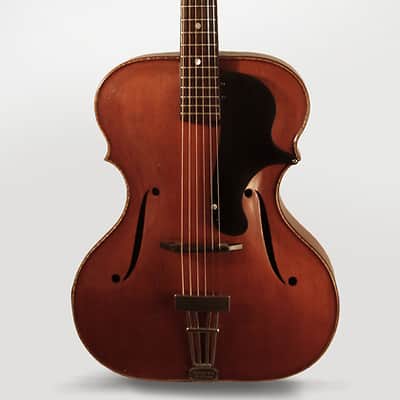
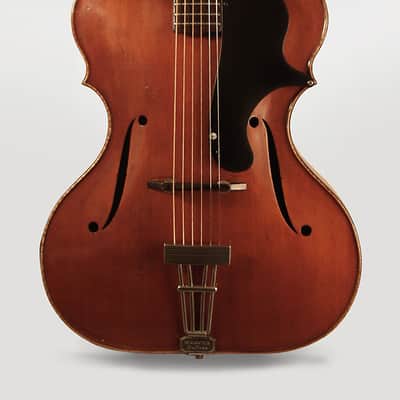
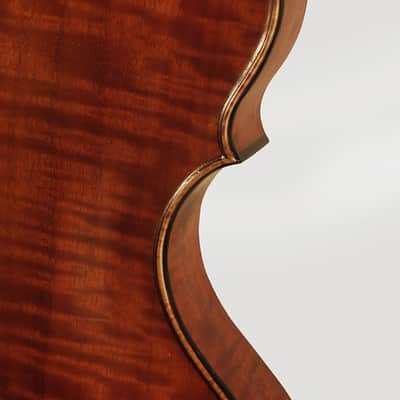
The body is in the standard Wilkanowski pattern, with cello-like points where the upper bout slopes down towards the waist. The "F" holes are segmented somewhat like early Epiphones but otherwise violin styled. The top is very fine-grained spruce, the back has a very dramatic flamed pattern and both are very highly arched. Top and back are multibound in contrasting wood with a thick strip of flamed lighter wood in the center, shaped into a distinctive edge curve. The pickguard is black composite, attached to the neck by a wooden fairing and pinned at the lower bout point by a screw and spacer. The elaborate bridge is hand carved from vividly figured rosewood with a two-foot bass, metal adjustment wheels and the wooden saddle has a sloped ridge on top for compensation. The tailpiece and tuners are Grover products typically used of New York made guitars of this era, the tailpiece is engraved "Grover Deluxe" and is very similar to a model often used by Gretsch.
In some ways this guitar has a very modern design aesthetic, foretelling later developments in archtop guitar design. All bindings are wood, unlike virtually all other top line guitars of the era which were swathed in layers of plastic binding and pearl ornamentation. The instrument exudes a "classical" sort of style, with the beauty of the tonewoods allowed to be the primary attraction. While very unlike the Gibsons, Strombergs and D'Angelicos of the 1940's, this relative austerity prefigures the direction archtop guitar design has taken since the 1960's. Later Wilkanowskis have wooden tailpieces and even pickguards, further prefiguring much more recent designs. The sound of this guitar is well rounded and quite loud, and it projects extremely well.
We are quite pleased to offer this exceptionally rare guitar for sale from its original home of Brooklyn NY, where Wilkanowski built the instruments he is remembered for.
Overall length is 41 in. (104.1 cm.), 16 1/16 in. (40.8 cm.) wide at lower bout, and 3 1/8 in. (7.9 cm.) in depth, measured at side of rim. Scale length is 24 3/4 in. (629 mm.). Width of nut is 1 3/4 in. (44 mm.). This guitar remains largely original and unaltered, with some general signs of play wear but no major repairs or modifications. There is overall finish wear, with small scratches, scuffs and dings into the varnish but no areas of serious loss. There are marks in the varnish on the top where the bridge stood to far forward for some time; Wilkanowski actually appears to heve habitually fit his bridges before the varnish on the top was fully dry, as most we have seen show evidence of the feet having stuck to the top! The wood-grained aluminum scroll shows some paint loss down to the bare metal on the edges. The original composite pickguard shows some mottling to the top surface but is completely intact; the mounting block by the neck has been replaced by a plain block of wood that is functional if not as elegant as it might be. Two of the Grover Sta-Tite tuners are the correct style but appear to date to the 1960's instead of the 1930's; it's likely they were substituted at some later point when the originals failed or were damaged. At the moment the frets are original with some moderate wear; the guitar is playable but there is a rise to the fingerboard above the 12th fret that is typical of many of these which causes some string buzz on the highest notes. In the interest of retaining this rarely-found guitar in its largely original state we have elected to leave correction of this at the discretion of the next owner-we will be happy to perform a fingerboard true and full or partial refret if the purchaser requests it. As it stands, this instrument still has a very strong sound with a lot of character-we'd rate it as the best example of this style Wilkanowski we have had, with more warmth and midrange response than some. Excellent - Condition.
#6869
This striking guitar is one of the most interesting and unusual American guitars arch-tops created, and a true (if eccentric) classic of the 1930's Deco era. Willi Wilkanowski was a well-known and quite successful Brooklyn violin builder who beginning around 1937 began crafting a very limited number of these unique and striking guitars. No paper or catalog references to Wilkanowski guitars have ever surfaced and they were almost certainly offered only for sale locally in the New York area. While the guitar superficially resembles a small 'cello with a six-string neck, all the forms and design elements are unique to the specific instrument. Only a handful of these guitars are known to exist, and few appear exactly alike. This particular guitar is nearly identical to other examples we have had that were hand dated to 1937-8 is typical of the earliest known style of Wilkanowski.
Willi Wilkanowski was born in Poland in 1886, and was a full-fledged violin maker by the age of 17. After coming to the United States in the early 20th century he built violins sold not only by himself but large concerns like the Ditson Company of Boston and New York, and then the Fred Gretsch Company in Brooklyn. A 1940 Gretsch Jobber Catalog offers Wilkanowski Artist Model violins priced from $50-$150 described as "his own personal work…no other hand touches them." While some sources claim Wilkanowski worked in Boston during the 1920's and early 1930's, he was listed as a violin maker and seller in Brooklyn well before 1933, and anecdotal evidence suggests that the shop was at that location since the 1920's. The 1942 book "KNOWN VIOLIN MAKERS" by John H. Fairfield estimates his production to that point as being 5000 violins and 100 violas, which would be prodigious for an individual or even a small workshop. At some point in the late 1930's, Wilkanowski became interested in the guitar either on his own or thru a customer request and from his violinmaker's perspective approached guitar design in a most unorthodox way.
Wilkanowski's guitars all seem to date from between 1937 and 1941. Some bear labels and some do not, and only some carry hand-applied dates. A few are labeled "Wilkanowski and Son" but what role Willi's son may have played in the making or marketing of the guitars is unknown; no known violins are so labeled. Like this example, most of the guitars carry no apparent serial number. Wilkanowski's family did not continue his instrument building after the father's death in 1954. It is possible that the guitar business was intended to be a separate entity perhaps run by his son or sons, but either it did not prosper or may have been discontinued due to the upheavals of the Second World War.
All Wilkanowski guitars are built to the same general shape and size, but variations include headstock shape, presence or absence of a logo, fingerboard inlay, top ornamentation, soundhole shape, types of tuners and hardware, and exact style and body width. Some of the later guitars carry the name "AIRWAY" and/or a stylized letter "W" on the headstock, which changes from the cast scroll sometime before 1940. Wilkanowski's guitars seem to go thru a rapid evolution of features in a short time, as is typical with completely handmade instruments. Whether these variations resulted from customer input or the builder's ongoung experiments remains unknown. The same published 1942 estimates mention 30 guitars as having been made to that point, selling for $400 each, and no evidence suggests any were built after that. Whether Wilkanowski examined contemporary guitars from Gibson or his fellow New York builders Epiphone and D'Angelico is unknown, but he must have been aware of these archtop instruments and gotten some general ideas from them. Certainly the quoted price reflects that he felt his guitars carried a value equal to a Gibson Super 400 or D'Angelico New Yorker! It is also unknown as to whether he had any input into or was influenced by Gretch's Synchromatic line, which was being designed and launched around 1939. He obviously had extensive business dealings with Gretsch at the time, and some design elements (notably the cat-s eye soundholes found on later Wilkanowskis) show some soer of cross-pollination.
This particular Wilkanowski guitar is both visually fabulous and extremely well preserved. It features an aluminum scroll at the top of the headstock painted in faux wood grain which was used only on the early model guitars. The paint on this piece is carefully matched and blended into the curly maple headstock both front and back. Later Wilkanowskis carry a flattened oval headstock crown not unlike the familiar 1960-70's Ovation design. The headstock itself has a pronounced rounded spine on the back, with the tuners recessed into either side. The neck has a rounded "V" contour and the back is unstained and lightly sealed, in the violin builder's manner. The dark rosewood fingerboard is ebony bound with a bone nut and has large pearl dot inlays, with a gentle point at that body end.
The body is in the standard Wilkanowski pattern, with cello-like points where the upper bout slopes down towards the waist. The "F" holes are segmented somewhat like early Epiphones but otherwise violin styled. The top is very fine-grained spruce, the back has a very dramatic flamed pattern and both are very highly arched. Top and back are multibound in contrasting wood with a thick strip of flamed lighter wood in the center, shaped into a distinctive edge curve. The pickguard is black composite, attached to the neck by a wooden fairing and pinned at the lower bout point by a screw and spacer. The elaborate bridge is hand carved from vividly figured rosewood with a two-foot bass, metal adjustment wheels and the wooden saddle has a sloped ridge on top for compensation. The tailpiece and tuners are Grover products typically used of New York made guitars of this era, the tailpiece is engraved "Grover Deluxe" and is very similar to a model often used by Gretsch.
In some ways this guitar has a very modern design aesthetic, foretelling later developments in archtop guitar design. All bindings are wood, unlike virtually all other top line guitars of the era which were swathed in layers of plastic binding and pearl ornamentation. The instrument exudes a "classical" sort of style, with the beauty of the tonewoods allowed to be the primary attraction. While very unlike the Gibsons, Strombergs and D'Angelicos of the 1940's, this relative austerity prefigures the direction archtop guitar design has taken since the 1960's. Later Wilkanowskis have wooden tailpieces and even pickguards, further prefiguring much more recent designs. The sound of this guitar is well rounded and quite loud, and it projects extremely well.
We are quite pleased to offer this exceptionally rare guitar for sale from its original home of Brooklyn NY, where Wilkanowski built the instruments he is remembered for.
Overall length is 41 in. (104.1 cm.), 16 1/16 in. (40.8 cm.) wide at lower bout, and 3 1/8 in. (7.9 cm.) in depth, measured at side of rim. Scale length is 24 3/4 in. (629 mm.). Width of nut is 1 3/4 in. (44 mm.). This guitar remains largely original and unaltered, with some general signs of play wear but no major repairs or modifications. There is overall finish wear, with small scratches, scuffs and dings into the varnish but no areas of serious loss. There are marks in the varnish on the top where the bridge stood to far forward for some time; Wilkanowski actually appears to heve habitually fit his bridges before the varnish on the top was fully dry, as most we have seen show evidence of the feet having stuck to the top! The wood-grained aluminum scroll shows some paint loss down to the bare metal on the edges. The original composite pickguard shows some mottling to the top surface but is completely intact; the mounting block by the neck has been replaced by a plain block of wood that is functional if not as elegant as it might be. Two of the Grover Sta-Tite tuners are the correct style but appear to date to the 1960's instead of the 1930's; it's likely they were substituted at some later point when the originals failed or were damaged. At the moment the frets are original with some moderate wear; the guitar is playable but there is a rise to the fingerboard above the 12th fret that is typical of many of these which causes some string buzz on the highest notes. In the interest of retaining this rarely-found guitar in its largely original state we have elected to leave correction of this at the discretion of the next owner-we will be happy to perform a fingerboard true and full or partial refret if the purchaser requests it. As it stands, this instrument still has a very strong sound with a lot of character-we'd rate it as the best example of this style Wilkanowski we have had, with more warmth and midrange response than some. Excellent - Condition.
#6869
| Listed | 11 years ago |
|---|---|
| Condition | Excellent (Used) Excellent items are almost entirely free from blemishes and other visual defects and have been played or used with the utmost care.Learn more |
| Brand | |
| Model |
|
| Finish |
|
| Categories | |
| Year |
|
| Made In |
|
| Body Shape |
|
Product safety information may be available here.