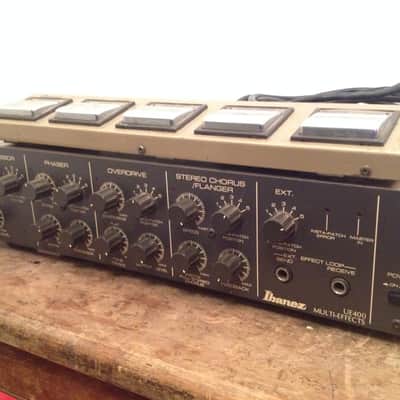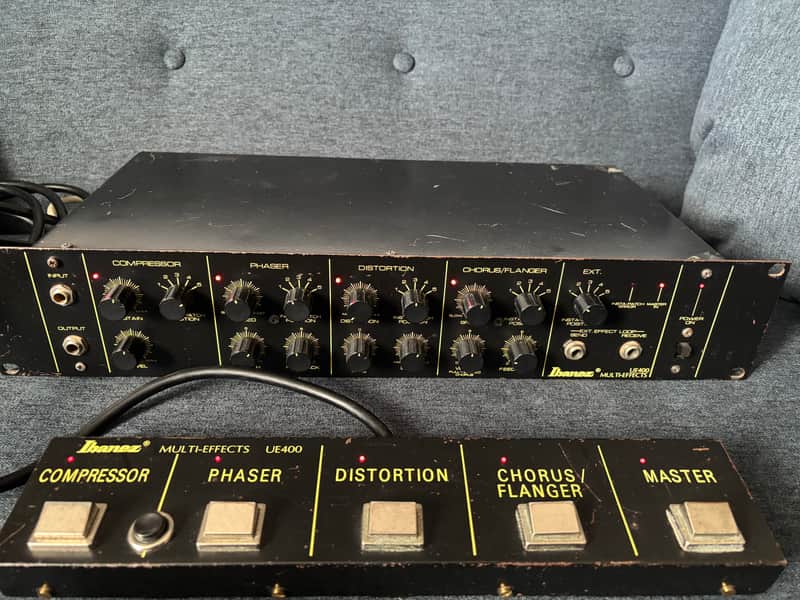
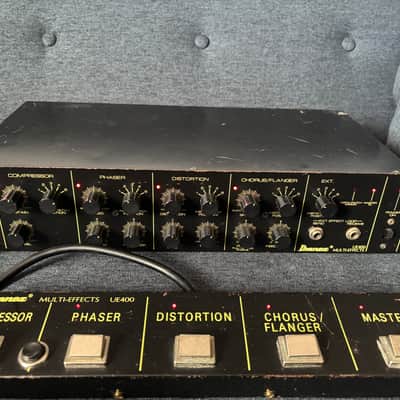
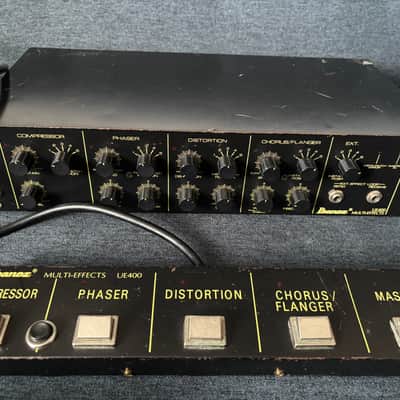
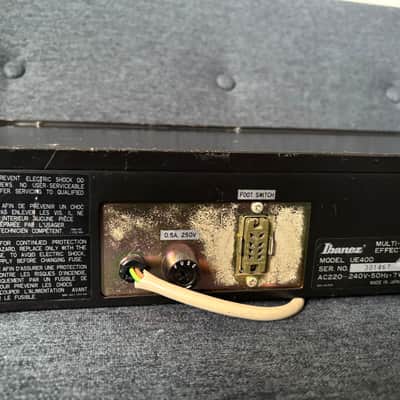
Ibanez UE400 Multi-Effects Rack with Foot Controller 1980s - Black


Great Value
Our users rate Reverb
Specs :
Compressor
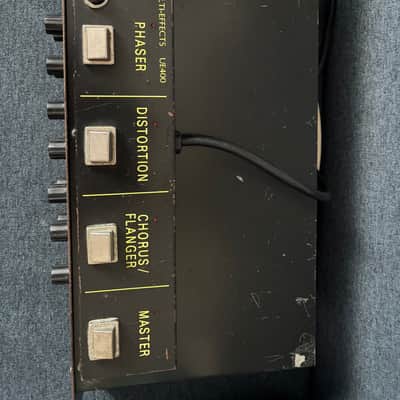
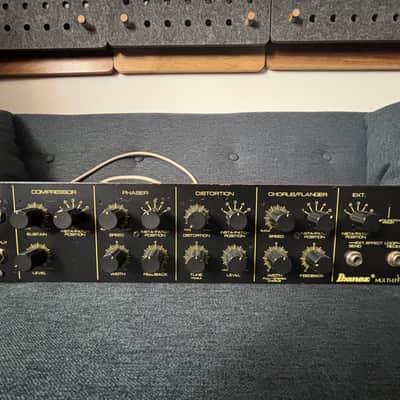
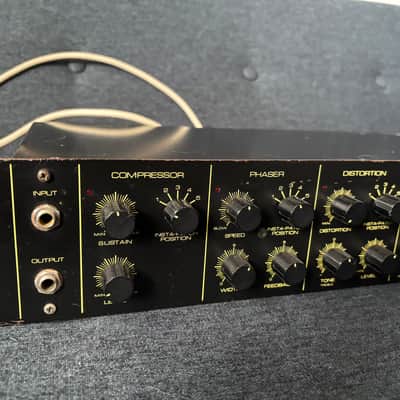
This has two controls: output level and sustain level. The insta-patch control may be taken as read from now on since it is present on each module. The output level may be used to set the signal level as high as possible to the rest of the circuit to ensure that noise is minimised. This, of course, presupposes that the compressor is placed at the start of the chain. The sustain control sets the compression ratio, with low settings causing very little compression and allowing the signal to pass more or less unchanged. Sadly, the two controls interact and increasing the sustain level also increases the output level, making setting up just slightly more involved. Compression range is quoted as 40dB. The added button is to turn on/off compressor. The original button doesn’t work properly. It was already done when I bought it.
Phaser
It is slightly curious (though very welcome) that both a phaser and a flanger are included in the same unit since the two effects are essentially similar. The phaser features the usual controls - speed, feedback (or depth) and width.
A wide range of effects may be generated, ranging from typical high quality phasing through to the characteristic poor imitation of a rotating speaker. This is obviously a good example of a phaser: it features eight phase shift networks and for my money outperforms most of the phasing effects available from DDLs.
Distortion
The distortion is extremely flexible, with controls to set overdrive level (the actual harshness of the sound), tone, and output level (to bring the signal level back into line with that of the input). In addition, if the overdrive is placed immediately after the compressor, a judicious tweak of the compressor output level can add a bit of muscle to the effect. After all, who's going to worry about distortion setting in?
The module can produce a useful range of effects varying from soft, gentle colouration to full, power-driving heavy-metal, and for a transistor unit the results really are quite respectable. The module is best used in conjunction with the compressor to get a more professional sound; the two effects complement each other well.
Stereo Chorus/Flanger
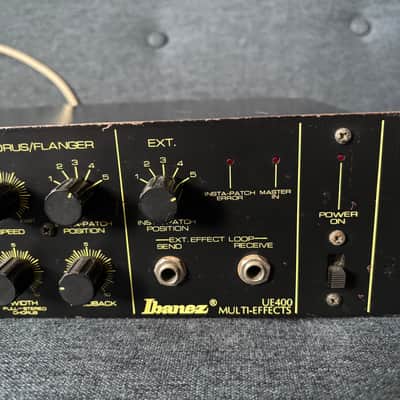
Obviously the most flexible of the modules, this features the same controls as the phaser with the addition of a switch (operated by pulling the width pot) to switch from flanging to chorus, since only one or the other is available at any one time.
The flanger ranks alongside DDL flangers in terms of quality and character and offers delay times from 1.46ms to 12.8ms, which is comparable to its digital brethren.
The chorus may be operated in one of two modes. If the main output alone is used a standard mono chorus reminiscent of a 12-string effect is obtained. However, if the stereo chorus output is used as well, an anti-phase, pseudostereo image is produced if the two channels are amplified separately. The results are very reasonable and thicken up a signal (especially a guitar) immensely
This item is sold As-Described
This item is sold As-Described and cannot be returned unless it arrives in a condition different from how it was described or photographed. Items must be returned in original, as-shipped condition with all original packaging.Learn More.
| Listed | a month ago |
|---|---|
| Condition | Very Good (Used) Very Good items may show a few slight marks or scratches but are fully functional and in overall great shape.Learn more |
| Brand | |
| Model |
|
| Finish |
|
| Categories | |
| Year |
|
| Pedal Format |
|
Product safety information may be available here.