Hayward, CA, United States
About this listing
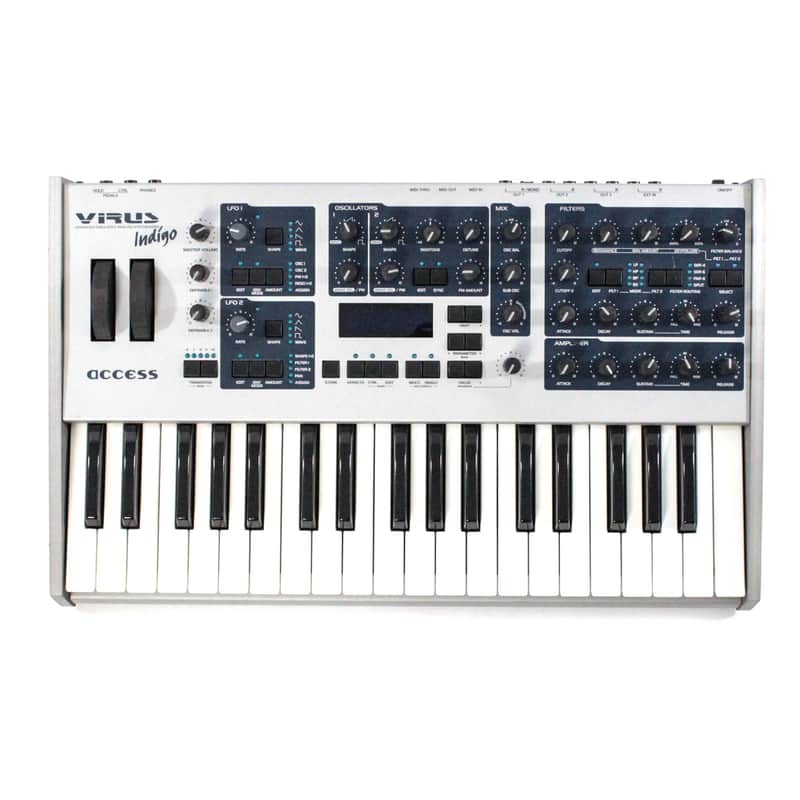
The Virus Indigo Keyboard sounds amazing and all controls have an excellent feel.There are cosmetic imperfections: scuffs and yellowing on the keys - see pictures. The cutoff knob feels a wobbly but sturdy, otherwise fully functional.All input/outputs are in good shape and make solid connections. All buttons, keys, knobs and controls work perfectly.Comes with power cable. Used in a smoke-free environment with no pets. I will ship safely and insured via Reverb with the default signature required; thanks for looking. Please feel free to ask any questions.### OverviewAccess Virus Indigo (2000)The synth that made digital feel dangerous again — a road-warrior VA with the soul of a Moog and the bite of a TB-303.Plug in the Access Virus Indigo and you’re not just turning on a synth — you’re arming a weapon. That first chord hits like a sub-bass sledgehammer, rich with harmonic grit and a resonance that snarls without collapsing into feedback. It’s the sound that defined late-'90s trance, industrial, and electro — not because it was polite, but because it refused to be ignored. The Indigo wasn’t Access’s first Virus, but it was the one that finally brought the full module experience into a gig-ready chassis, marrying the raw engine of the Virus B with a 37-key keyboard, aftertouch, and a front panel packed with enough knobs to make programming feel tactile, not transactional.Released in 2000 as the “Roadster” version of the Virus B Rack, the Indigo carved its niche between the desktop modules and the later, more polished Virus C line. It wasn’t flashy, but it didn’t need to be. This was a synth built for the road, with solid construction, a no-nonsense layout, and a sound that cut through any mix. The voice architecture is pure virtual analog — two oscillators per voice with classic waveforms (saw, pulse, triangle, sine), oscillator sync, and a sub-oscillator for that extra low-end punch. The filters are where it sings: dual resonant filters with six-pole (36dB/octave) steepness, capable of everything from buttery Moog-style sweeps to screaming acid lines that rival a 303. And unlike some digital synths that feel sterile, the Indigo has weight — a kind of analog-like saturation in the filter overdrive that gives even simple patches a lived-in, organic character.It’s not perfect. The interface, while knob-dense, still demands menu diving for deeper parameters. The LCD is small, the graphics primitive by today’s standards, and the workflow assumes you’re willing to spend time learning its logic. But that’s part of the charm. This isn’t a preset browser — it’s a synth you earn. Owners report that after a few weeks of daily use, the menu structure clicks, and suddenly you’re tweaking LFO rates on the fly or modulating filter resonance via velocity without thinking. The modulation matrix is deep for its time — three sources, six destinations — and while later models expanded on that, the Indigo’s implementation feels surgical, not overwhelming. And despite being digital, it responds to playing dynamics with surprising nuance, especially when you engage aftertouch to warp a filter or swell a delay in real time.SpecificationsPolyphony: 20 voicesOscillators: 2 per voice plus 1 Sub-Osc: sine, triangle, sawtooth, variable-width pulse; oscillator sync; 1 FM mode with 64 digital spectral waveformsLFO: 2 per voice with triangle, saw down, square, sample/hold, sample/glideFilter: 2 independent resonant filters; lowpass, hipass, bandpass, band reject, parallel, split, 2 serial modes; up to 36dB/octave (6-pole); overdrive/saturationVCA: 2 ADSTR envelopes per voiceModulation Matrix: 3 Sources, 6 DestinationsEffects: Up to 22 simultaneous effects: 4 chorus types, global reverb/delay, vocoderKeyboard: 37 keys with aftertouchMemory: 256 ROM patches, 256 RAM patches, 128 multi RAM patchesControl: MIDI (16 multitimbral parts)Arpeggiator: Onboard arpeggiator with multiple patterns and real-time controlVocoder: 32-band programmable vocoderInputs/Outputs: Audio In (for filter processing), Headphone Out, MIDI In/Out/Thru, Sustain Pedal InDimensions: 54 x 34 x 11.5 cmWeight: 7.5 kgThe Indigo wasn’t just a keyboard version of the Virus B — it was a statement. At a time when most virtual analogs were either desktop modules or full-sized workstations, the Indigo offered a middle ground: compact enough to toss in a flight case, heavy enough to feel substantial on stage, and loaded with enough I/O to integrate into any rig. The 37-key keyboard isn’t huge, but it’s velocity- and aftertouch-sensitive, and the action is firm without being stiff — ideal for stabbing basslines or expressive lead work. The side panels are solid aluminum, and the chassis feels like it could survive a fall from a tour van. This is a synth built for people who play live, not just program in the studio.Filter Section That BitesIf there’s one reason the Indigo still turns heads, it’s the filter. Access didn’t just model analog filters — they pushed them into territory where real analog might self-destruct. The six-pole response is brutal in the best way: when you crank the resonance on a lowpass, it doesn’t just whistle — it screams, with a controlled feedback howl that’s perfect for acid lines. But it’s not one-dimensional. Back off the resonance, open up a bandpass, and you’ve got something smooth and vocal, ideal for pads or filtered sweeps. The overdrive circuit adds a layer of grit that many digital synths lack, giving even simple patches a sense of warmth and saturation. And because the filter section can be fed external audio via the input, you can route drum machines, vocals, or entire mixes through it — a feature that made the Indigo a favorite among electronic producers who wanted to treat their entire signal chain with that signature Virus tone.Deep but Demanding ProgrammingThere are 32 knobs and 27 buttons on the front panel, which sounds like a lot — and it is, compared to menu-diving synths of the era. But don’t mistake that for immediacy. The Indigo still requires you to navigate menus for many parameters, especially in the modulation and effects sections. The LCD is small and monochrome, and the hierarchy isn’t always intuitive. But this isn’t a flaw — it’s a trade-off. The depth is there: you can modulate almost anything, chain effects, layer oscillators, and create evolving textures that feel alive. It just expects you to put in the work. Owners who stick with it report that the synth rewards patience, revealing new tricks after months of use. And once you’ve internalized the menu structure, the hands-on controls let you tweak in real time with a precision that software synths still struggle to match.Historical ContextThe early 2000s were a battleground for the soul of synthesis. Analog was still in exile, dismissed as outdated and unreliable, while digital workstations ruled the charts with pristine pads and sterile leads. Into this landscape stepped the Access Virus — not as a nostalgic throwback, but as a digital insurgent that dared to sound *analog*. The original Virus A (1997) stunned the industry with its aggressive, fat tone, proving that digital didn’t have to mean clinical. The Virus B refined that engine, and the Indigo brought it to the stage.At the time, competitors like the Nord Lead 2 and Korg MS2000 offered knob-per-function interfaces and portability, but they lacked the raw power and multitimbral depth of the Virus. Roland’s JP-8080 was a powerhouse, but bulky and expensive. The Indigo split the difference: it wasn’t the most intuitive, but it was one of the most capable. It became a staple in the rigs of artists like BT, The Crystal Method, and Nine Inch Nails — acts that needed a synth that could deliver both precision and brutality. And while the later Virus C and TI series added more voices, better effects, and improved interfaces, the Indigo remains the purest expression of the original Virus sound: unfiltered, uncompromising, and unmistakable.Collectibility & ValueDespite its age, the Indigo holds its value well because it does something few modern synths replicate: it sounds *dangerous*. In an era of pristine digital modeling, the Indigo’s slight digital edge, combined with its analog-like saturation, gives it a character that stands out. It’s not the easiest synth to program, but for those who value depth over convenience, it’s still a first-tier virtual analog.
Price$1,500
Free Shipping
Free Shipping
from Hayward, CA