SFX Split & Mix (S&M) High Spec 2 Channel Blender
This gear has sold
See similar gear from other Reverb sellers
Listed:6 years ago
Views:321
Watchers:8
Offers:1

Chester, United Kingdom
Our users rate Reverb
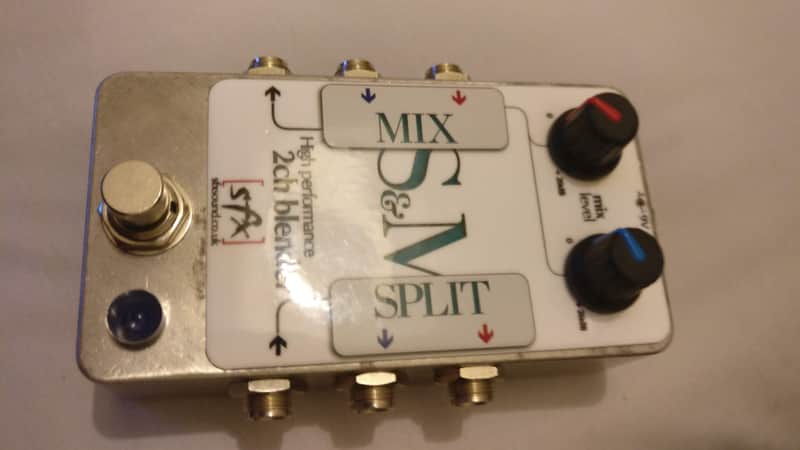
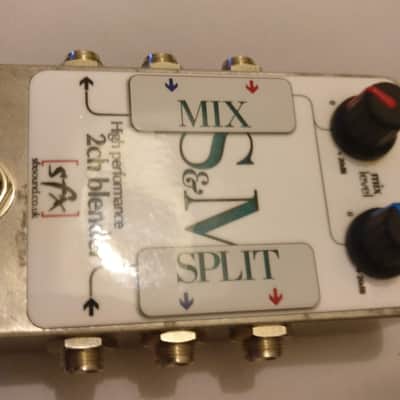
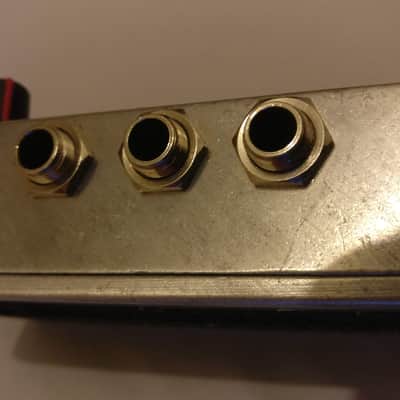
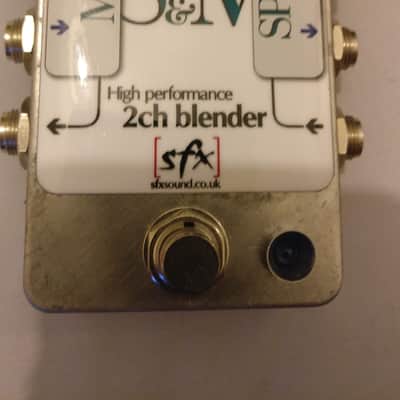
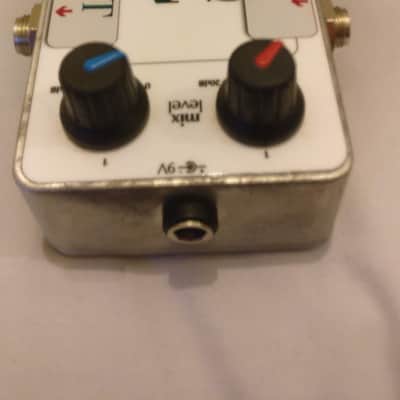
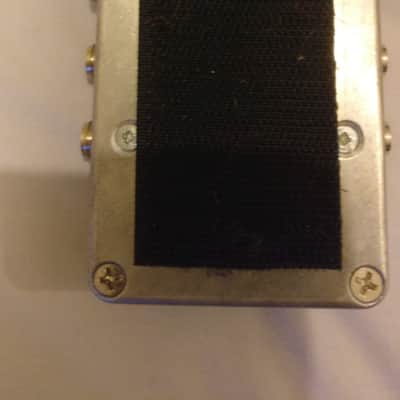
SFX S&M High Performance 2 Channel Blend Pedal : As Pictured, This very rare SFX S&M is in fantastic condition. No real wear and tear, apart from the glue behind the Plastic overlay is beginning to age. Nigh on flawless apart from that.
[sfx] Micro Thumpinator And S&M Pedals Tom Bowlus
The Company Line
There’s this fellow over in the UK named Max Greco who likes to build these tidy, wickedly useful pedals under the brand [sfx]. Many, if not most, [sfx] pedals first came into being to address one particular player’s one particular need (that player often being Max, himself). As such, they are focused on achieving that one goal (or set of goals), and don’t throw in any fluff along the way. As a result, [sfx] pedals are, by and large, very straightforward, but yet uniquely brilliant at the same time. They tend to be compact, easy to understand, and very good at what they do.
I first came to learn of Max’s pedals when investigating the various options for high-pass filtering in a live bass rig. The Thumpinator and Micro Thumpinator are designed to do just that, but as I learned more about his other pedals and as I perused his product line, I realized that he was already making several other pedals which I definitely needed, I just didn’t know that they existed. With that in mind, I ordered two pedals from Max: a Micro Thumpinator and an S&M split/mix pedal. After several years and many gigs, these pedals have yet to let me down, and still occupy a space in my pedal board.
First Impressions
The topic of high-pass filtering is both very interesting and very useful. No doubt, we shall devote some pages here in Bass Gear Magazine to take a deeper look at the various strategies employed to control infra sonic signals (“subsonics”) and to clean up our precious low end. But to state the case briefly, if you filter out the very lowest frequencies (which really just tend to shake things in the room, and don’t really translate well into sound waves that our ears/brain can interpret), a number of beneficial things happen. Those “things” in the room (like chairs, tables, ceilings, etc) stop shaking so much. Your amp quits trying to waste energy producing notes which are hard to hear, so it has an easier time producing the notes that we can hear. Speaker life is enhanced. There are less of those big, long, waves bouncing around the room, and muddying up the tone. In general, things sound tighter. But, the cool thing is that we still “hear” plenty of low bass (and if you’ve been reading Tom Lees’ various From the Bench columns, you’ll know why!). There are benefits to be had in the studio, as well. High-pass filtering helps remove initial subsonic peaks and allows recording engineers to increase the input gain and, consequently, the useful dynamic range.
While some amp manufacturers incorporate high-pass filtering into their heads, directly,most do not. This is where a device like the Thumpinator or Micro Thumpinator comes in handy. Throw one of these into your signal chain, and you effectively introduce a pretty steep roll-off, starting at about 30Hz (see Fig. 1). You can place this pedal anywhere you want in your signal chain (and there is sufficient debate in favor of, or against, pretty much all of the available options). I prefer to place it near the front, to make it more likely that my downstream pedals will be able to do what they are asked to do (and not thrown a curve ball by any subsonic content). The main difference between the Thumpinator and its little brother are the balanced/unbalanced inputs and outputs (the Micro Thumpinator is unbalanced, only). Both units have the ability to accept instrument and line level signals, making them very flexible as to where you can place them in your signal chain.
The S&M split and mix pedal was one of those devices that as soon as I saw it, I knew immediately what it could do for my signal chain, and I just had to have it. Several of the bands I play in cover a very wide range of music, calling for a very wide range of bass tones. Of the various effects which I use, two effects which are (IME, at least) difficult to achieve the “right” tone/effect without losing the low end heft are overdrive and synth. With the S&M, you have the ability to dial in just the right amount of your desired effect with your clean signal. This greatly increases the range of usable tones you can get from your existing effects, as you can dial things in for the optimal “effect,” and then use the blend function to mix it with your clean signal to maintain good lows. Another way to use the S&M is to blend two “wet” signals, such as a chorus and delay. Note, when blending an effected signal with your clean signal, you would only insert one loop (if the jacks are not inserted in one set of outputs/inputs, the S&M connects them internally). With +20dB of gain on tap, you can boost the level of your effects signal pretty much as hot as you’d ever want to. Newer versions of the S&M also feature a phase switch on the blue channel.
A Closer Look
These are some nice, clean, intelligently laid-out pedals. Both use aluminum Hammond enclosures (1590A for the Micro Thumpinator, 1590B for the S&M), and the “printing” is done on a thick, high-quality “sticker” that is adhered to the top. The labeling is legible, and uses plain language. The color coding on the S&M really helps make things crystal clear. Max Greco is all about functionality when it comes to his layouts and designs. A gigging bass player, himself, his pedals are as utilitarian as they are attractive. Cracking open the cover, [sfx] pedals have beauty that is more than skin deep. Internal space is very well-utilized, and all of the components are laid out with an attention to detail that only someone with at least a little OCD can pull off.
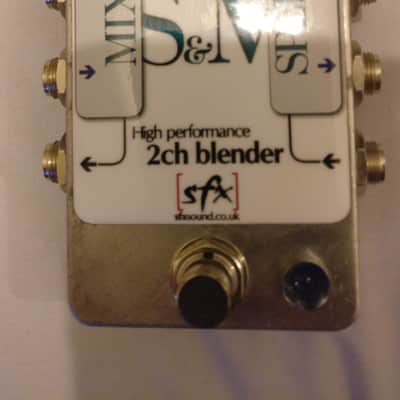
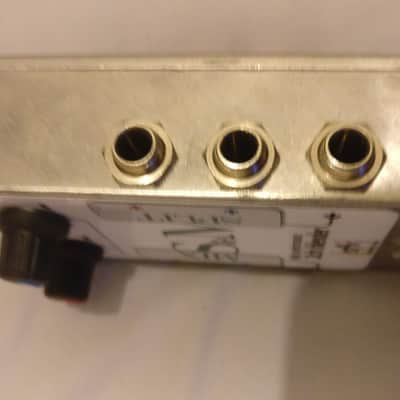
there are a growing number of high-pass filter options on the market nowadays, and if you ask me, that’s nothing but a good thing. If you like to keep things simple, though, the Micro Thumpinator is the way to go. It rolls off content very aggressively below 30Hz, but does nothing at all to your signal above that. It’s simple, sturdy and effective. The small size and smart layout (input on the right, power on the top, output on the left) make it easy to fit into any pedal board. The S&M also places the main input on the right, power on the top, and output on the left, with the split outputs heading right, and the mix inputs coming in from the left. The true-bypass on/off switch is confidence inspiring, and somewhat lower in profile to some of the other such switches on my board. Those bright blue LEDs leave no doubt to the status of either pedal. My initial love affair with this pedal came when paired up with various overdrive pedals, where the wet/dry blend ability let me get aggressive with the drive, while keeping a solid foundation. However, I have recently incorporated the Amptweaker Bass TightFuzz into my board, which has the inherent ability to blend in “dry lows.” What this means is that I’m now able to focus on blending the bass synth from my Akai Uni-Bass with my clean signal. Nice. This pedal really offers a ton of functionality.
Lasting Impressions
In addition to making some killer effects pedals, Max Greco makes pedals which allow your other gear to do more things, as well. This is some great gear, folks!
Manufacturer: SFX
Made in: UK
Model: S&M
Enclosure: Hammond 1590A (aluminum)
Inputs: 1/4” (high impedance) input, two 1/4”
mix return inputs (red and blue), 7-10V
adapter input (2.1mm center negative,
regulated; 60mA)
Output: 1/4” output, two 1.4” send outputs
(red and blue)
Controls: true-bypass switching, mix level
(red), mix level (blue) [newer units have
phase switch for blue channel]
Other Features: Blue LED for power-on; DC
power can be daisy-chained
Dimensions: 4.43" L x 2.38" W x 1.22" H
Weight: 8.6 oz.
Warranty: 1 year
Price: £145.00 (@ $234)
[sfx] Micro Thumpinator And S&M Pedals Tom Bowlus
The Company Line
There’s this fellow over in the UK named Max Greco who likes to build these tidy, wickedly useful pedals under the brand [sfx]. Many, if not most, [sfx] pedals first came into being to address one particular player’s one particular need (that player often being Max, himself). As such, they are focused on achieving that one goal (or set of goals), and don’t throw in any fluff along the way. As a result, [sfx] pedals are, by and large, very straightforward, but yet uniquely brilliant at the same time. They tend to be compact, easy to understand, and very good at what they do.
I first came to learn of Max’s pedals when investigating the various options for high-pass filtering in a live bass rig. The Thumpinator and Micro Thumpinator are designed to do just that, but as I learned more about his other pedals and as I perused his product line, I realized that he was already making several other pedals which I definitely needed, I just didn’t know that they existed. With that in mind, I ordered two pedals from Max: a Micro Thumpinator and an S&M split/mix pedal. After several years and many gigs, these pedals have yet to let me down, and still occupy a space in my pedal board.
First Impressions
The topic of high-pass filtering is both very interesting and very useful. No doubt, we shall devote some pages here in Bass Gear Magazine to take a deeper look at the various strategies employed to control infra sonic signals (“subsonics”) and to clean up our precious low end. But to state the case briefly, if you filter out the very lowest frequencies (which really just tend to shake things in the room, and don’t really translate well into sound waves that our ears/brain can interpret), a number of beneficial things happen. Those “things” in the room (like chairs, tables, ceilings, etc) stop shaking so much. Your amp quits trying to waste energy producing notes which are hard to hear, so it has an easier time producing the notes that we can hear. Speaker life is enhanced. There are less of those big, long, waves bouncing around the room, and muddying up the tone. In general, things sound tighter. But, the cool thing is that we still “hear” plenty of low bass (and if you’ve been reading Tom Lees’ various From the Bench columns, you’ll know why!). There are benefits to be had in the studio, as well. High-pass filtering helps remove initial subsonic peaks and allows recording engineers to increase the input gain and, consequently, the useful dynamic range.
While some amp manufacturers incorporate high-pass filtering into their heads, directly,most do not. This is where a device like the Thumpinator or Micro Thumpinator comes in handy. Throw one of these into your signal chain, and you effectively introduce a pretty steep roll-off, starting at about 30Hz (see Fig. 1). You can place this pedal anywhere you want in your signal chain (and there is sufficient debate in favor of, or against, pretty much all of the available options). I prefer to place it near the front, to make it more likely that my downstream pedals will be able to do what they are asked to do (and not thrown a curve ball by any subsonic content). The main difference between the Thumpinator and its little brother are the balanced/unbalanced inputs and outputs (the Micro Thumpinator is unbalanced, only). Both units have the ability to accept instrument and line level signals, making them very flexible as to where you can place them in your signal chain.
The S&M split and mix pedal was one of those devices that as soon as I saw it, I knew immediately what it could do for my signal chain, and I just had to have it. Several of the bands I play in cover a very wide range of music, calling for a very wide range of bass tones. Of the various effects which I use, two effects which are (IME, at least) difficult to achieve the “right” tone/effect without losing the low end heft are overdrive and synth. With the S&M, you have the ability to dial in just the right amount of your desired effect with your clean signal. This greatly increases the range of usable tones you can get from your existing effects, as you can dial things in for the optimal “effect,” and then use the blend function to mix it with your clean signal to maintain good lows. Another way to use the S&M is to blend two “wet” signals, such as a chorus and delay. Note, when blending an effected signal with your clean signal, you would only insert one loop (if the jacks are not inserted in one set of outputs/inputs, the S&M connects them internally). With +20dB of gain on tap, you can boost the level of your effects signal pretty much as hot as you’d ever want to. Newer versions of the S&M also feature a phase switch on the blue channel.
A Closer Look
These are some nice, clean, intelligently laid-out pedals. Both use aluminum Hammond enclosures (1590A for the Micro Thumpinator, 1590B for the S&M), and the “printing” is done on a thick, high-quality “sticker” that is adhered to the top. The labeling is legible, and uses plain language. The color coding on the S&M really helps make things crystal clear. Max Greco is all about functionality when it comes to his layouts and designs. A gigging bass player, himself, his pedals are as utilitarian as they are attractive. Cracking open the cover, [sfx] pedals have beauty that is more than skin deep. Internal space is very well-utilized, and all of the components are laid out with an attention to detail that only someone with at least a little OCD can pull off.
there are a growing number of high-pass filter options on the market nowadays, and if you ask me, that’s nothing but a good thing. If you like to keep things simple, though, the Micro Thumpinator is the way to go. It rolls off content very aggressively below 30Hz, but does nothing at all to your signal above that. It’s simple, sturdy and effective. The small size and smart layout (input on the right, power on the top, output on the left) make it easy to fit into any pedal board. The S&M also places the main input on the right, power on the top, and output on the left, with the split outputs heading right, and the mix inputs coming in from the left. The true-bypass on/off switch is confidence inspiring, and somewhat lower in profile to some of the other such switches on my board. Those bright blue LEDs leave no doubt to the status of either pedal. My initial love affair with this pedal came when paired up with various overdrive pedals, where the wet/dry blend ability let me get aggressive with the drive, while keeping a solid foundation. However, I have recently incorporated the Amptweaker Bass TightFuzz into my board, which has the inherent ability to blend in “dry lows.” What this means is that I’m now able to focus on blending the bass synth from my Akai Uni-Bass with my clean signal. Nice. This pedal really offers a ton of functionality.
Lasting Impressions
In addition to making some killer effects pedals, Max Greco makes pedals which allow your other gear to do more things, as well. This is some great gear, folks!
Manufacturer: SFX
Made in: UK
Model: S&M
Enclosure: Hammond 1590A (aluminum)
Inputs: 1/4” (high impedance) input, two 1/4”
mix return inputs (red and blue), 7-10V
adapter input (2.1mm center negative,
regulated; 60mA)
Output: 1/4” output, two 1.4” send outputs
(red and blue)
Controls: true-bypass switching, mix level
(red), mix level (blue) [newer units have
phase switch for blue channel]
Other Features: Blue LED for power-on; DC
power can be daisy-chained
Dimensions: 4.43" L x 2.38" W x 1.22" H
Weight: 8.6 oz.
Warranty: 1 year
Price: £145.00 (@ $234)
This item is sold As-Described
This item is sold As-Described and cannot be returned unless it arrives in a condition different from how it was described or photographed. Items must be returned in original, as-shipped condition with all original packaging.Learn More.
| Listed | 6 years ago |
|---|---|
| Condition | Very Good (Used) Very Good items may show a few slight marks or scratches but are fully functional and in overall great shape.Learn more |
| Brand | |
| Model |
|
| Finish |
|
| Year |
|
| Made In |
|
Product safety information may be available here.