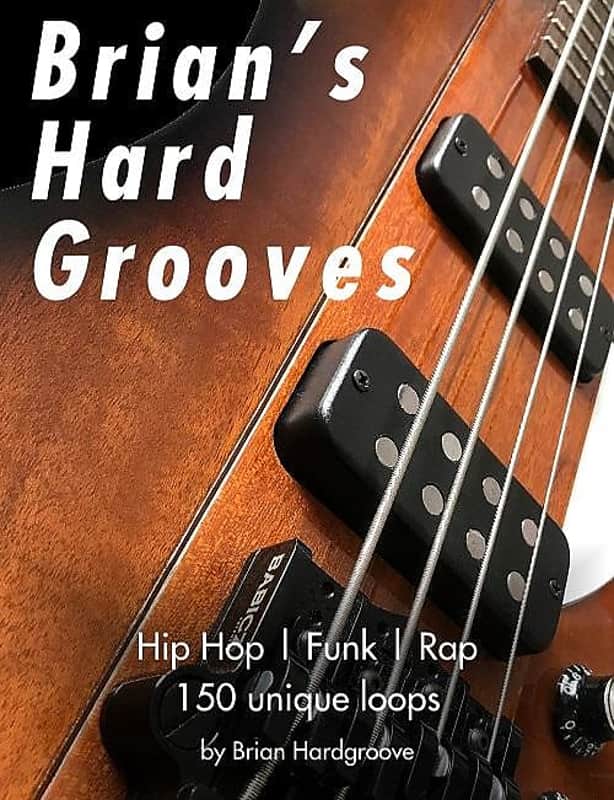
Brian's Hard Groove Bass Loop Library
This listing has ended
See similar gear from other Reverb sellers

Our users rate Reverb
Now Public Enemy’s Brian Hardgroove can add his unique combination of R&B and rock flair on bass to your own productions.
Brian Hardgroove is a bassist, record producer, and member of the legendary Rock-n-Roll Hall of Fame hip-hop group Public Enemy. He’s done productions that include the extraordinary talents of Chuck D (Public Enemy), Steven Tyler & Joe Perry (Aerosmith), Burning Spear (Grammy winner “Reggae Album of the Year”), Marc Anthony, Supertramp, and The Fine Arts Militia. Now his unique bass riffs can power your music. This collection includes:
- 150 unique loops in both REX2 and Acidized (Groove Clip) format, for 300 loops total (374 MB)
- Arranged in two groups of seven folders; each group has its own native tempo (80 BPM and 100 BPM)
- 44.1 kHz, 16-bit resolution
- 22 chromatic bass note one-shots (44.1 kHz, 24-bit resolution, 62 MB) for making your own loops
- Acidized and REX2 file formats
Each folder starts with a Hardgroove loop. Then in collaboration with Craig Anderton, additional variations on the main loop were created from this loop by cutting, pasting, re-arranging, and sometimes transposing notes. By retaining the original notes, tone, and style, these variations allow building up a song with variations that can be far more interesting than conventional repetitive loops. Just drag them in, and get inspired.
TRANSPOSING AND STRETCHING
Each loop has a “native” key. Note that for stretching, the REX and Groove Clip (WAV) formats have different strengths and limitations.
REX files are optimum for playing at the native key, and stretch well over a wide tempo range. REX files stretch more elegantly to slower tempos than WAV files. Unlike Acidized files, which (depending on your host) can follow tempo changes, REX files don’t follow pitch changes.
Acidized “Groove Clip” files stretch over a wide range, but sound better when sped up compared to slowing them down. They also transpose well and follow Pitch Markers; the fidelity depends on how far you transpose from the native pitch.
7 folders have loops with an 80 BPM native tempo. Keys are E (3 folders), G (2 folders), A (1 folder), and D (1 folder). 7 folders have loops with a 100 BPM native tempo. Keys are E (3 folders), G (2 folders), and A (2 folders).
BONUS ONE-SHOTS
In addition to the loops, the Chromatic Notes folder contains 22 one-shot files of the individual bass notes used in the loops. Use these to create variations with the existing loops, or even create your own loops with the same sound—so they fit in perfectly with Brian’s loops.
MODIFYING THE LOOPS
These loops transpose well in Melodyne. After choosing the tempo and importing the file, convert either the RX2 or Acidized format to a standard WAV or AIF file by rendering/bouncing the clip (see your DAW’s documentation for how to do this). Now you can open it in Melodyne and transpose individual notes, or even entire patterns.
Compatibility
All mainstream DAWs on both Mac and Windows support Acidized files either directly or by importing to a similar format internally, and most support REX2 files as well. (Note: Apple Logic Pro X supports Acidized WAV files, but REX2 file support requires running a terminal command). Many virtual instruments also support REX2 files. Windows users can edit Acidized files with the free DAW Cakewalk by BandLab
What's new?
Please note: This is a download-only product. No physical product will be shipped.
| Brand | |
|---|---|
| Model |
|
| Categories |
Product safety information may be available here.