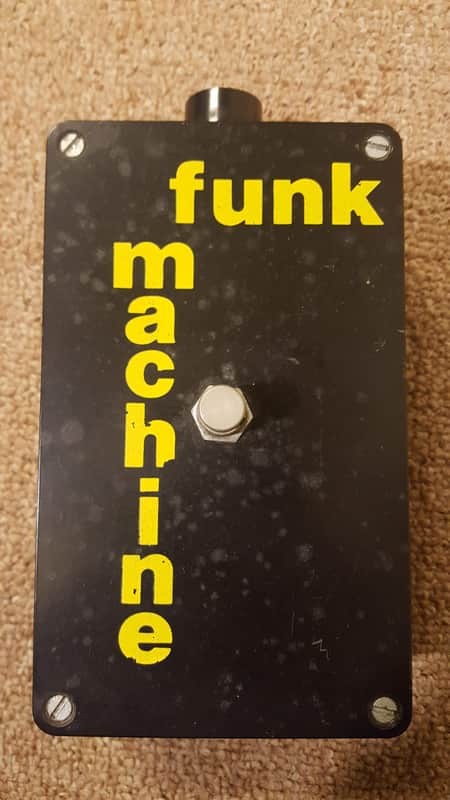
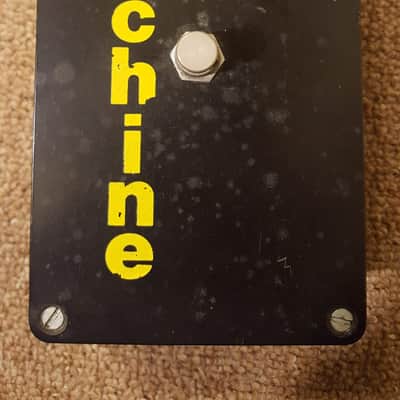
Seamoon Funk Machine 70s
This gear has sold
See similar gear from other Reverb sellers

Our users rate Reverb
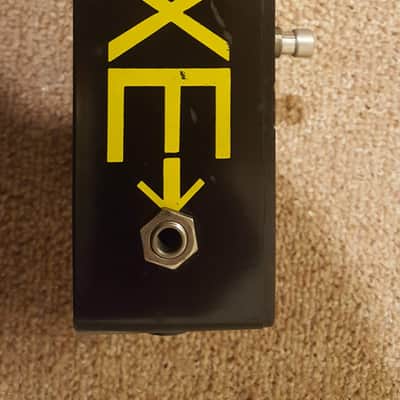
The Funk Machine TM works with any electrified musical device-guitar, bass, microphone, horns, etc. It uses a standard 9 volt battery, which is turned on when you plug a cord into the AXE jack. The foot-switch on the top is an in/out switch. When the F.M. is not in use, you are wired into your amp.
You wire freaks might like to know that the F.M. is a filter whose resonant frequency parallels the amplitude envelope.
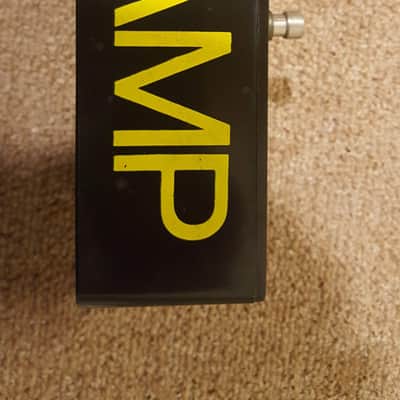
Plug your axe, with the volume control on full, into the AXE jack. Run a cord from the jack marked AMP into your amp.
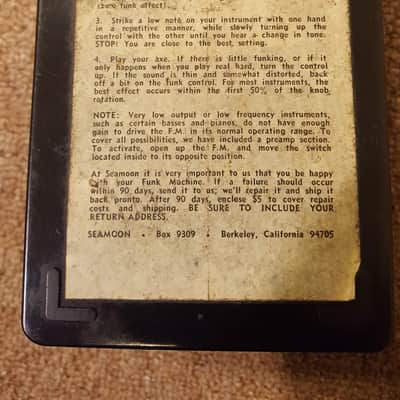
Proper setting of the F.M. sensitivity control is vital for best results. Start by turning it full counter-clockwise (zero funk effect).
Strike a low note on your instrument with one hand in a repetitive matter, while slowly turning up the control with the other until you hear a change in tone. STOP! You are close to the best setting.
Play your axe. If there is little funking, or if it only happens when you play real hard, turn the control up. If the sound is thin and somewhat distorted, back off a bit on the funk control. For most instruments, the best effect occurs within the first 50% of the knob rotation.
NOTE: Very low output or low frequency instruments, such as certain basses and pianos, do not have enough gain to drive the F.M. in its normal operating range. To cover all possibilities, we have included a preamp section. To activate the preamp, open up the F.M. and move the switch located inside to its opposite position.
SEAMOON . Box 9309 . Berkeley, California 94705
The original version was designed by Craig Anderton.
Jerry Pynckel
John Lang (Seamoon owner) and Michael Brinkerhoff (John's business partner) wanted me to improve the Funk Machine and asked what could be done to increase falling sales and make it really successful. I took the Funk Machine circuit and added a TIS58 FET input, tied around a simple single stage, low parts count compressor, incorporated low noise resistors and improved capacitors and then the variable shift all on a new PC board that actually mounted to the case with screw. Plus we had worked on a new case design that we did used on the '76 effects.
They both said it was fantastic, called in some musicians who couldn't stop playing it. They said just the overall sound was so much better than before. It had a much tighter sound and weaker signals were no longer a problem.
We did not incorporate the FET/Compressor or the improved parts because John had already ordered the PC boards and parts. The Variable Shift could be used since parts are just soldered on top of the board. John asked if we could do the same with the FET/Compressor circuit and I said no to that. The case would have been full of off circuit components hanging off the old board. I believe this was the final straw for Michael since the extra parts did not cost much. They had a quite few arguments over the choice not to manufacture the unit with all the new features. The effect was so much better however since John had ordered parts and circuit boards without Michaels' knowledge the all new Funk Machine couldn't be produced. They didn't speak to each other as often as they did before and shortly after that Michael left Seamoon.
| Listed | 8 years ago |
|---|---|
| Condition | Very Good (Used) Very Good items may show a few slight marks or scratches but are fully functional and in overall great shape.Learn more |
| Brand | |
| Model |
|
| Categories | |
| Year |
|
| Made In |
|
Product safety information may be available here.