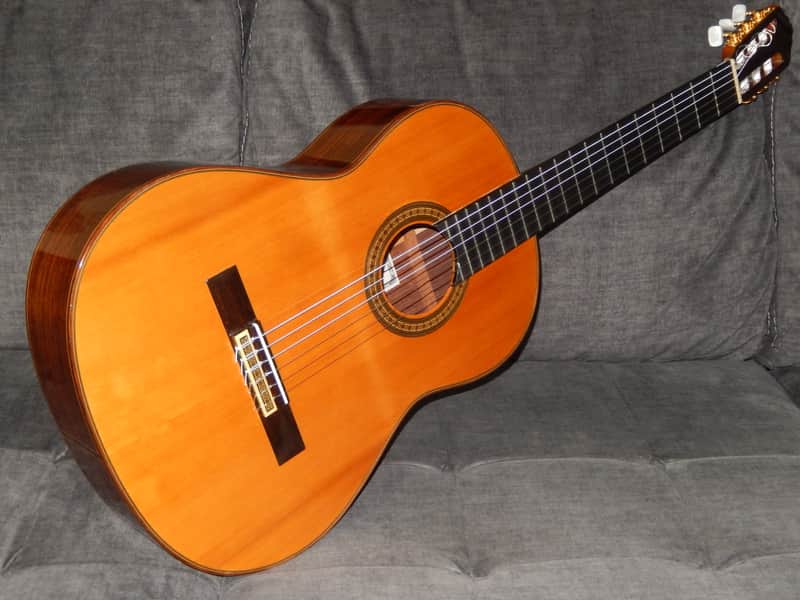
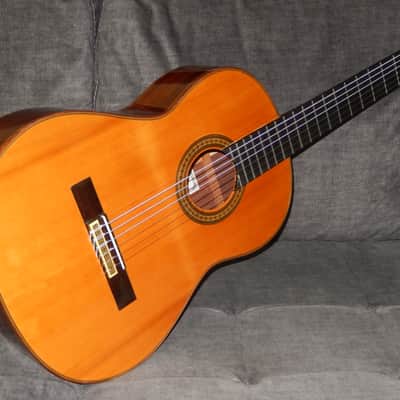
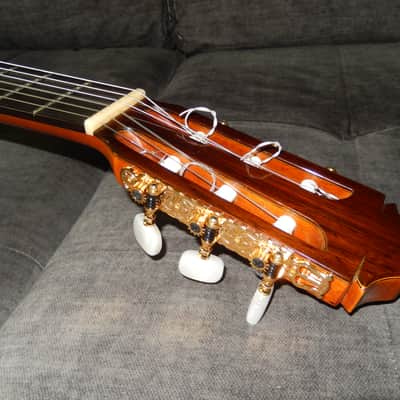
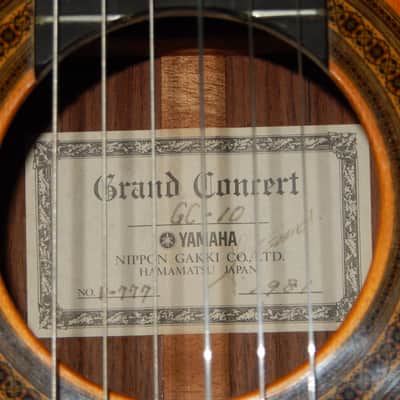
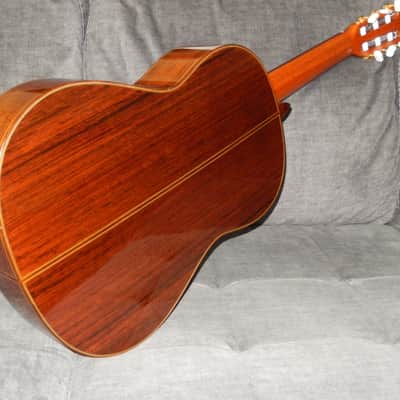
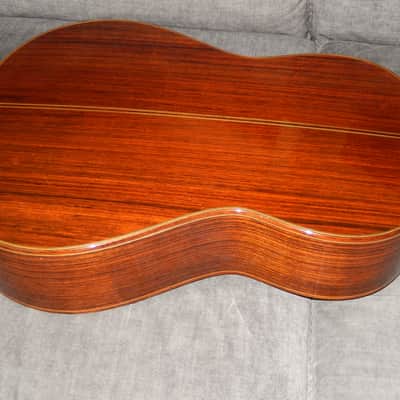
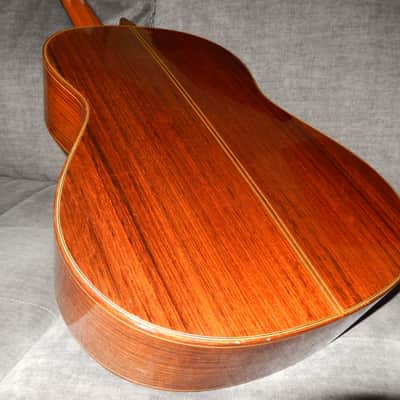
MADE IN 1981 BY HIDEYUKI EZAKI - TERRIFIC YAMAHA GC10 - CLASSICAL CONCERT GUITAR
This gear has sold
See similar gear from other Reverb sellers
Our users rate Reverb
Yamaha GRAND CONCERT GC10 1981
This Yamaha guitar made in Japan in 1981 is yet another great guitar introduced by Yamaha Corporation. It was made and signed by one of the greatest Yamaha’s luthier Hideyuki Ezaki.
Hideyuki joined Yamaha’s classical guitar workshop in 1967 and in 1968 left for Spain where he spent 3 years sudying guitar making under Eduardo Ferrer in Granada and Manuel Hernadez in Madrid. Upon his return in 1971 he joined Yamaha's custom shop and worked along Toshiro Kato (Head luthier at Yamaha's Custom Shop) and Hiroshi Harada. Initially Hideyuki Ezaki was making some midrange Yamaha models in relatively small numbers. He was also a member of Yamaha's design group, working on various innovations leading to improved tonal properties of Yamaha guitars. Since 1975 through 1982 Hideyuki was making Yamaha's top Cedar top model GC30B. After Toshihiro Kato's departure in late 1980s, Hideyuki became the leader of Yamaha's Custom Shop and was running it until his retirement in 2007. While receiving his retirement pension from Yamaha corporation he actually opened his own workshop, which he runs until today. His least expensive models are priced 600 000 yen which translates to at least $6000 in US distribution.
This guitar is a great example of Hideyuki Ezaki’s superb craftsmanship. Its sound will amaze every player. It has deep resonating somewhat metallic basses, clear but colorful trebles, all notes well separated, balanced and magnified by very impressive sustain. Guitar is loud and very responsive. IT IS TRULY GRAND CONCERT!
This guitar being priced 100 000 yen in 1981, was worth entire starting yearly salary of Japanese college graduate. It was also quite expensive to international buyers. By late 1970s era of wonderful Japanese made instruments sold in the West at very affordable prices has ended.
Currently internationally distributed Yamahas GC32C or GC42C are simply no match to this “old faithful” GC10 from 1981.
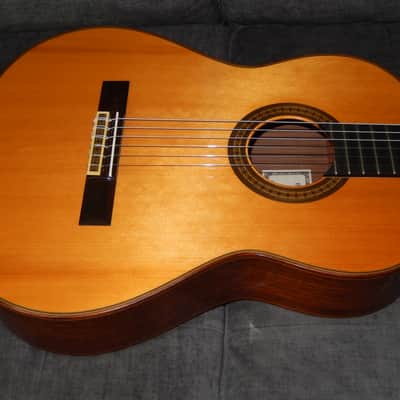
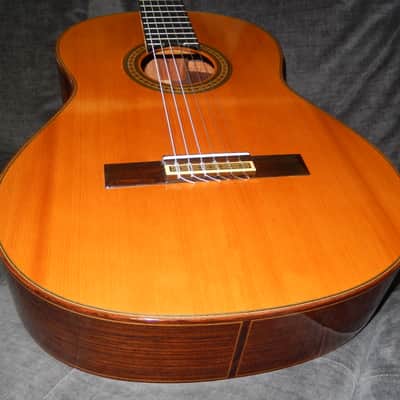
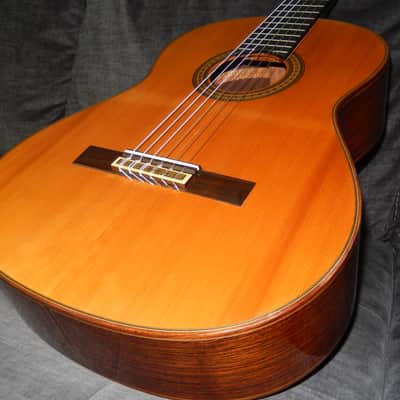
This guitar despite being 38 years old remains in overall excellent condition. Its top bears only few of very small dents and very shallow scratches within the finish. Other surfaces are practically scratch/dent free.
The most noticeable imperfections are “gaps” in top’s finish along both sides of fingerboard (visible as whitish lines on pictures 10&11). These are not associated with any cracks in the wood nor any gaps between soundboard and fingerboard, and don’t look like typical finish cracks. It looks like the finish dried and chipped off, or maybe was intentionally removed, or perhaps the fingerboard has been re-glued sometime in the past. Regardless of what is the true story behind that, these “scars” don’t affect guitar’s tonality or performance. Guitar is structurally sound and doesn’t need any repairs.
SPECIFICATIONS:
Year(s) Sold: 1979-1984
Original US MSRP: $1,999.00
Top: Solid Spruce/lacquer
Back & Sides: Solid Indian Rosewood /urethane
Neck: Honduras Mahogany
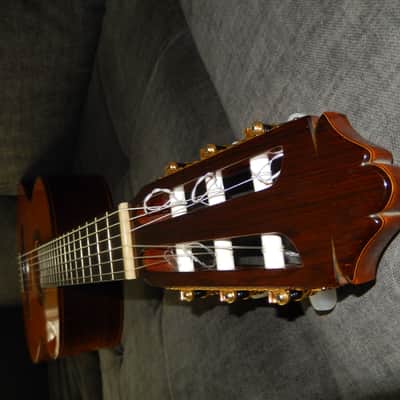
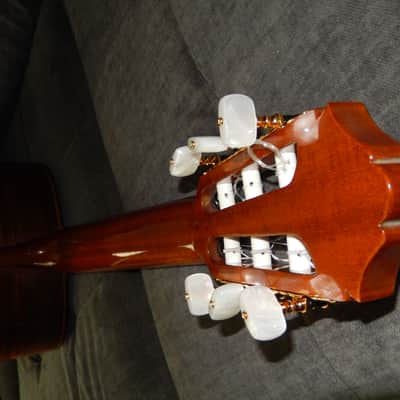
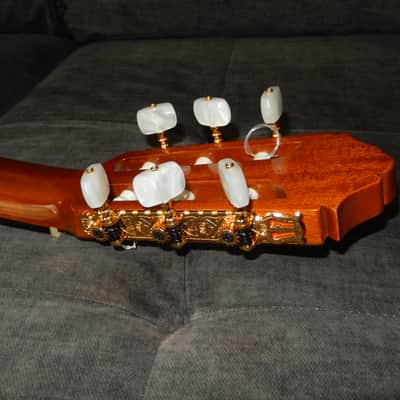
Tuners are not original They are brand new Gotoh set
Fingerboard: Ebony
String Length: 650mm
Nut width: 52 mm
Guitars action is set to 3.90mm under E6 and 3.0 mm under E1 with practically no extra room on the saddle.
Guitar will be shipped in non-original hard shell case in still very good condition.
History of modern era Yamaha Guitars.
During late1960s/early 1970s Japanese guitar makers were still trying hard to win as many international customers as possible. These were they years of significant international recognition of their, soon very highly regarded products. Yamaha was unquestioned leader among Japanese guitar exporters. Their guitars offered the highest possible level of craftsmanship with great deal of attention to even the tiniest details.
Yamaha started their fight for international clients in 1967 with new lineup of classical Grand Concert guitars made according to Spanish blueprints. They were: GC3 (solid Spruce top/ solid Indian Rosewood b/s) GC5, GC7 and GC10 (all 3 models with solid Spruce tops and solid Brazilian Rosewood b/s).
In 1968 Yamaha also introduced their lineup of great Grand Concert flamenco guitars. They were GC5F, GC7F and GC10F. The master luthier responsible for production of these guitars was Toshihiro Kato. He was helped by Hiroshi Harada, who was making classical models GC3 and GC5. Both these luthiers were trained by Eduardo Ferrer, a Spanish luthier from Granada, Spain who being invited (and appropriately rewarded) by Yamaha co., travelled to Japan during years 1964-1967.
It is very important to explain that 1960s and 1970s were years of very rapid devaluation of Japanese yen (hence rapid inflation of prices for all products). Because during those years practically all guitar models had some numbers closely related to their prices in yen, these models were quite frequently upgraded (relabeled) to higher numbers reflecting their higher prices.
For that reason, mentioned above Yamaha’s classical GC guitars lineup, was changed in 1971. New (1971-1973) lineup included models GC3D, GC6D, GC8D, GC10D (all 4 models made with solid Spruce tops & solid Indian Rosewood b/s) GC12D, GC15D and GC20D (all 3 models with solid Spruce tops & solid Brazilian Rosewood b/s). It is worth to mention that until 1974 all Yamaha classical GC models were made exclusively with Spruce tops.
In 1974 Yamaha’s classical GC guitar lineup was changed yet again. In that year, for the first time in its history, Yamaha decided to make classical guitars with cedar tops. This newly introduced GC classical guitar lineup included models: GC5M(S), GC7M(S), GC10M(S), GC15M(S), (all with Indian Rosewood b/s), GC20M(S), GC30A, GC30B (all with Brazilian Rosewood b/s). M=spruce. S=cedar, A=spruce, B=cedar
Yamaha GC10M was priced 100 000 yen in 1974, when starting yearly salary of Japanese college graduate was around 75 000 yen. Masaru Kohno 10 was priced the same 100 000 yen. Yamaha Co. didn't compete with Kohno by lowering prices of their guitars. Yamaha GC guitars simply offered more for the same price. You will never find Kohno 10 from that era that would sound even close to this Yamaha GC10M.
In 1974 Kohno top models were 15, 20 and 30 (all with Brazilian Rosewood b/s). Model 30 was priced 300 000 yen just like Yamaha GC30A(B). In 1977 Kohno changed his lineup adding models 40 and 50 (both with improved looks but sounding no different than his earlier model 30) and changing specifications of model 15 from Brazilian Rosewood b/s to Indian Rosewood b/s. Yamaha's kept their lineup unchanged until 1979. In order to keep their prices at the same level, Yamaha GC guitars made in 1979 were made with somewhat lower grade woods, different finishes and less impressive ornamental extras if compared with those made in 1974. Production of GCM and GCS models ended by the end of 1979. Between years 1980-1985, Yamaha's lineup was being changed at least few times.
In 1985 top models made at Yamaha's Hamamatsu workshop were GC70 (Spruce/figured Brazilian Rosewood, all shellac finish), GC60 (Spruce/figured Brazilian Rosewood, shellac finish top) GC50 (Spruce/figured Brazilian Rosewood, all lacquer finish) & GC40 (Spruce/figured Brazilian Rosewood, lacquer finish top), and GC30 (Spruce/straight grain Brazilian Rosewood, urethane finish).
Correct evaluation of a real grade of vintage Yamaha guitars can't be done just by looking at their model numbers. Yamaha GC10 from 1980 is simply no match to GC10M from 1975. Yamaha GC10D from 1973 is of equal grade with GC15M from 1975. Yamaha GC10 from 1970 is of equal grade with Yamaha GC20D from 1973 and GC40 from 1985.
Real Value of Japanese Vintage Guitars
The key to understand value of vintage Japanese guitars is to acknowledge galloping devaluation of Japanese yen in 1960s & 1970s. This devaluation was somewhat slower in 1980s. The best measure of this devaluation is Starting Yearly Salary of Japanese College Graduate (SYSJCG).
SYSJCG in in 1965 was 19 600 yen, in 1969 – 34 600 yen, in 1970 39 200 yen, in 1972 – 62 300 yen, in 1975 79 200 yen, in 1977 85 200 yen and in 1980 - 100 000 yen.
During 1960s and most of 1970s model numbers of Japanese guitars were strictly interconnected with their prices in Japanese yen. In late 1970s and during following decades model numbers were no longer strictly associated with their prices. Many Japanese guitar makers introduced model names instead of model numbers. Others were still using model numbers with addition of letter abbreviations or other symbols.
The best and only logical approach while evaluating real value (real grade) of vintage Japanese guitar is to compare its price in Japanese yen with SYSJCG during the year guitar was made.
Any guitar priced 100 000 in 1970 (labelled usually as No10) would be priced 200 000 yen in 1975 (relabeled to No20 or 2000), 300 000 yen in 1977 (labelled as No3, No30 or 3000). Starting in 1977 Masaru Kohno introduced his model No50 priced at 500 000 (skipping theoretical model 40). Soon other famous Japanese luthiers did the same. By 1983 Kohno started using model names instead numbers and was raising their prices as he was pleased. Naturally soon other Master luthiers did the same.
Knowing all of that, you can bet on that Masaru Kohno No50 made in 1982 is practically the same quality as Kohno No15 made in 1972, or Kohno no20 made in 1975 or Kohno No30 made in 1977. I know it for a fact.
The lowest grade models currently made by Matsuoka workshop are M75 and MH75. They are commonly considered as “beginner guitars”. Matsuoka model M30 made in 1973 is simply far, far better instrument. It is naturally better than model M50 made in 1977, model 80 made in 1982 or model M100 made in 1990. At present, the highest grade Matsuoka models are M300 and MH300. They absolutely stand no chance in competition with model M150 made in 1975… or model M200 made in 1977.
It is very important to mention that if modern era luthiers are using 40 years old woods to make a classical guitar, its price is at least $8000.
| Listed | 7 years ago |
|---|---|
| Condition | Very Good (Used) Very Good items may show a few slight marks or scratches but are fully functional and in overall great shape.Learn more |
| Brand | |
| Model |
|
| Finish |
|
| Categories | |
| Year |
|
| Made In |
|
| Body Shape |
|
Product safety information may be available here.