Analog Synths
Shop by Brand
Buying Guides
Reverb News
Popular Analog Synths
- MoogKeyboards and SynthsDesktop SynthsCompare 17 from kr4,442.01
(56)Compare 15 from kr4,088.93
Multiple Finishes(48)Compare 18 from kr2,807.58
Multiple Finishes(49)Compare 11 from kr7,762.49
Multiple Finishes(18)Compare 29 from kr5,467.09
Multiple Finishes(33)Compare 6 from kr4,442.01
(30)Compare 13 from kr5,524.04
(73)Compare 9 from kr3,986.42
(32)Compare 8 from kr14,237.23
(25)Compare 14 from kr4,954.55
Multiple Finishes(88)Compare 15 from kr2,619.65
Multiple Finishes(24)Compare 5 from kr19,362.63
Used Analog Synths
kr47,825.69kr47,825.69Sweden
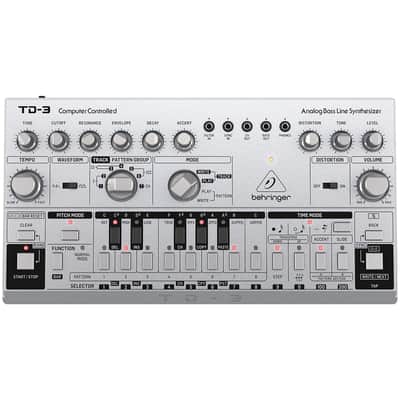
Behringer TD-3-MO Analog Bass Synthesizer – Black + Decksaver
Used – Very Goodkr1,423.72kr1,423.72Spain
kr22,665.66kr22,665.66Free ShippingGermany
kr33,941.55kr33,941.55Free ShippingGermany
kr22,665.66kr22,665.66Free ShippingGermany
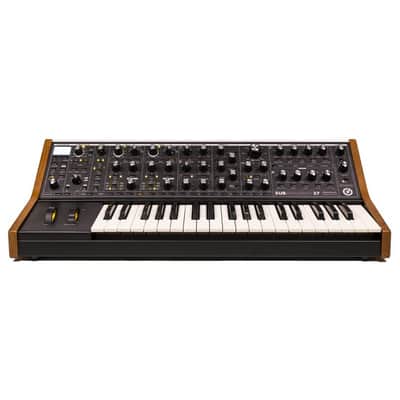
Moog Subsequent 37 Analog Synth 2017 - Present - Black
Used – Excellentkr21,071.09kr21,071.09Free ShippingGreece
Analog Synths For Sale on Reverb
While analog synth history arguably dates back to the late 19th-century, the story of what most people think of when they think of synths begins with the innovations of Bob Moog, Don Buchla, and other pioneers in the 1960s. This era saw the first reliable, commercially viable synthesizers hit the market bringing with them an entirely new sound built on voltage-controlled oscillators, filters, amps and other components.
Analog synths fell out of favor in the '80s as digital models entered the scene. In recent years, however, there's been a major analog revival among musicians and producers looking for a path to their ideal waveforms and sounds. Whether you're looking for a vintage synth or a modern alternative, we've got a broad variety of analog synthesizers to choose from—find your next one here.
What does analog synth mean?
It may seem odd that something that’s digital can be considered analog, but analog synths do exist! Instead of advanced programming, an analog synthesizer uses analog circuits and analog signals to generate sound.
How do analog synths work?
Briefly put, analog synthesizers work by manipulating electric voltages to produce their sounds.
But it’s a little more advanced than that. Just like any instrument, an analog synth needs a generator (in this case, an oscillator) and a resonator (the filter). An oscillator produces a pitch at a steady frequency (aka, pitch). In many cases, this is pressing down a key on a keyboard.
That signal goes through a filter, which the player then manipulates to get the exact sound they want. This can involve running the tone through high- and low-pass filter. The tone is then fed through an analog synth module (aka, effects) and then an amplifier so it’s audible.
Why are analog synths better than digital?
We would never want to say that analog synths are better or worse than digital synths -- they’re just different. The biggest difference with analog synthesizer music is that their sound is often described as “warmer.” However, a lot of musicians don’t necessarily want a warmer sound and find themselves more than happy with a digital synth.
You might also find that you can access a wider variety of sounds with analog synths. That’s because, with digital synths, you’re constrained to a world of binary 1s and 0s, which isn’t the case with analog synths.
Are analog synthesizers overrated?
We don’t think analog synthesizers are overrated, but it depends on who you ask! Some of this mindset comes from perceived snobbery around analog synths, as well as the high prices of some of the units compared to digital synths. However, we firmly believe that if you love it and it helps you find your dream sound, it can’t possibly be overrated.