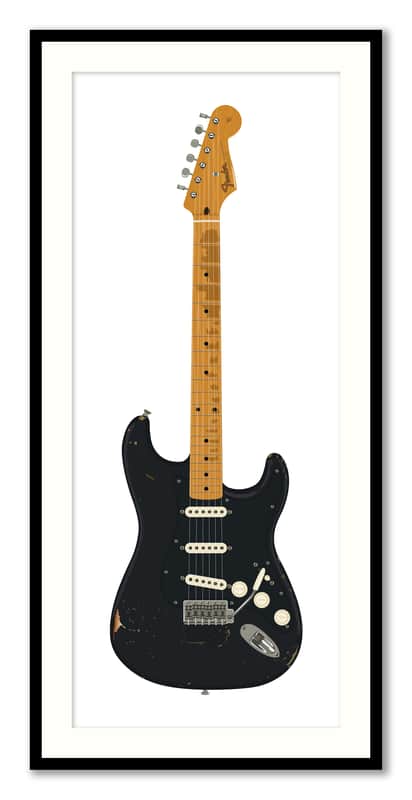




Fender Stratocaster | David Gilmour - "The Black Strat" | Half scale PRINT
This seller is currently away
See similar gear from other Reverb sellers

Our users rate Reverb
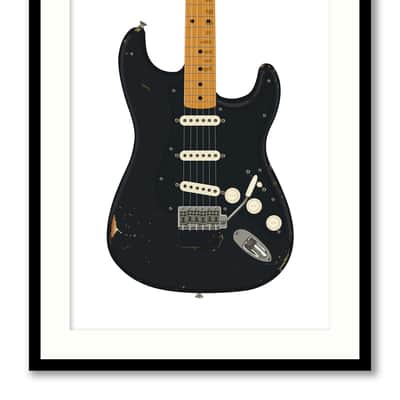
This is a half scale PRINT of David Gilmour's iconic Fender Stratocaster, "The Black Strat"
Limited edition 1/250.
Printed on high quality 210gsm paper, using the Giclée method.
Shipped in a secure cardboard tube, ready for framing.
Dimensions: 60x27.5cm.
The Black Strat
David Gilmour’s Black Strat is arguably one of the most iconic and important Stratocasters to ever emerge from the original Fullerton factory.
In 1970 Pink Floyd found themselves on their third US tour when, after their second New Orleans show, they found that all of their equipment had been stolen. Amongst the gear was Gilmour’s Stratocaster, which he had purchased a mere 6 weeks (and 15 shows) earlier – whilst the majority of the equipment was eventually recovered, this Strat was never to be seen again.
Enter the Black Strat. Born a sunburst 1969 CBS era Stratocaster with the CBS style large headstock, the guitar was purchased in May 1970 by Gilmour from the iconic Manny’s Music store in New York. While the guitar was born sunburst Manny’s had repainted it in Black prior to Gilmour’s purchase – this would be the first in a long list of modifications the guitar would undergo during its life.
During its 55 year life the guitar has been fitted with no less than 6 necks, 2 pickguards, a Kahler bridge, a series of electronic circuit modifications and an XLR output. Gilmour has always seen the guitar as a working tool which he would adapt to suit his needs, he is quoted as saying:
“I've always considered that to be my bodge-up guitar that nothing is sacred on. I've had holes drilled in it. It's still a good guitar.”
The first live outing for the Black Strat was in the early morning of Sunday 28th June 1970 at the Bath Festival of Blues and Progressive music; a lineup which included not only Pink Floyd, but the legendary Led Zeppelin and Jefferson Airplane. This was followed up by a performance at the Kralingen Music Festival in Rotterdam the same day.
Gilmour would spend the rest of the year experimenting with a series of guitars, including a sunburst Strat, a white Strat and a brown Telecaster before ultimately settling on the Black Strat as his number 1 guitar by the outset of their 1971 Atom Heart Mother World Tour through Europe, Australia and Japan
In 1972 the guitar saw its first major modification in the shape of the installation of an XLR socket – Gilmour wanted to be able to run the signal out of his guitar, into the pedal board, back into the guitar (via the volume control) before sending out to the amp. In his own words:
“That didn’t last terribly long so I made some paste out of sawdust and wood glue and filled it back in again.”
In mid-1972 Gilmour would replace the original maple neck with the rosewood neck from his sunburst Stratocaster, ahead of the debut performance of the entirety of The Dark Side of The Moon in June 1972. Shortly thereafter, ahead of the September 1972 US tour upon which they would embark Gilmour made a circuitry modification to the Stratocaster. The middle position of the pickup selector switch on a Stratocaster, as standard, selects on the middle pickup – however Gilmour wanted to achieve a tone more akin to a Jazzmaster by selecting the Neck and Bridge pickups simultaneously, whilst leaving out the middle pickup. Gilmour installed an additional switch which allowed him to do precisely that.
By January 1973 Gilmour had routed the body and installed a Gibson PAF style humbucker in the bridge position, which he would trial during performances with Roland Petit’s Ballets de Marseille.
During the course of this period, specifically from June 1972 through March 1973, Pink Floyd had been recording their seminal The Dard Side of The Moon album and according to Phil Taylor (Gilmour’s long-time guitar Technician) the Black Strat served as the principle recording guitar for this album. Most notably the evergreen solo on the song Time and two of three solos on Money.
By June of 1973, during their US tour, the guitar had been refitted with single coil pickups and, following a brief French tour in the wake of the astonishing success of The Dark Side of The Moon, the white pickguard was replaced with a custom made black pickguard. Upon installation of this pickguard the guitar received its nom du guerre “The Black Strat”, a name it will carry for the rest of time.
The Dark Side of The Moon would be followed up by Gilmour’s favourite Pink Floyd Album, Wish You Were Here, and again the Black Strat would be mainstay of the recording which took place between January and July of 1975, once again in the hallowed recording rooms of Abbey Road in London.
Following Wish You Were Here, the guitar was once again used to record Animals, albeit by this point it was fitted with a DiMarzio FS-1 single coil in the bridge position.
Ahead of the first April 1979 recording session for Pink Floyd’s concept album The Wall, the guitar was fitted with a custom Charvel birdseye maple neck. Recording then moved to Producers workshop in LA through November 1979. Ultimately, the Black Strat would be used to record what is, arguably, the greatest guitar solo of all time in the shape of Comfortably Numb.
By the start of their The Wall tour the bridge pickup had once again been replaced, albeit this time for a Seymour Duncan SSL-1 which the guitar still wears to this day.
In 1982 the band then began recording The Final Cut, for which Gilmour had installed another custom Charvel birdseye maple neck on the Black Strat – although this time a 22-fret version in order to give Gilmour access to one more semitone.
Gilmour had already used the guitar to record his 1978 solo album David Gilmour, and in August of 1983 drew for it once again for the recording of About Face. Before these recording sessions the guitar had been installed with a Kahler tremolo bridge, requiring significant routing of the body. In addition, it was also during this installation that Gilmour experimented with a short tremolo arm, created by literally taking a hacksaw to the metal arm and reinstalling the plastic guard on the tip of the arm. Gilmour credits the Kahler as the single reason why the Black Strat fell out of favour in years to come, although the shorter tremolo arm would become a mainstay henceforth as it “helped to create a style”.
It was at this time that Gilmour purchased a 1957 reissue Stratocaster in Candy Apple Red which would go on to be Gilmour’s principal guitar for the next 2 decades.
From August 1986 until 1997 the guitar was loaned for display purposes to the Dallas branch of The Hard Rock Café. Quite incomprehensibly, the guitar was displayed within arm’s reach of customers with no protective barrier to protect it and as such upon its return it was heavily damaged and missing a substantial amount of componentry.
For restoration the guitar was send to Chandler Guitars who oversaw a comprehensive overhaul and refresh. The Kahler tremolo was replaced with a factory correct Stratocaster tremolo bridge, with the resultant hole filled (albeit still visible), and the 22-fret Charvel neck was replaced with a new 57 vintage reissue maple neck in order to approximate the feel of the Red 57V Strat that Gilmour had become accustomed to over the intervening two decades.
The guitar remained relatively hidden from public view, save for a few brief outings. Its real comeback would come on Saturday 2nd July 2005 when the classic-era Floyd lineup of Gilmour, Waters, Mason and Wright would headline the legendary Live-8 concert in London’s Hyde Park – their first performance together in some 24 years.
Following its return to prominence the guitar was utilised on a string of Gilmour’s subsequent solo albums and Pink Floyd live shows, including the inimitable Live at Pompeii, which saw Gilmour’s most memorable rendition of the Comfortably Numb solo ever captured (as well as the first performance at the venue with an audience since AD 79).
Fender subsequently released reissues of the guitar, in conjunction with the custom shop, in both relic and NOS finishes.
In 2019 it was announced that Gilmour (in partnership with Christie’s) would be auctioning off a vast number of guitars, with the proceeds being donated to charity. Amongst the lots the Black Strat was, without question, the crown jewel of the collection – with an estimate of $100,000-$150,000.
On Thursday June 20th 2019 the guitar sold for an incredible $3,975,000 to Indianapolis Colts owner, and avid guitar collector, Jim Irsay. At the time it was the most expensive guitar ever sold at auction, this record would only be broken on Saturday 20th June 2020 when Kurt Cobain’s 1959 Martin D-18E would be sold for $5,000,000 to Peter Freedman, co-founder of Røde Microphones.
The Stratocaster
The Fender Stratocaster stands as an iconic symbol in the world of electric guitars, renowned for its distinctive sound, innovative design, and cultural impact. Its history is a fascinating journey that spans over seven decades, marked by technological advancements, musical revolutions, and the enduring legacy of its creator, Leo Fender.
The Stratocaster was Leo’s sophomore solid body electric guitar, a follow up to the legendary Fender Broadcaster – or Telecaster as it’s now known thanks to a lawsuit from Gretsch. The Telecaster was the first commercially successful solid-body electric guitar, featuring: a slab body, 2 pickups, a bolt-on-neck, a maple fretboard, and a hardtail bridge.
While the Telecaster was hugely popular from its first release and has remained in constant production since then – Leo was ever the innovator and set about designing a guitar that built on the feedback he had so diligently collected from users of his original solid-body guitar.
In 1954, the Strat was released to the world in all its glory – key differences compared to the Telecaster included the double cutaway body for easier access to the upper frets, elongated and offset horns for better balance when playing while wearing a strap, comfort cuts to the body to aid with ergonomics (as compared to the Tele’s flat body), fitment of a third pickup and standard installation of a spring tension vibrato system.
The Strat has survived every iteration of Fender, including the sale to CBS and the eventual employee buyback and transformation into FMIC. During this time it has undergone several changes: some as simple as moving from singly-ply pickguards with 8 screws to triple-ply pickguards with 11 screws, others more substantial such as introducing rosewood fingerboards or the addition of the now iconic 5-way selector switch.
One of the things the Strat is most famous for is its aptitude for modification thanks to its modular design and construction. Bolt on necks, easy to access electronics, simple to remove and replace hardware - as a result owners have been modifying Strats for generations. Replacing pickups, installing new bridges, changing necks, repainting, replacing tuners, new wiring configurations – the possibilities are nearly endless, and this customisability is in no small part responsible for the success of the Stratocaster.
While there has always been some offering of a garden variety Stratocaster, Fender have also been incredibly astute with the sheer variety of versions on offer – the Suona thinline Semi-Hollow Strat, the Aerodyne Series, Jim Root’s EMG-fitted signature or the HM run of Floyd Rose fitted shredder Strats to name but a few. There is a Strat for everyone from Jazz to Blues to Rock to Metal and everything in between.
As a result of its versatility the Strat has become one of the most ubiquitous guitars ever designed – the list of Strat players is a veritable who’s who of modern music and include: Billie Joe Armstrong, Jeff Beck, Eric Clapton, Kurt Cobain, Dick Dale, Tom DeLonge, John Frusciante, David Gilmour, Buddy Guy, George Harrison, Jimi Hendrix, Eric Johnson, Mark Knopfler, Yngwie Malmsteen, John Mayer, Pete Townshend, Stevie Ray Vaughan, and Ronnie Wood.
| Condition | Brand New (New) Brand New items are sold by an authorized dealer or original builder and include all original packaging.Learn more |
|---|---|
| Brand | |
| Model |
|
| Made In |
|
Product safety information may be available here.