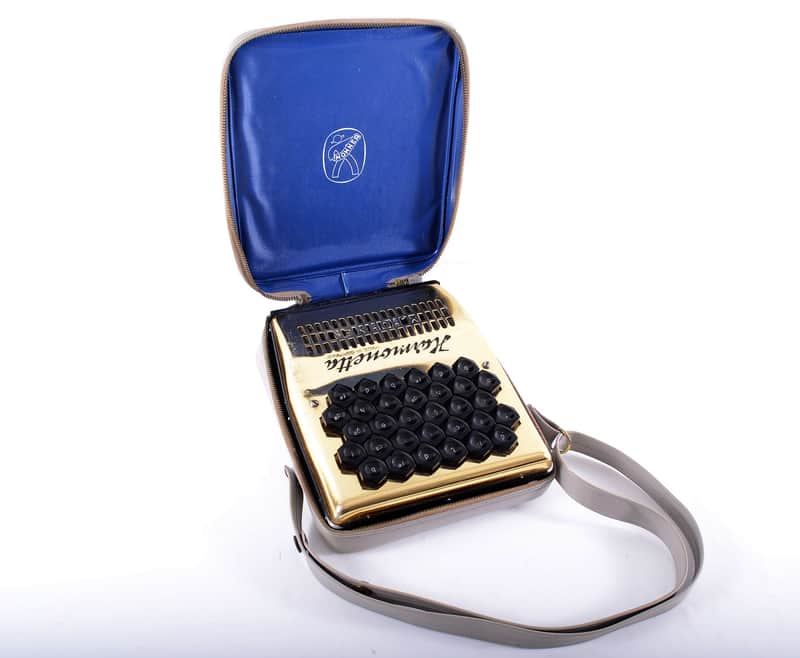
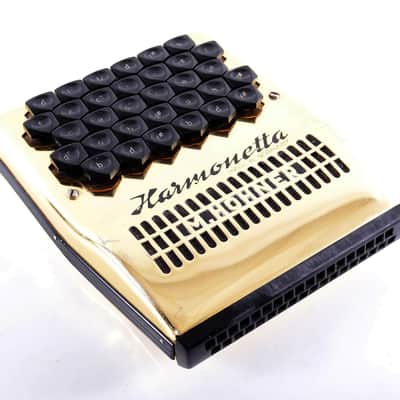
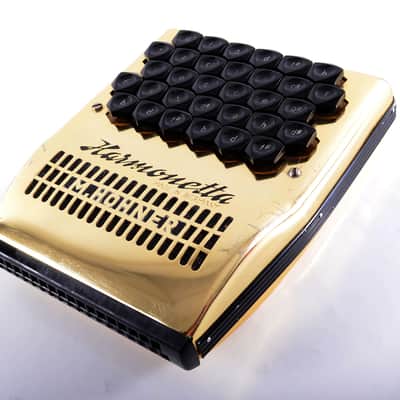
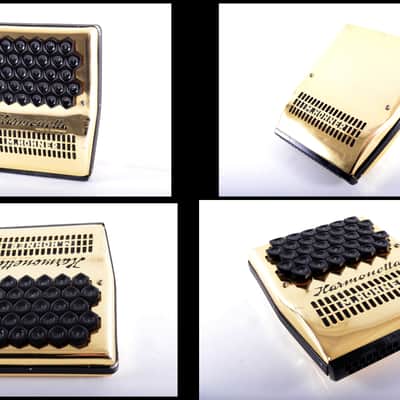
Extremely Rare, Vintage, Collectible, Excellent Musical Instrument Hohner Harmonetta Harmonica + Original Case - Made in Germany - 1960`s
This listing has ended
See similar gear from other Reverb sellers

Our users rate Reverb
The Hohner Harmonetta is a mouth-blown free-reed instrument which was introduced by Hohner in the 1950s. It has an approximately 3-octave range, from C3 to B5.
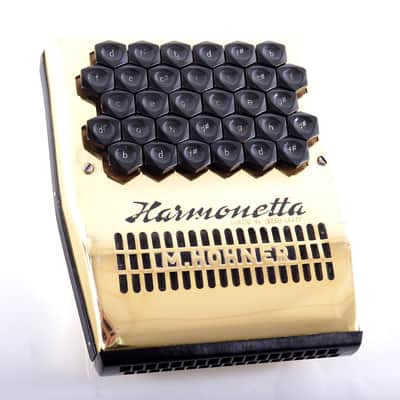
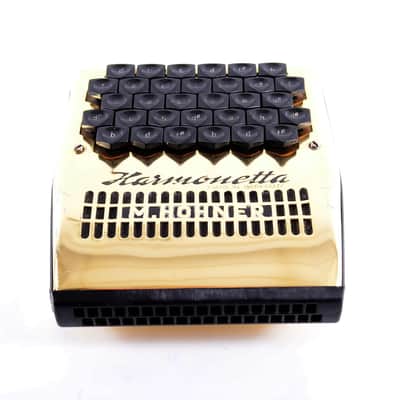
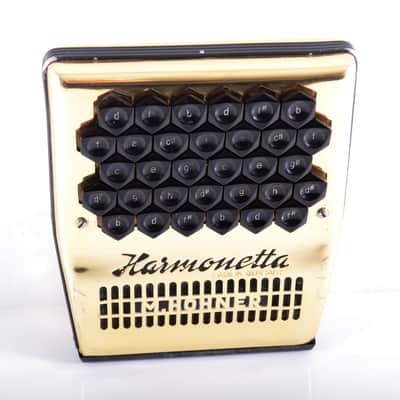
The Harmonetta combines features of the harmonica and the melodica. It has a keyboard of 32 hexagonal buttons laid out according to the harmonic table, each labeled with one of the 12 pitch classes. The buttons (on this particular example) are labelled in German, thus the letter "h" is used where English speakers would use "b", and the letter "b" is used where an English speaker would use "Bb". Depressing a key makes it possible to play all notes of that pitch class; which octave sounds depends on where the mouth is positioned on the mouthpiece. There were other location-specific versions of the Harmonetta released, including the French-designated one, in which the buttons say tone names such as "Do Re Me" instead of "C D E". There was also the US export versions. The instrument is unisonoric, meaning that the same note is played on both blowing and drawing. Hohner discontinued the Harmonetta in 1984.
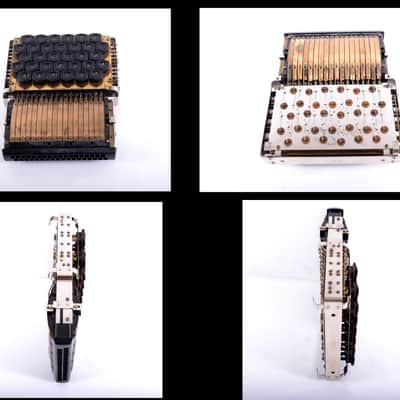
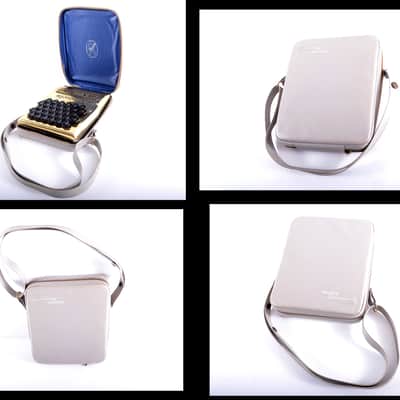
The earliest of the Harmonettas featured all black keys, and did not say "Made in Germany" on the cover plates. These Harmonettas internally used red Bakelite parts. The cases of these first Harmonettas were wooden, with felt interior. Starting on the 2nd generation models, the case was changed to a zipper and the "made in Germany" stamping appeared on the top cover. The later Harmonettas (1960s and newer) featured white rings around the "E" keys, in the center of the instrument and had black internal Bakelite parts.
There was a 2 row prototype Harmonetta, with built in synthesizer, called the CharlieMonica, built in the early 1970s. It is thought that Bernie Bray owned this instrument for a short time.
Measurements
harmonica: 1 15/16 in x 6 in x 7 1/8 in; 4.92125 cm x 15.24 cm x 18.0975 cm
case: 2 3/4 in x 6 5/8 in x 10 in; 6.985 cm x 16.8275 cm x 25.4 cm
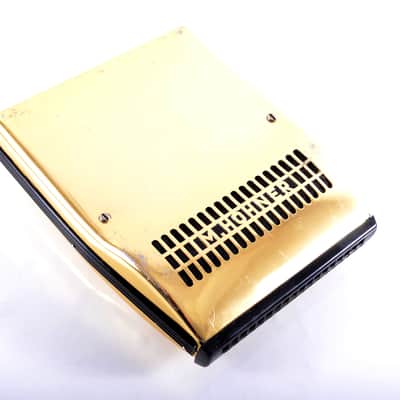
This harmonetta was made by M. Hohner in Germany, early 1950s – mid-1970s. It has 18 double holes with 32 hexagonal buttons in harmonic table note layout. This harmonetta has a black plastic comb with a gold tone metal body with air holes. Accessioned with original leather covered wooden case.
The harmonetta combines features of the harmonica and the melodica. Individual notes can be played by depressing a single button. Chords can be played by depressing multiple adjoining buttons.
German musician and engineer Ernst Zacharias (b. 1924) invented the harmonetta and has received over 90 patents for Hohner, including plastic recorders and watch and clock mechanisms.
This is an amazingopportunity to buy a rare Hohner HARMONETTA Chord Harmonica. Very few of these incredible instruments were ever made. It allows the player to play every chord you can imagine as well as tunes and each note works on the blow and draw to produce the same pitch. On the top of the harmonica there are all the notes you need for chords or melodies arranged in clusters. This makes all the chords - both major and minor - easily accessible.
NOT EASY PIECE TO FIND!!!!
In the 1950's Hohner manufactured this perculiar mechanic wonder: Harmonetta chord harp. Harmonetta is an interesting combination of accordion and harmonica. There are a set of keys on top. Each key selects the playable note when blowed (or drawed). The key opens up to three reeds each one octave apart. The musician can then select the playing octave by varying the playing position.
Because the same set of notes are produces with both blowing and drawing, this enables the production of very fast and accurate rythmic patterns, which is a great benefit to an accompany instrument like this.
From the construction point of view, this means that each note requires two reeds - one for blowing and another for drawing.
Harmonetta is an ideal instrument for producing incredible complicated chord structures. In theory is would be suitable for playing melodies too, but the cumbersome key layout and fine air hole structure makes it very difficult to pick up the right notes.
Harmonetta has reed plates which have flat valves, so overblowing or note bending is not possible. In addition the physical distance between the holes and the reeds does not allow fine tuning of air flow, thus articulation variations are quite limited. It is unfortunate that Hohner decided to cease manufacturing this fine chord instrument already around 1960's. Harmonetta capabilities as accompany instrument are yet to be defeated.
This item is sold As-Described
This item is sold As-Described and cannot be returned unless it arrives in a condition different from how it was described or photographed. Items must be returned in original, as-shipped condition with all original packaging.Learn More.
| Listed | 4 years ago |
|---|---|
| Condition | Very Good (Used) Very Good items may show a few slight marks or scratches but are fully functional and in overall great shape.Learn more |
| Brand | |
| Model |
|
| Categories | |
| Year |
|
| Made In |
|
Product safety information may be available here.