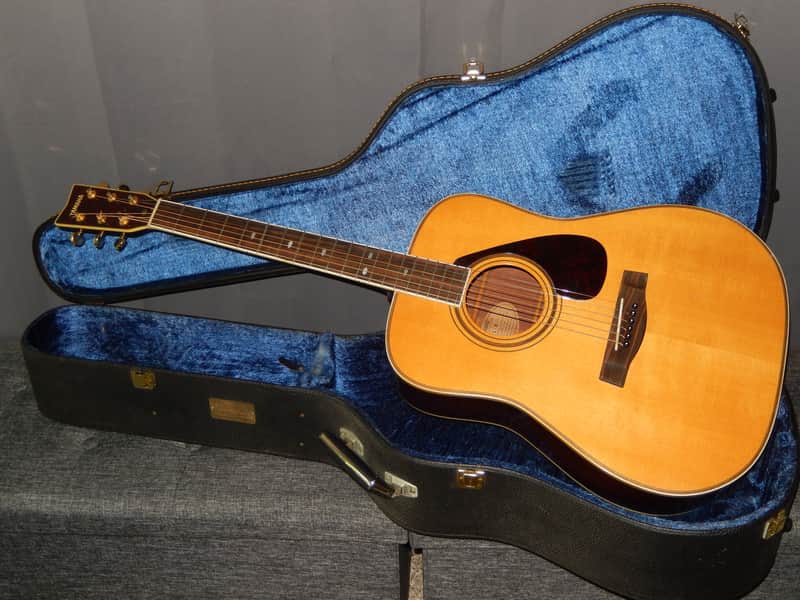
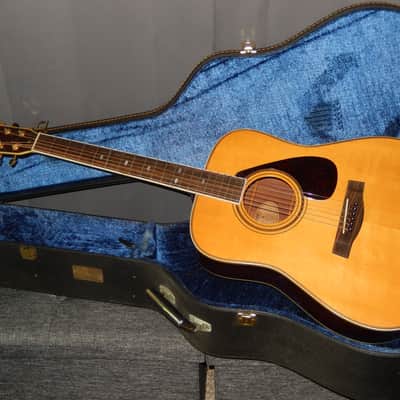
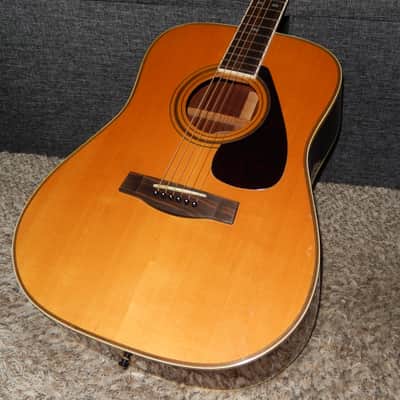
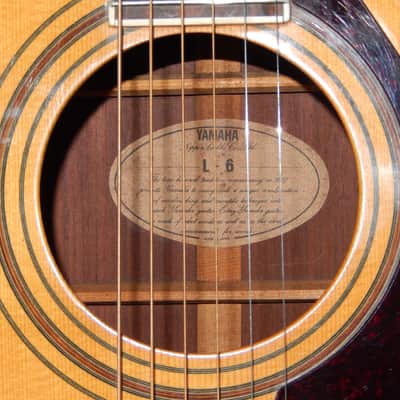
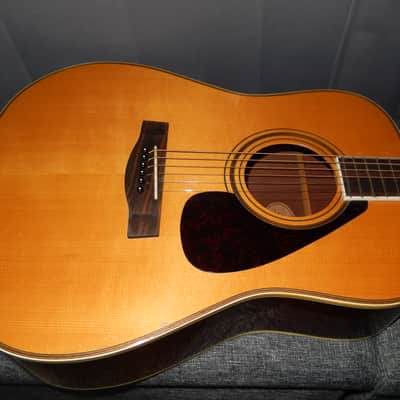
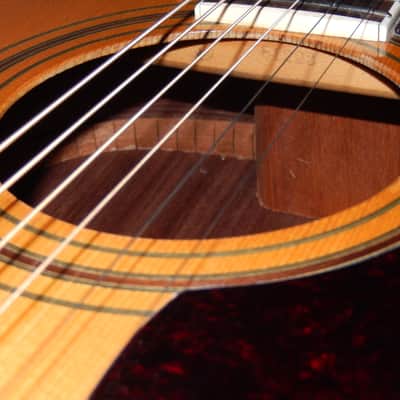
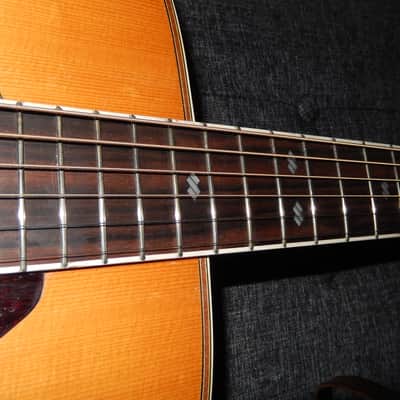
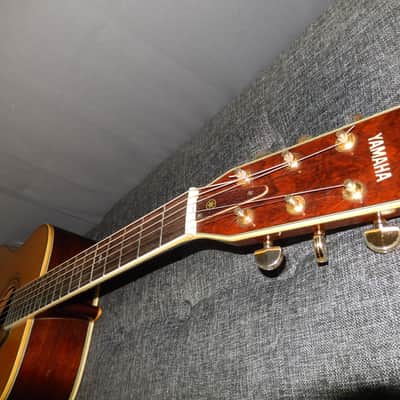
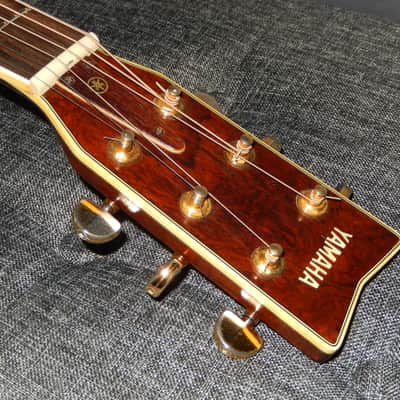
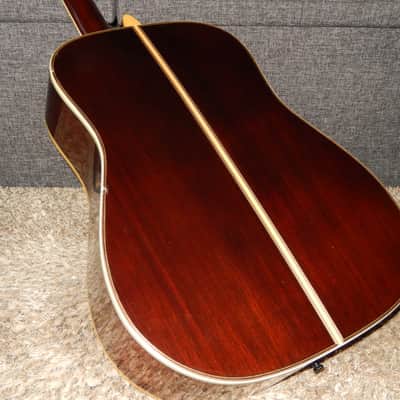
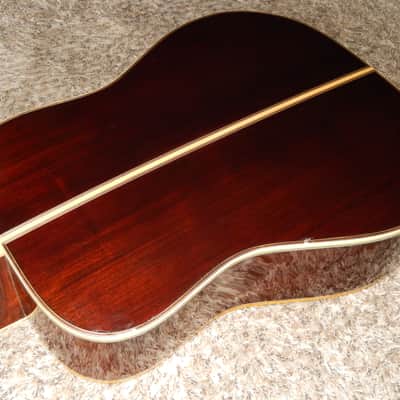
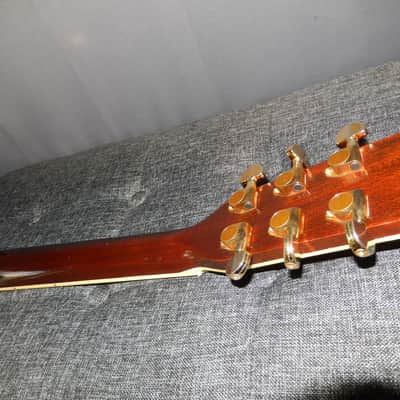
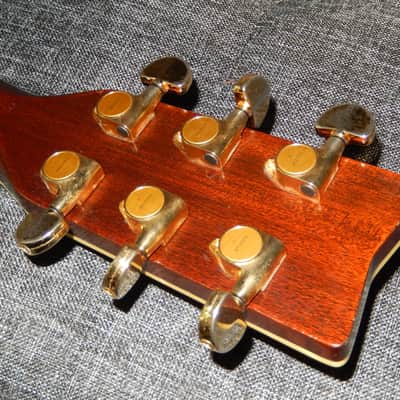
MADE IN JAPAN - YAMAHA L6 1978 - ABSOLUTELY MARVELOUS ACOUSTIC CONCERT GUITAR
This listing has ended
See similar gear from other Reverb sellers

Our users rate Reverb
Yamaha L6 1978
This Yamaha guitar was made in early 1978 at Yamaha's Custom Workshop in Hamamatsu, Japan. Since early 1970s this workshop was led and supervised by Terry Nakamoto, a luthier legend in his own right.
Yamaha’s L series acoustic guitars were officially launched in 1976 and priced at the same level as Yamaha’s classical guitar Grand Concert models. L stands for “luxury”.
When you try to play this guitar, you'll quickly agree that it not only sounds much better than most $5000+ guitars currently sold at Guitar Center but can beat many much higher priced "luthier made" acoustics.
Among all Japanese makers active in 1970s, Yamaha was they only one workshop not making “copies” of famous Western brand guitars. Although originally inspired by Martin, Gibson or Guild blueprints, Yamaha had their own designs and innovations, creating marvelous instruments that frankly leave all the US brands “in a dust”.
Once you experience that sound of this Yamaha L6, you won’t be drawn to any other brand guitars. Guaranteed.
This guitar is loud and very responsive. Its tonality is of breathtaking beauty, rich with overtones and harmonies yet combined with very high level of note clarity and separation all along the neck. There are no weaker or dead notes. They are all evenly expressive across entire range. All these traits are "magnified" by very extended sustain. It is simply a magical joy to play.
Yamaha L6 was priced 60 000 yen in 1978, offering exceptional value for the money.
Despite their visual differences (ornamental extras), model L6 made until 1978 was of practically the same grade as model L8 made until 1978 and model L10 made between 1979-1980.
Since 1976 through late 1978 model 6 was made with solid Indian Rosewood b/s, (black or striped) ebony bridge and fingerboard. In 1979 model L6 was made with solid Indian Rosewood back but non-solid sides (ebony bridge and fingerboard). In 1980 model L6 was made with non-solid back and sides, rosewood bridge and ebonized rosewood fingerboard.
Since late 1960s Japanese guitar makers were trying hard to win as many international customers as possible. These were the years of significant international recognition of their, soon very highly regarded products. Their guitars offered the highest possible level of craftsmanship with great deal of attention to even the tiniest details. Yamaha was unquestioned leader among Japanese guitar exporters and by late 1970s it was also a world leader on musical instruments market. The same late 1970s were also the end of "Golden Era" for Japanese guitar makers. Changes in world and Japanese economies and very importantly changes in currency exchange rates have led to higher prices of materials imported to Japan and higher real prices of goods exported from Japan. Many smaller scale makers went out of business or sold their workshops to larger companies or investors. As one of major Japanese guitar makers Yamaha had to do redesign their guitar lineups to stay profitable. Their lower end models had to be made from lower grade materials and simpler way, while higher end models had to be priced higher. To offer great quality instruments at affordable prices, in mid 1980s Yamaha decided to close their old Tenryu/Wada factory and open new Kaohsiung Factory in Taiwan. Since that moment only the very top Yamaha models were made by its custom shops in Hamamatsu. In 1990 Yamaha opened yet another factory in Indonesia. As of today, great majority of Yamaha guitars are made in China. Many of them are of very high grade yet sold at quite affordable prices. Those made in Japan are priced very high.
I hope that by now you may realize the real value of this nearly 40 years old wonderful Yamaha L6.
This guitar remains in “very good for its age” structural and cosmetic condition. While its top bears several light dents and scratches, back and sides bear few more light dents, scratches and abrasions, there are few light capo marks on the back of the neck, guitar is structurally sound and very playable. Very importantly its neck is straight, while frets and fingerboard are still in excellent condition.
SPECIFICATIONS:
Year(s) Sold: 1976-1980
Top: Solid Yezo Spruce/lacquer
Back & Sides: Solid Indian Rosewood/urethane
Neck: Honduras Mahogany
Fingerboard: Striped Ebony
Bridge: Striped Ebony
String Length: 650mm
Nut width: 43 mm
Current action is set to 2.5mm under E6 and 2.00 mm under E1 with plenty of extra room on the saddle.
Guitar will be shipped in used hard shell case in still good condition.
Real Value of Japanese Vintage Guitars
The key to understand value of vintage Japanese guitars is to acknowledge galloping price inflation (devaluation of Japanese yen) during 1960s & 1970s. This inflation slowed down in 1980s.
During 1960s and most of 1970s model numbers of Japanese guitars were strictly interconnected with their prices in Japanese yen. By early 1980s and during following decades model numbers were no longer strictly associated with their prices. Some Japanese guitar makers introduced model names instead of model numbers. Others were still using model numbers with addition of letters and/or other symbols.
It is then important to understand that two Yamaha GC10 guitars made 10 years apart are two instruments of totally different class. The same applies to any other Japanese maker/brand.
The logical way to estimate the true class of any given Japanese made instrument is to compare its price with the average annual salary of wage workers in Japanese private sectors. This salary was: 450 600 yen in 1965 - 825 900 yen in 1970 - 1 868 300 yen in 1975 - 2 689 000 yen in 1980 - 3 163 000 yen in 1985 - 3 761 000 yen in 1990 - 4 107 000 yen in 1995 - 4 082 000 yen in 2000.
Any guitar priced 100 000 yen in 1970 (labelled as No10 or No100) would be priced 200 000 yen in 1975 (relabeled to No20, No200 or 2000), 300 000 yen in 1977 (labelled as No3, No30 or 3000) and 500 000 yen by 1985 (labelled as No50 or 5000).
Starting in 1977 Masaru Kohno introduced his new models No40 priced 400 000 yen and No50 priced 500 000 yen. By early 1980s Kohno started using model names instead of numbers and was steadily raising their prices without changing model labeling. His very top model 50 became model “Special”, and a decade later it became model “Maestro”. Naturally, all other Japanese guitar makers were doing similar pricing (labelling) upgrades.
Knowing all of that, you can bet on that Masaru Kohno No50 made in 1982 is practically the same grade instrument as Kohno No20 made in 1972, or Kohno no 30 made in 1975.
In early 1970s the lowest Ryoji Matsuoka (all plywood) model was 10, followed by (solid top) models 15, 20, 25, 30, 40, 50, 60, 80 and (all solid woods) models 100 and 150. Models 50, 60 and 80 were made with non-solid figured Brazilian Rosewood (double) back and sides and top model 150 was the only one made with solid figured Brazilian Rosewood b/s.
In 1980 the lowest Matsuoka model was (all plywood) 20, followed by (solid top) models 30,40,50, 60 and all solid woods models 80,100,150 and 200. By 1990 the lowest Matsuoka model was M40 and the highest was M300. By 2010 the lowest Matsuoka model was M50 and the top model was M270.
You can bet that Ryoji Matsuoka model 50 from 1980 is of the same grade as model M100 from 2000, model 100 from 1980 is of the same grade as model M150 from 2000, model 150 from 1980 is of the same grade as M200 from 2000 and model 200 from 1980 is of the same grade as model M300 from 2000.
It is important to mention that if modern era luthiers are using 40+ years old woods to make an “all solid” wood classical guitar, its price is minimum $8000.
All vintage guitars made with Brazilian Rosewood are especially precious, including those made straight grain varieties and those with non-solid b/s.
Because response and tonal properties of Spruce soundboards are improving over time, long seasoned Spruces are far more precious than long seasoned Cedars.
It is not very difficult to find out what are current prices of such guitars made by world’s leading luthiers.
| Listed | 4 years ago |
|---|---|
| Condition | Very Good (Used) Very Good items may show a few slight marks or scratches but are fully functional and in overall great shape.Learn more |
| Brand | |
| Model |
|
| Finish |
|
| Categories | |
| Year |
|
| Made In |
|
| Body Shape |
|
Product safety information may be available here.