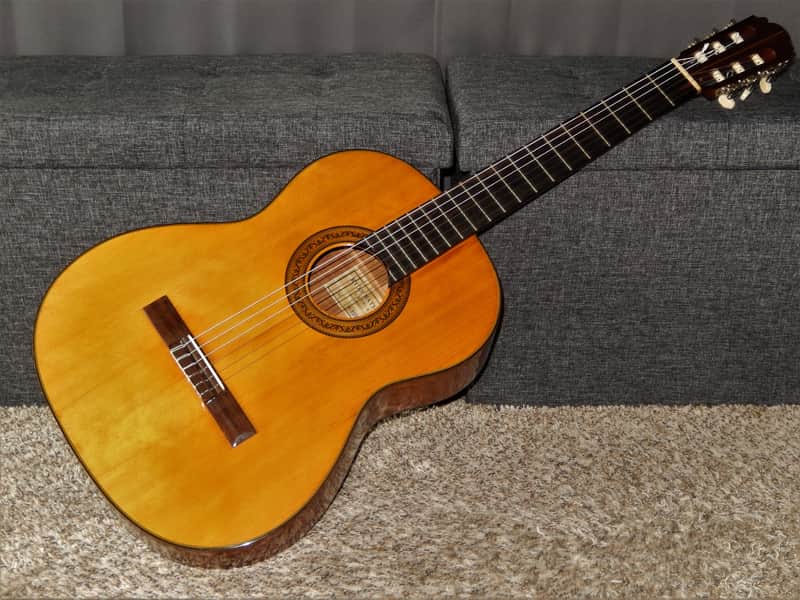
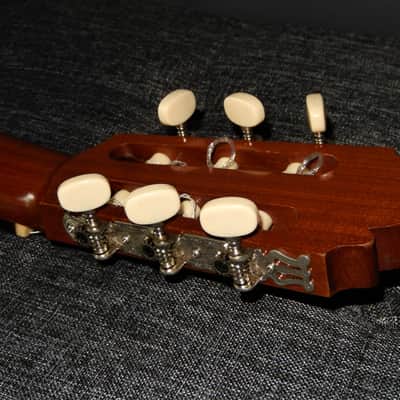
HAND MADE IN 1968 - RYOJI MATSUOKA No.120 - SOLID SPRUCE TOP CLASSICAL GUITAR
This listing has ended
See similar gear from other Reverb sellers

Our users rate Reverb
Made in 1968 Ryoji Matsuoka 120 Classical Guitar
Ryoji Matsuoka was one of the best known Japanese luthiers. His classical guitars are played all around the world. Through all the years of his professional career Ryoji's guitars offered exceptional value for the price. If compared to guitars made by other Japanese luthier's and Gakkis, Ryoji's guitars were clearly underpriced. It was Ryoji's business philosophy to deliver great instruments at prices affordable to less wealthy guitar enthusiasts. Even though since 1986 Ryoji's workshop was managed by his son Toshiaki, Ryoji's vision was still in place. It is quite likely that Ryoji's workshop wasn't profitable at the end of its existence. It might not be a coincidence that soon after Ryoji's death in September of 2014, his workshop was closed and production of "made in Japan" Matsuoka guitars ended. As of today, all brand-new Matsuoka guitars available on Japanese market are made in China.
Guitar you are looking at was made by Ryoji’s workshop 50+ years ago.
My experience with vintage Japanese made classical guitars leads me to a conclusion that this guitar was made around 1967/68.
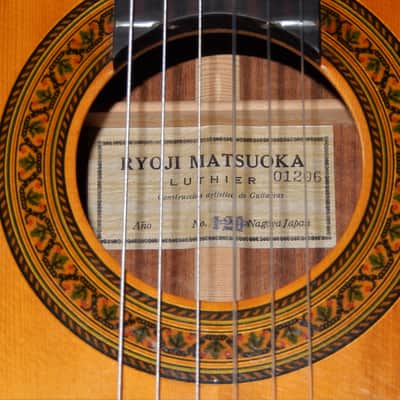
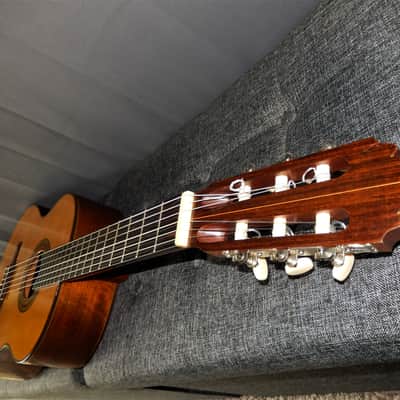
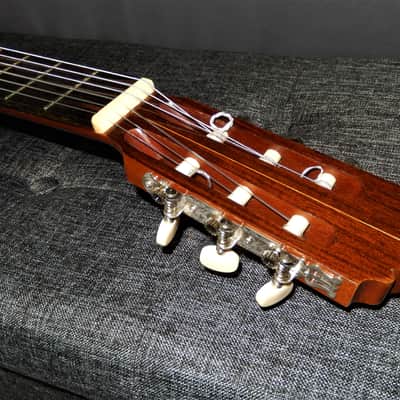
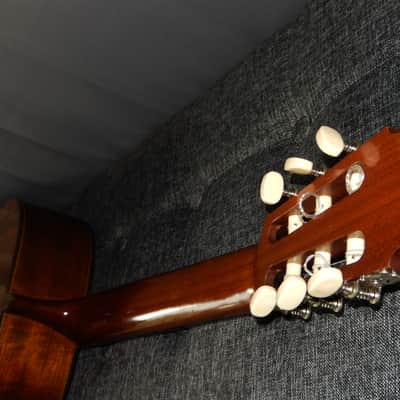
The oldest Matsuoka guitars I have ever encountered were made in 1964. They had no serial numbers. By 1967/68 Matsuoka started making guitars for Shiro Arai, sold as Arai or later as Aria guitars. These guitars had Matsuoka’s initials (R.M.) stamped on the brace or heel block. Serial numbers were Aria’s not Matsuoka’s. The oldest Matsuoka’s guitars with English version label and serial number I’ve seen so far, were made in 1970. Their serial numbers were 02795 and 03331. Guitar you are looking at has serial number 01206. Guitars with the same style headstock, bridge and label design were used by Matsuoka only in late 1960s.
Model 120 was made only in those late 1960s. It was priced 12 000yen. There was no other model 120 ever made between 1970 - 2014. In 1970 the lowest Matsuoka models were 10 (10 000yen), 12 (12000 yen) 15 (15 000 yen), 20 (20 000yen). In 1972 the very top Matsuoka models were 100 (100 000 yen) and 150 (150 000 yen).
Although made with solid top No.120 was a lower end model. While it offers very good volume and quite nice tonality it should be considered nothing more but student level instrument.
Because of the way it was made back then it has relatively high (Ramirez style) action even though its saddle is lowered to 1mm margin.
Therefore, as it is, I could recommend it only to a beginner or someone who needs a guitar for practice (during travel etc.).
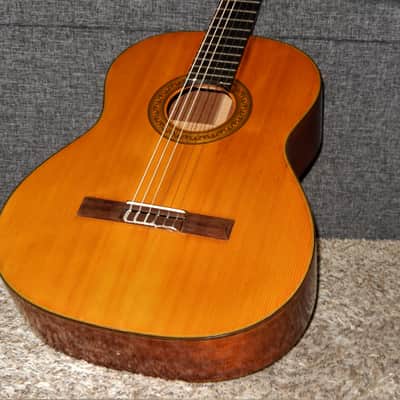
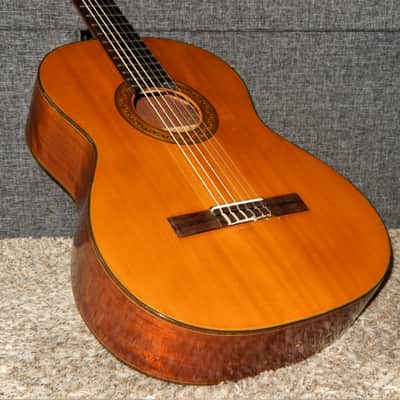
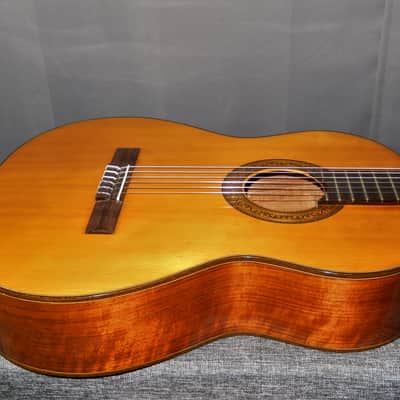
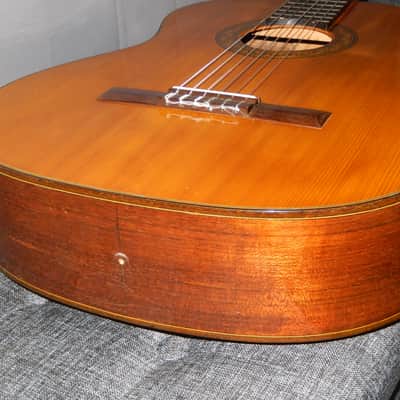
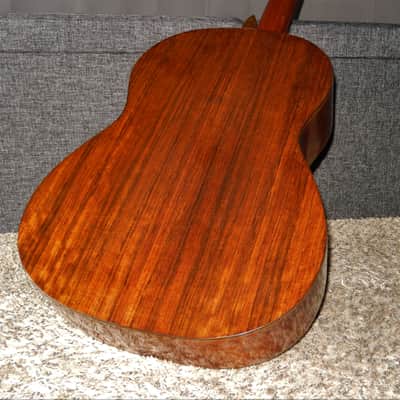
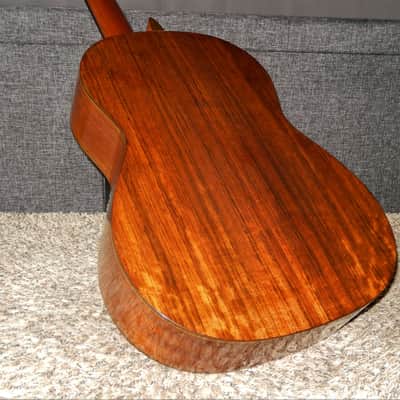
Overall condition of this guitar can be described as “at least very good for its age”. Besides several small marks within its finishes, its body doesn’t bear any conspicuous dents or scratches. However it has suufered a terrible damage: someone installed end-pin on its bottom. To make matters even more terrible, this end-pin is missing. Otherwise this fuitar doesn’t have any structural flaws.
Specifications:
Top: Solid Spruce
Back and sides: non-solid Flamed Mahogany
Neck: Mahogany
Fingerboard: Brazilian Rosewood or striped Indian Ebony
Scale: 650 mm
Nut width: 52 mm
Current action is set to around 4.5 mm under E6 and 4.00 mm under E1 with practically no extra room on the saddle. Therefore you should only use low tension strings.
Guitar will be shipped without any case, just securely packed in sturdy shipping box.
The key to understand value of vintage Japanese guitars is to acknowledge galloping devaluation of Japanese yen in 1960s & 1970s. This devaluation was somewhat slower in 1980s. The best measure of this devaluation is Starting Yearly Salary of Japanese College Graduate (SYSJCG).
SYSJCG in 1965 was 19 600 yen, in 1969 – 34 600 yen, in 1970 39 200 yen, in 1972 – 62 300 yen, in 1975 79 200 yen, in 1977 86 200 and in 1980 - 100 000 yen.
During 1960s and most of 1970s model numbers of Japanese guitars were strictly interconnected with their prices in Japanese yen. In late 1970s and during following decades model numbers were no longer strictly associated with their prices. Many Japanese guitar makers introduced model names instead of model numbers. Others were still using model numbers with addition of letter abbreviations or other symbols.
The best and only logical approach while evaluating real value (real grade) of vintage Japanese guitar is to compare its price in Japanese yen with SYSJCG during the year guitar was made.
Any guitar priced 100 000 in 1970 (labelled usually as No10) would be priced 200 000 yen in 1975 (relabeled to No20 or 2000), 300 000 yen in 1977 (labelled as No3, No30 or 3000). Starting in 1977 Masaru Kohno introduced his new models No40 priced 400 000 yen and No50 priced 500 000 yen. By 1984 Kohno started using model names instead numbers and was raising their prices as he was pleased. Model 50 became model “Maestro”, model 40 became model “Special”, model 30 became model “Professional-J”. Naturally all other Japanese guitar makers were doing the same pricing (labelling) upgrades.
Knowing all of that, you can bet on that Masaru Kohno No50 made in 1982 is practically the same grade instrument as Kohno No20 made in 1972, or Kohno no 30 made in 1976. Kohno No40 made in 1982 is of the same grade instrument as Kohno No15 made in 1972 or Kohno No20 made in 1975.
In 1970 the lowest Ryoji Matsuoka (all laminates) model was 10, followed by (solid top) models 15, 20, 25, 30, 40, 50, 60, 80 and (all solid woods) models 100 and 150. Models 60 and 80 were made with non-solid figured Brazilian Rosewood (double) b/s and top model 150 was the only one made with solid figured Brazilian Rosewood b/s.
In 1980 the lowest Matsuoka model was (all laminates) 20, followed by (solid top) models 30,40,50, 60 and all solid woods models 80,100,150 and 200. By 1990 the lowest Matsuoka model was M40 and the highest was M300. By 2010 the lowest Matsuoka model was M50 and the top model was M270.
You can bet that Ryoji Matsuoka model 50 from 1980 is of the same grade as model M100 from 2000, model 100 from 1980 is of the same grade as model M150 from 2000, model 150 from 1980 is of the same grade as M200 from 2000 and model 200 from 1980 is of the same grade as model M300 from 2000.
It is important to mention that if modern era luthiers are using 40 years old woods to make an all solid woods classical guitar, its price is minimum $8000.
All vintage guitars made with Brazilian Rosewood are especially precious, including those made straight grain varieties and those with non-solid b/s.
Because response and tonal properties of Spruce soundboards are improving over time, long seasoned Spruces are far more precious than long seasoned Cedars.
It is not that very difficult to find out what are current prices of such guitars made by world’s leading luthiers.
All vintage guitars that I have for sale are inspected, cleaned, fixed and improved if necessary, their frets leveled, fingerboards cleaned and dressed with lemon oil, new strings (matching guitar’s potential) installed and their height adjusted to improve their playability. Thanks to my detailed descriptions experienced players know exactly what I have to offer. These experienced buyers know what great value and peace of mind they get while buying a guitar from me. For that I am being paid. My prices are set very at very fair level for what they represent.
This item is sold As-Described
This item is sold As-Described and cannot be returned unless it arrives in a condition different from how it was described or photographed. Items must be returned in original, as-shipped condition with all original packaging.Learn More.
| Listed | 5 years ago |
|---|---|
| Condition | Very Good (Used) Very Good items may show a few slight marks or scratches but are fully functional and in overall great shape.Learn more |
| Brand | |
| Model |
|
| Finish |
|
| Categories | |
| Year |
|
| Made In |
|
| Body Shape |
|
Product safety information may be available here.