Peavey Kosmos Pro Sub-Harmonic Processor / High Freq Enhancement System #30980
Price€244.51
+ Shipping
This listing has ended
See similar gear from other Reverb sellers
Listed:11 years ago
Views:659
Watchers:21

Pensacola, FL, United States
Our users rate Reverb
Thank you for taking the time to visit Blues Angel Music's Reverb store! Blues Angel Music, est. in 1997 in Pensacola, Florida, has been named by NAMM (National Association of Music Merchants) as one of the "TOP 100" music stores in the USA since 2011!!! Your satisfaction is our #1 objective!
Peavey Kosmos Pro Sub-Harmonic Processor / High Frequency Enhancement System #30980
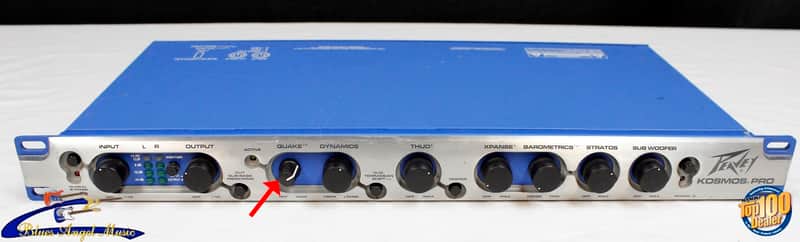
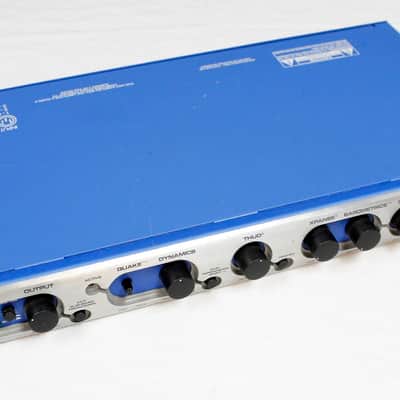
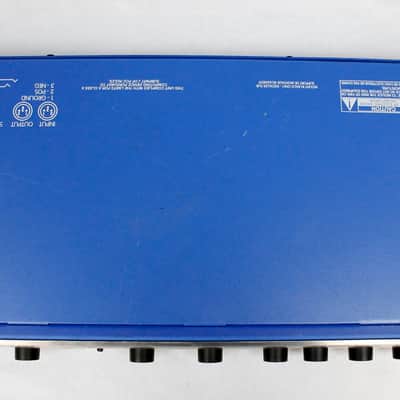
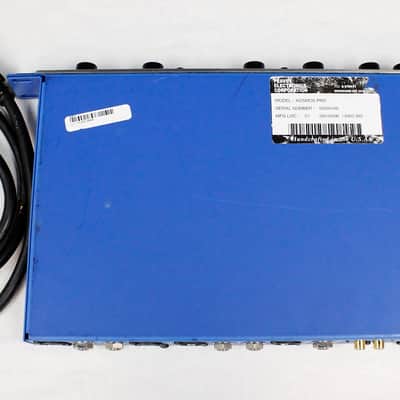
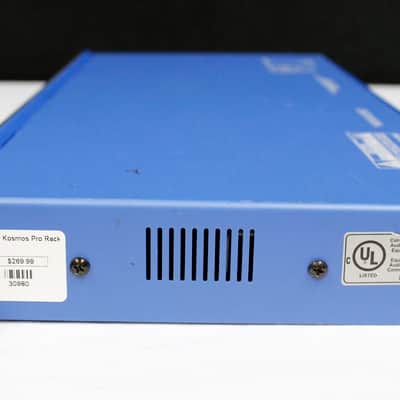
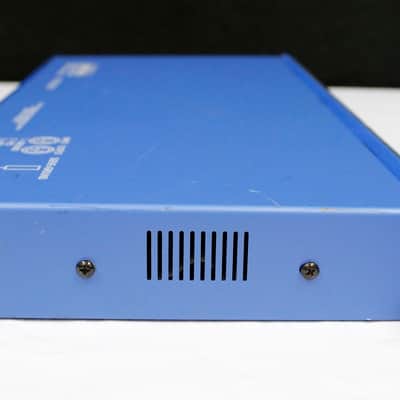
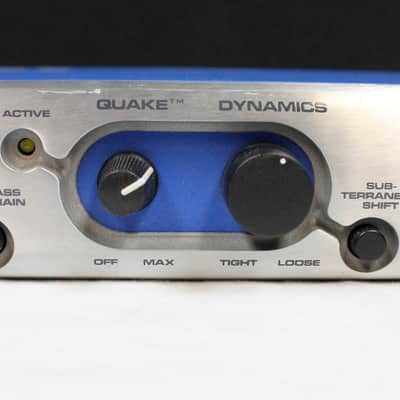
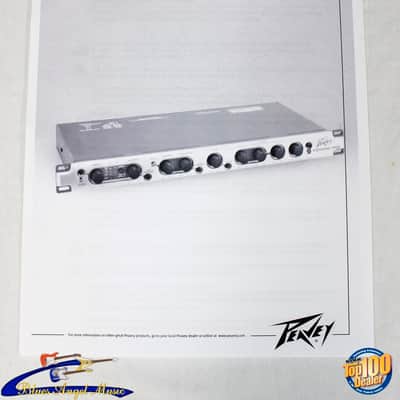
Blues Angel Music is pleased to present this Peavey Kosmos Pro Rack-mount unit! Designed and made in the USA, this blue wonder has been gently cared for, and is in Very Good to Excellent cosmetic condition, with just a few minor surface scratches (see pics). Comes with power cable and printed manual. One of the original knobs is missing, and has been replaced with a spare (see pics). It has been tested and is in 100% optimal working condition! We invite you to view its pictures carefully and contact us with any questions you may have.
Manufacturer's Description The kosmos Pro is the next generation of the award winning kosmos sub-harmonic enhancement system. Through special processes (patents pending), it can provide planet rattling bass while simultaneously adding clarity, definition, and sparkle. Its design puts it at home in any rack of professional gear, where it will soon become the most used piece.
The design philosophy of this unit was to create a processor that would enable a small set of speakers to appear as if they were larger, and large speakers to sound huge, while at the same time improving the fidelity and image. By adding generated bass sub-harmonics and high frequency harmonics that are not present in the original source, these enhancements do not cloud the mix, but add separation.
To keep the sub-bass from walking over other instruments in the mix, it must be precisely created with a defined envelope in a specific frequency range. We call this circuitry QUAKE. It operates by continuously monitoring the input signal for bass content that meets defined criteria, then generates synchronized low frequency material an octave below it. It has a unique feature that is found on no other bass processors- an adjustable dynamics control which modifies the bass tracking parameters from tight to loose. The tight setting provides higher definition and punch, the loose setting allows a longer settling time. The output frequency range of the process can be shifted higher or lower to match the speaker size by using the SUB-TERRANEAN shift switch. The sub-harmonic activity is monitored and indicated by a light and the output level is fully adjustable.
In addition to the QUAKE process, there is an additional bass circuit, THUD, tuned roughly an octave above the sub-harmonic range, which can be used to fill in and fatten out the upper‚ low end. A tuning switch removes some of the higher bass frequencies, giving it a deeper tonality. Since the QUAKE and THUD circuits are phase synced, the two adjustments interact, supplying waveform and level adjustment for the bass enhancement process. High frequency content and stereo imaging can be improved with the three atmospheric controls (XPANSE, BAROMETRICS, and STRATOS), which give increased separation and clarity. The XPANSE works with the BAROMETRICS control to provide phase and frequency manipulation that works especially well with vocals. The STRATOS control adds a high frequency harmonic sheen.
All inputs and outputs are balanced. To allow for maximum flexibility, input and output level controls are provided with selectable metering. The sub-woofer output has built in cross-over circuitry and a separate level control to supply an equalized bass signal for systems with subs. The QUAKE and THUD processes can be removed from the main left and right outputs, leaving them only in the sub-woofer output. S/PDIF in and out is also provided for direct connection to other digital audio equipment. If used as an analog to digital converter, the kosmos Pro defaults to a 44.1K Hz sampling rate, if receiving input from another source, it locks onto the incoming clock. The status is indicated on the rear panel. All together, the systems in the kosmos Pro affect the soundscape from underground to upper atmosphere. It will rattle your planet, or just your windows.
Front Panel Controls Global Bypass: This switch disables all functions except the sub woofer control which still functions as a cross-over level control (with the kosmos bass effects turned off) when bypassed. The status is indicated by a red LED which is lit when bypassed.
Input Level: This control sets the input gain of the unit. For optimum signal to noise and performance, it should be set so that the 0 dB LED (+4 dBu) of the level meter (when set to monitor the input) is flickering most of the time and the clip LED does not blink. The center detent position is the unity gain point. If the levels are too high, heavy bass material could result in clipping and distortion.
Meter Select: The meter will display the level of either the input signal after the input level control or the output. The top LED has two colors; it will illuminate yellow as a warning, then change to red 4 dB below the clip point.
Output Level: The output of the unit is set by the output level control. The detent position is the unity gain point, with an additional 10 dB gain available. Set this control so that the output level does not change when the bypass switch is pressed. This control also affects the S/PDIF output level.
Cut Sub-bass from Main: This switch removes the QUAKE sub-harmonics and the THUD bass from the main left and right outputs. (It does NOT remove normal bass from the program material.) This allows all the ADDED bass to be sent only to the sub woofer output when a three speaker system is used. When the left and right speakers can not handle the additional bass produced, this is the best way to route low frequency enhancements. The XPANSE, and STRATOS signals are always sent to the mains and are not affected by this switch’s setting.
Sub-terranean Shift: This switch changes the sub-harmonic tuning between two speaker size settings. The “out” position has a higher center frequency which is more suitable for small speakers, the “in” position shifts the frequency content lower for larger speakers that can handle the deeper bass. If there is no noticeable difference, the speakers may not be able to reproduce the deep bass, so the small speaker setting is recommended. This trims back the lowest frequencies, keeping the amplifier from delivering power that the speaker can’t use or may even be harmful.
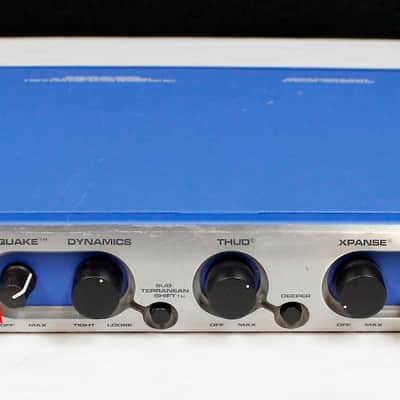
Quake: This control adds a synthesized bass signal one octave lower than what is present in the source. It works in tandem with the DYNAMICS control. The circuitry of this process looks for specific bass information (frequency and amplitude) and generates natural sounding sub-harmonics. It does no processing if the input signal is outside of its defined range. It will thicken and deepen the bass of most program material and is especially effective on bass drums. Since it boosts the low frequency portion significantly, care must be taken to prevent amplifier clipping and speaker damage by excessive bass levels, especially if small speakers are used.
Quake Active: The activity of the QUAKE circuitry is indicated by this light. It is provided as a reference; sub-harmonics are still being generated when it is not lit if useable bass information is present, although the level may be very low. If there is no bass in the source, this lamp will not light.
Dynamics: There are instances when you want the sub-harmonics to tightly track the natural bass, and other times you may want it to follow loosely. The QUAKE DYNAMICS control allows this to be adjusted. The tight setting adds punch, the loose setting adds a fuller low end, just as a damped bass drum is percussive and an undamped one has increased sustain.
Thud: This control adds a specific band of bass frequencies (natural, not synthesized) to the subharmonics generated by the QUAKE process. It is tuned roughly an octave above the sub-harmonics, and is used to even out the low end balance. The THUD and Quake waveforms are phase synchronized, so adjustments effectively modify the wave-shape as well as the amplitude, and may sound different than expected.
Deeper: This narrows the THUD circuitry’s range by removing some of the higher bass frequencies. This gives another option for low frequency adjustments.
Xpanse: This control works in conjunction with the BAROMETRICS control. It simultaneously adds high frequency components and increases stereo width. The minimum position is the flat setting, as it is advanced, the left-right image becomes wider and clarity is increased. It has been designed to pull vocals more to the front of the mix and to reduce speaker comb filtering effects. It will not create a stereo image from a mono source, but will improve one that is already there.
Barometrics: This control pans between the two processes of the XPANSE circuitry. When set counterclockwise (DENSE) the phase manipulating processes dominates. When set clockwise (THIN), it accentuates the high frequency enhancements. The typical setting will be close to the center of the range.
Stratos: This control adds high frequency harmonics to the source. The frequency range is higher than the XPANSE range and compliments it. It will add crispness to dull source material.
Sub-woofer: Built into the kosmos Pro is a 90 Hz sub-woofer cross-over. The sub-woofer signal is the sum of the QUAKE output, the THUD output, and the low frequencies from the 90 Hz cross-over network. This control sets the output level. When the bypass switch is engaged, the added QUAKE and THUD components are removed, leaving only the low frequency cross-over material. In this mode, the control behaves as a normal sub-woofer level control.
Power: Applies AC mains power to the unit and causes the power LED will light. Line power is required even in bypass mode, since the unit has built-in active level shifting capabilities with its independent input and output level controls.
Rear Panel Controls IEC Mains: Used to connect the supplied AC mains cord. Make sure that the correct line voltage is applied, or damage to the unit could result. (See markings on unit.)
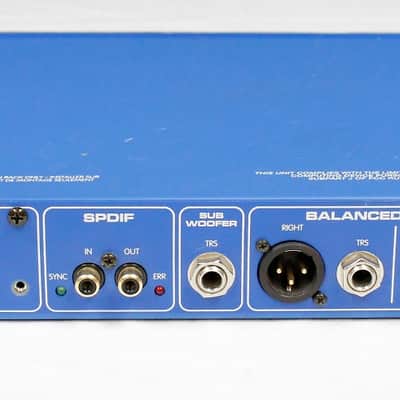
S/PDIF: These are the stereo digital inputs and outputs provided to connect to other digital equipment, such as a computer or DAT deck. The input syncs to an incoming clock (up to 48 kHz) if one is present, defaulting to 44.1 kHz if one is not. Two lights indicate if it has locked onto an input clock or if there is an error in the data. The digital input is only connected to the analog processes if the kosmos Pro input selector switch is in the S/PDIF mode, but it will always be used (if it has a clock) as a sync to set the internal sampling frequency. The S/PDIF output is always live and is the same as the main left and right outputs. Digital full-scale (zero) corresponds approximately to the analog clipping point (+22 dBu). At typical operation levels this leaves 18 dB of headroom.
Sub-woofer Output: This is a 1/4" TRS electronically-balanced output, that can be used either in balanced mode (with a 1/4" TRS jack) or unbalanced (standard 1/4" jack). This output supplies the signal for the sub-woofer amplifier (line level).
Left/Mono and Right Outputs: The left/mono and right outputs are electronically balanced, with pin 2 (and tip) positive. The XLR and 1/4" TRS phone jacks are directly wired in parallel. Balanced and unbalanced jacks should not be mixed on the same channel outputs since this would cause both to become unbalanced. The left/mono output has the mono output signal when in the mono mode.
Inputs: The left and right input jacks are balanced with pin 2 (and tip) positive. The XLR and 1/4" TRS jacks are directly wired in parallel. If a mono signal is used, apply it to the left/mono jack (XLR or 1/4") and depress the MONO switch.
Input Select: Either the analog (XLR and 1/4”) inputs or the S/PDIF digital input can be selected. Selecting one disconnects the other. This affects both the left and right inputs. The mono switch is disabled when the unit is set for S/PDIF inputs.
Mono: If only one input of the kosmos Pro is used, this switch should be pressed. It insures proper internal levels to the processes which rely on having both left and right signals. This switch does not affect the S/PDIF units.
Peavey Kosmos Pro Sub-Harmonic Processor / High Frequency Enhancement System #30980
Blues Angel Music is pleased to present this Peavey Kosmos Pro Rack-mount unit! Designed and made in the USA, this blue wonder has been gently cared for, and is in Very Good to Excellent cosmetic condition, with just a few minor surface scratches (see pics). Comes with power cable and printed manual. One of the original knobs is missing, and has been replaced with a spare (see pics). It has been tested and is in 100% optimal working condition! We invite you to view its pictures carefully and contact us with any questions you may have.
Manufacturer's Description The kosmos Pro is the next generation of the award winning kosmos sub-harmonic enhancement system. Through special processes (patents pending), it can provide planet rattling bass while simultaneously adding clarity, definition, and sparkle. Its design puts it at home in any rack of professional gear, where it will soon become the most used piece.
The design philosophy of this unit was to create a processor that would enable a small set of speakers to appear as if they were larger, and large speakers to sound huge, while at the same time improving the fidelity and image. By adding generated bass sub-harmonics and high frequency harmonics that are not present in the original source, these enhancements do not cloud the mix, but add separation.
To keep the sub-bass from walking over other instruments in the mix, it must be precisely created with a defined envelope in a specific frequency range. We call this circuitry QUAKE. It operates by continuously monitoring the input signal for bass content that meets defined criteria, then generates synchronized low frequency material an octave below it. It has a unique feature that is found on no other bass processors- an adjustable dynamics control which modifies the bass tracking parameters from tight to loose. The tight setting provides higher definition and punch, the loose setting allows a longer settling time. The output frequency range of the process can be shifted higher or lower to match the speaker size by using the SUB-TERRANEAN shift switch. The sub-harmonic activity is monitored and indicated by a light and the output level is fully adjustable.
In addition to the QUAKE process, there is an additional bass circuit, THUD, tuned roughly an octave above the sub-harmonic range, which can be used to fill in and fatten out the upper‚ low end. A tuning switch removes some of the higher bass frequencies, giving it a deeper tonality. Since the QUAKE and THUD circuits are phase synced, the two adjustments interact, supplying waveform and level adjustment for the bass enhancement process. High frequency content and stereo imaging can be improved with the three atmospheric controls (XPANSE, BAROMETRICS, and STRATOS), which give increased separation and clarity. The XPANSE works with the BAROMETRICS control to provide phase and frequency manipulation that works especially well with vocals. The STRATOS control adds a high frequency harmonic sheen.
All inputs and outputs are balanced. To allow for maximum flexibility, input and output level controls are provided with selectable metering. The sub-woofer output has built in cross-over circuitry and a separate level control to supply an equalized bass signal for systems with subs. The QUAKE and THUD processes can be removed from the main left and right outputs, leaving them only in the sub-woofer output. S/PDIF in and out is also provided for direct connection to other digital audio equipment. If used as an analog to digital converter, the kosmos Pro defaults to a 44.1K Hz sampling rate, if receiving input from another source, it locks onto the incoming clock. The status is indicated on the rear panel. All together, the systems in the kosmos Pro affect the soundscape from underground to upper atmosphere. It will rattle your planet, or just your windows.
Front Panel Controls Global Bypass: This switch disables all functions except the sub woofer control which still functions as a cross-over level control (with the kosmos bass effects turned off) when bypassed. The status is indicated by a red LED which is lit when bypassed.
Input Level: This control sets the input gain of the unit. For optimum signal to noise and performance, it should be set so that the 0 dB LED (+4 dBu) of the level meter (when set to monitor the input) is flickering most of the time and the clip LED does not blink. The center detent position is the unity gain point. If the levels are too high, heavy bass material could result in clipping and distortion.
Meter Select: The meter will display the level of either the input signal after the input level control or the output. The top LED has two colors; it will illuminate yellow as a warning, then change to red 4 dB below the clip point.
Output Level: The output of the unit is set by the output level control. The detent position is the unity gain point, with an additional 10 dB gain available. Set this control so that the output level does not change when the bypass switch is pressed. This control also affects the S/PDIF output level.
Cut Sub-bass from Main: This switch removes the QUAKE sub-harmonics and the THUD bass from the main left and right outputs. (It does NOT remove normal bass from the program material.) This allows all the ADDED bass to be sent only to the sub woofer output when a three speaker system is used. When the left and right speakers can not handle the additional bass produced, this is the best way to route low frequency enhancements. The XPANSE, and STRATOS signals are always sent to the mains and are not affected by this switch’s setting.
Sub-terranean Shift: This switch changes the sub-harmonic tuning between two speaker size settings. The “out” position has a higher center frequency which is more suitable for small speakers, the “in” position shifts the frequency content lower for larger speakers that can handle the deeper bass. If there is no noticeable difference, the speakers may not be able to reproduce the deep bass, so the small speaker setting is recommended. This trims back the lowest frequencies, keeping the amplifier from delivering power that the speaker can’t use or may even be harmful.
Quake: This control adds a synthesized bass signal one octave lower than what is present in the source. It works in tandem with the DYNAMICS control. The circuitry of this process looks for specific bass information (frequency and amplitude) and generates natural sounding sub-harmonics. It does no processing if the input signal is outside of its defined range. It will thicken and deepen the bass of most program material and is especially effective on bass drums. Since it boosts the low frequency portion significantly, care must be taken to prevent amplifier clipping and speaker damage by excessive bass levels, especially if small speakers are used.
Quake Active: The activity of the QUAKE circuitry is indicated by this light. It is provided as a reference; sub-harmonics are still being generated when it is not lit if useable bass information is present, although the level may be very low. If there is no bass in the source, this lamp will not light.
Dynamics: There are instances when you want the sub-harmonics to tightly track the natural bass, and other times you may want it to follow loosely. The QUAKE DYNAMICS control allows this to be adjusted. The tight setting adds punch, the loose setting adds a fuller low end, just as a damped bass drum is percussive and an undamped one has increased sustain.
Thud: This control adds a specific band of bass frequencies (natural, not synthesized) to the subharmonics generated by the QUAKE process. It is tuned roughly an octave above the sub-harmonics, and is used to even out the low end balance. The THUD and Quake waveforms are phase synchronized, so adjustments effectively modify the wave-shape as well as the amplitude, and may sound different than expected.
Deeper: This narrows the THUD circuitry’s range by removing some of the higher bass frequencies. This gives another option for low frequency adjustments.
Xpanse: This control works in conjunction with the BAROMETRICS control. It simultaneously adds high frequency components and increases stereo width. The minimum position is the flat setting, as it is advanced, the left-right image becomes wider and clarity is increased. It has been designed to pull vocals more to the front of the mix and to reduce speaker comb filtering effects. It will not create a stereo image from a mono source, but will improve one that is already there.
Barometrics: This control pans between the two processes of the XPANSE circuitry. When set counterclockwise (DENSE) the phase manipulating processes dominates. When set clockwise (THIN), it accentuates the high frequency enhancements. The typical setting will be close to the center of the range.
Stratos: This control adds high frequency harmonics to the source. The frequency range is higher than the XPANSE range and compliments it. It will add crispness to dull source material.
Sub-woofer: Built into the kosmos Pro is a 90 Hz sub-woofer cross-over. The sub-woofer signal is the sum of the QUAKE output, the THUD output, and the low frequencies from the 90 Hz cross-over network. This control sets the output level. When the bypass switch is engaged, the added QUAKE and THUD components are removed, leaving only the low frequency cross-over material. In this mode, the control behaves as a normal sub-woofer level control.
Power: Applies AC mains power to the unit and causes the power LED will light. Line power is required even in bypass mode, since the unit has built-in active level shifting capabilities with its independent input and output level controls.
Rear Panel Controls IEC Mains: Used to connect the supplied AC mains cord. Make sure that the correct line voltage is applied, or damage to the unit could result. (See markings on unit.)
S/PDIF: These are the stereo digital inputs and outputs provided to connect to other digital equipment, such as a computer or DAT deck. The input syncs to an incoming clock (up to 48 kHz) if one is present, defaulting to 44.1 kHz if one is not. Two lights indicate if it has locked onto an input clock or if there is an error in the data. The digital input is only connected to the analog processes if the kosmos Pro input selector switch is in the S/PDIF mode, but it will always be used (if it has a clock) as a sync to set the internal sampling frequency. The S/PDIF output is always live and is the same as the main left and right outputs. Digital full-scale (zero) corresponds approximately to the analog clipping point (+22 dBu). At typical operation levels this leaves 18 dB of headroom.
Sub-woofer Output: This is a 1/4" TRS electronically-balanced output, that can be used either in balanced mode (with a 1/4" TRS jack) or unbalanced (standard 1/4" jack). This output supplies the signal for the sub-woofer amplifier (line level).
Left/Mono and Right Outputs: The left/mono and right outputs are electronically balanced, with pin 2 (and tip) positive. The XLR and 1/4" TRS phone jacks are directly wired in parallel. Balanced and unbalanced jacks should not be mixed on the same channel outputs since this would cause both to become unbalanced. The left/mono output has the mono output signal when in the mono mode.
Inputs: The left and right input jacks are balanced with pin 2 (and tip) positive. The XLR and 1/4" TRS jacks are directly wired in parallel. If a mono signal is used, apply it to the left/mono jack (XLR or 1/4") and depress the MONO switch.
Input Select: Either the analog (XLR and 1/4”) inputs or the S/PDIF digital input can be selected. Selecting one disconnects the other. This affects both the left and right inputs. The mono switch is disabled when the unit is set for S/PDIF inputs.
Mono: If only one input of the kosmos Pro is used, this switch should be pressed. It insures proper internal levels to the processes which rely on having both left and right signals. This switch does not affect the S/PDIF units.
| Listed | 11 years ago |
|---|---|
| Condition | Excellent (Used) Excellent items are almost entirely free from blemishes and other visual defects and have been played or used with the utmost care.Learn more |
| Brand | |
| Model |
|
| Categories | |
| Made In |
|
Product safety information may be available here.